
KölnSkulptur #11: Body Manoeuvres
Gardens or parks like the Skulpturenpark Köln are carefully organised sections of nature in which forms, rhythms and colours form a harmonious yet contrasting and stylistically varying whole by means of elements like trees, shrubs, stones and lawns. Visitors are led along paths to experience a balanced place, rich in details, unfolding in time and space. Nuances of seasonally changing atmospheres are captured in the interplay of light and shadow.
This forms the background for the 11th edition of KölnSkulptur, along with the park’s permanently installed sculptures and buildings, which have coalesced into a whole over the years. The presentation marks a range of positions between the monumental and the ephemeral, and in doing so takes important developments in contemporary art into account. We encounter globally relevant issues such as technological developments in the area of artificial intelligence, the impact of climate change, current challenges faced by democratic institutions or the rise of new economies in works specially made for KölnSkulptur by eight contemporary artists. In different ways they reflect and formulate approaches to art, nature and the future at a time of global uncertainty and crisis.
The urban setting is an obvious starting point for artistic work processes. It is perceived as a place of social interaction in which people, time and the particular characteristics of the location combine in an essential way with the experience of open-air sculptures. Here, where environmental effects can be experienced very directly by each individual – more so than in the enclosed, sheltered spaces of a museum, for example – the impact of various natural, cultural and social forces on the body becomes the overall theme of the exhibition.
»Under the title Cologne Sculpture #11, the Cologne Sculpture Park presents its new, must-see program (…) A truly exciting program that integrates very well with the existing sculptures.«
Thomas Kliemann in the General-Anzeiger Bonn · June 21, 2024
The invited artists direct their gaze outward in an invitation, through their objects and proposals, to experience art as a kind of fertile ground for experimenting with boundaries that also show up the fragility and vulnerability of every organism. Their works are based on the understanding that the world as we know it is being fundamentally changed by science and technology. This in turn influences what it means to be human and how the conditions of a body might appear in the context of human capital. The works reflect transformations within cultural narratives, particularly how historical processes and individual recollection affect the body and the collective memory.
The body should not therefore be considered solely in its biological self-evidence; as a central social ‘organ’ it refers both to naturalness and to artificiality, and it also has a fictional character as the abstraction of various social narratives and realities. Many of the sculptures extend the conventional definition of their medium as a permanent fixed form and presence in space and time by going beyond the usual standard of a self-contained body and sometimes incorporating unusual materials. They range from the subtle to the colossal, from scattered to monolithic, from performative hybrid forms to the medium of film.
In most cases the on-site circumstances are taken into consideration, as in Insides, by Marte Eknæs. This work presents a system integrated into an existing hole in the sculpture park. Recycled building materials recreate a kind of open torso with its specific organs, and at the same time imagine it as the continuum of an otherwise hidden urban infrastructure. Peter Wächtler responds to the sculptural representations found in the vicinity, mostly on the (rather bleak) squares in front of public buildings, with a bronze sculpture positioned between figuration and disembodied abstraction. It chafes at images of the body that reflect the political and social life of past eras, but the direction to be taken in response to imminent changes remains unclear: flight or paralysis?
As well as these pieces, the exhibition also presents new sculptures by Olga Balema, Julian Göthe, Judith Hopf, Paulina Olowska, Georgia Sagri and Frances Scholz, all of whom attempt to locate the body in the materiality of their works, and to materialise it as a means to negotiate an individual position in relation to the surrounding landscape. Through deft manoeuvres requiring a (controlled) alteration in movement or direction they open up new ways of seeing the human body and its relationship to the world.
Nikola Dietrich
Curator KölnSkulptur #11
Nikola Dietrich is an art historian and curator. Until recently, she was the director of Kölnischer Kunstverein, where she had been responsible for numerous exhibitions and publications with renowned artists since 2018. Her career also includes her tenure as director of the Museum für Gegenwartskunst in Basel from 2008 to 2013, during which time she also played a pivotal role in initiating the museum’s adjacent project space Elaine. Prior to that, she was a curator at Portikus in Frankfurt from 2004 to 2007. In addition to being the editor of numerous artist monographs and exhibition catalogues, she has also been active since 2014 as co-editor of Starship, a magazine based in Berlin. Nikola Dietrich appointed artistic director of Liste Art Fair Basel in September 2024.
»It is a very beautiful place that confronts one with diverse forms of 20th- and 21st-century art and sculpture. (…) In the broadest sense, it is about sculpture—sculpture on the one hand as a physical body, which in this case stands in public space, but also about bodies in general, about organisms in our present time, in a time of multiple crises, challenges, and the recurring question: What are we? What constitutes the human condition?«
Claudia Dichter on WDR 3 Kultur at Noon · June 21, 2024
New positions in this exhibition
*1984 in Lviv/Ukraine, lives and works in New York/USA
Participant of KölnSkulptur # 11
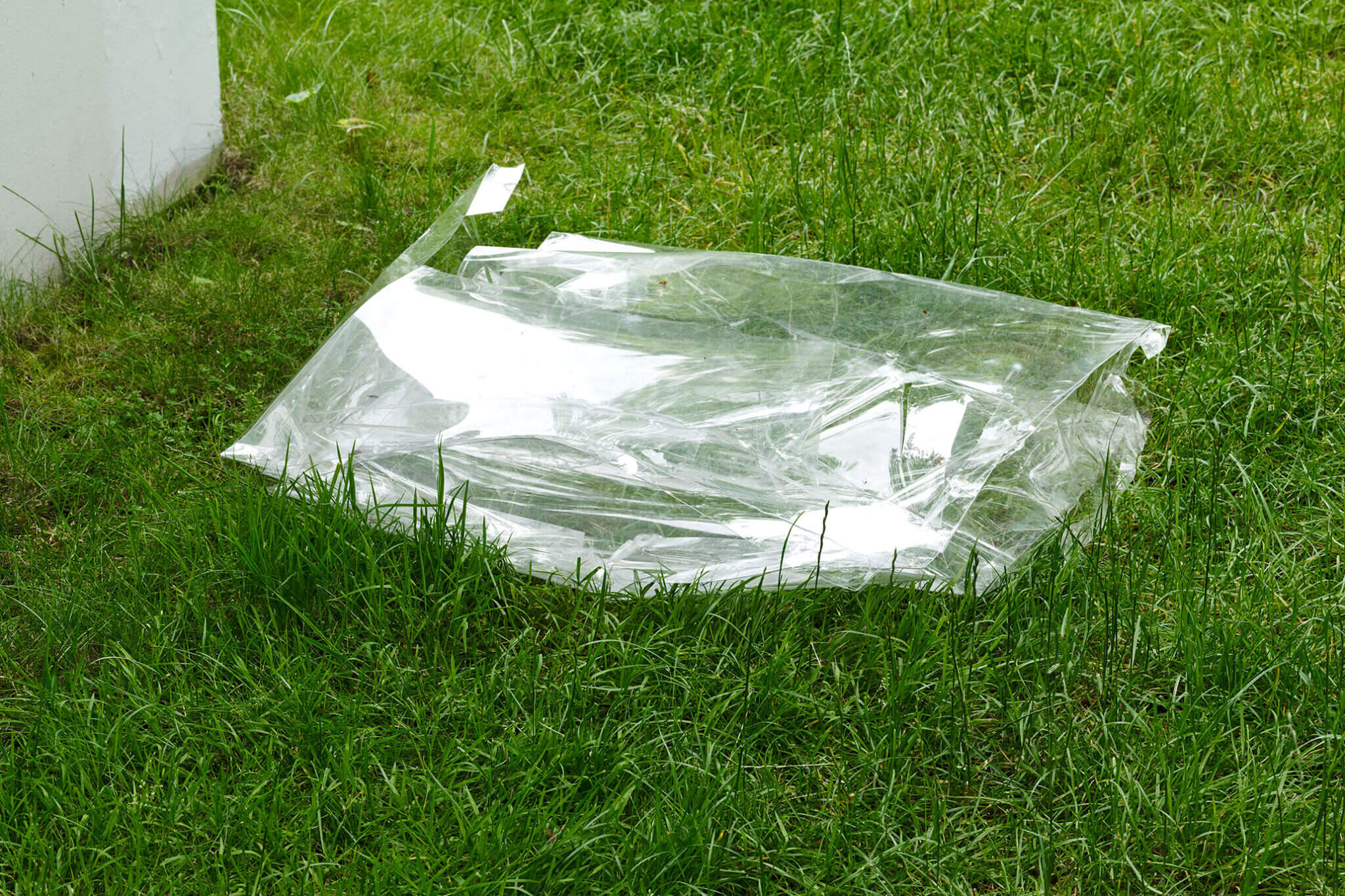
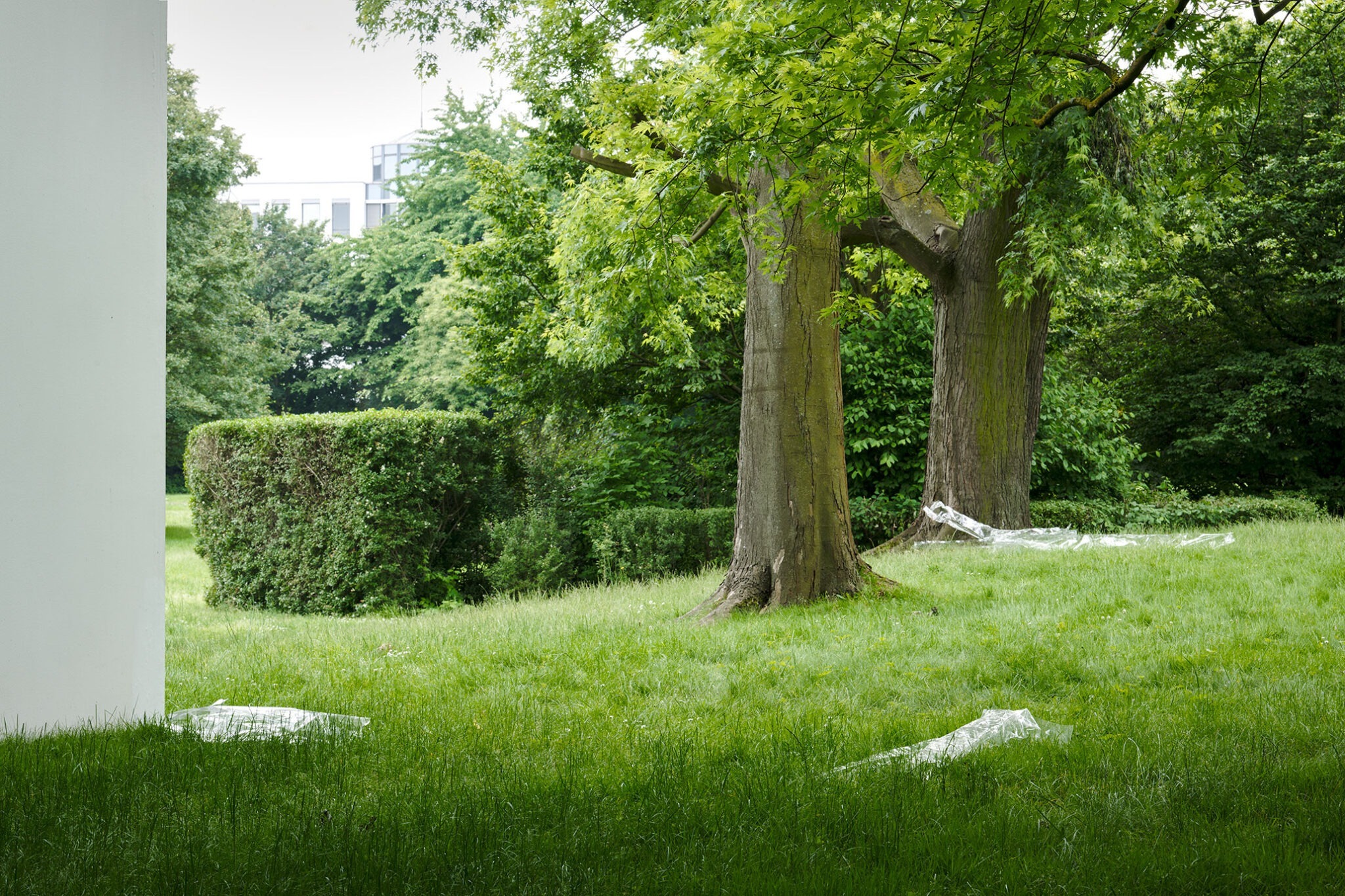
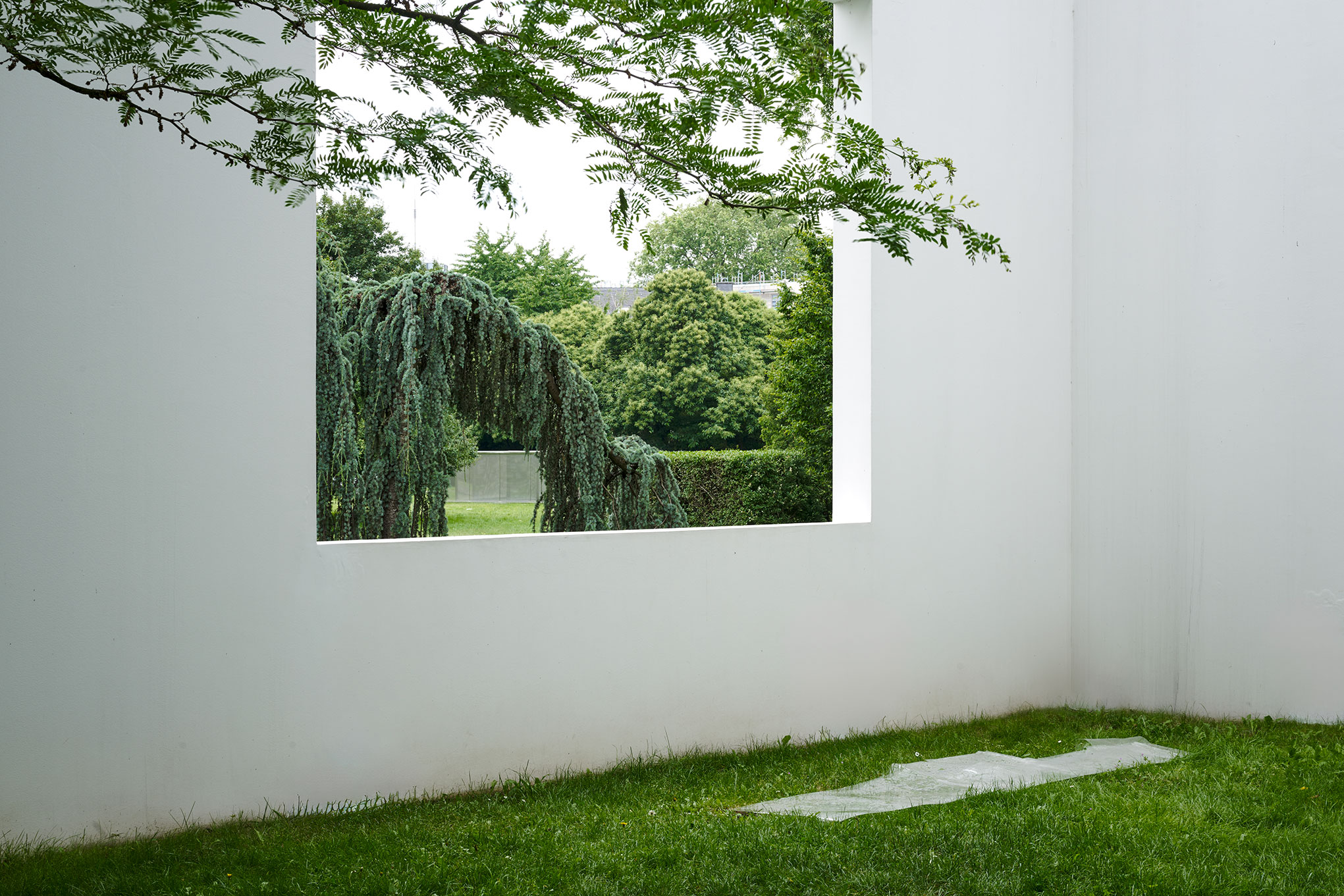
Olga Balema: Loop 1A, Loop 34A, Loop 15A, Loop 7A, 2024
Polycarbonate boards, solvent
Balema bends industrially produced materials into almost structureless forms, only just visible as sculptures, hovering loosely above the ground. Minimal in design, they are made without additional aids and appear in performative formation depending on the artist’s operations. The boundaries between interior and exterior are fluid; they unfold as if of their own accord, without clear edges or distinct shadows. As if they had settled only temporarily in the natural world, their materialisation implies the possibilities of change.
*1978 in Elverum/Norway, lives and works in Berlin/Germany and Oslo/Norway
Participant of KölnSkulptur # 11
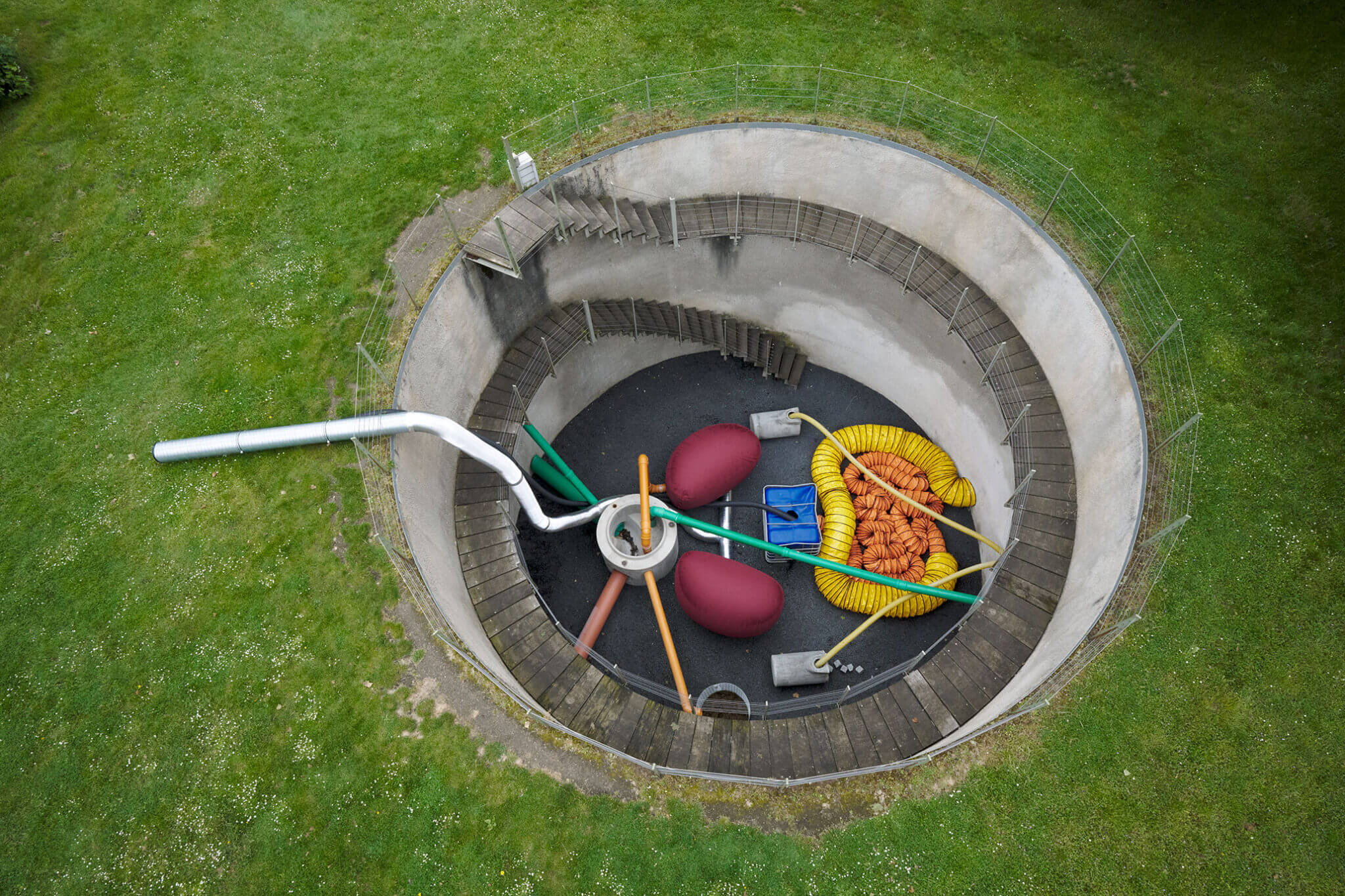
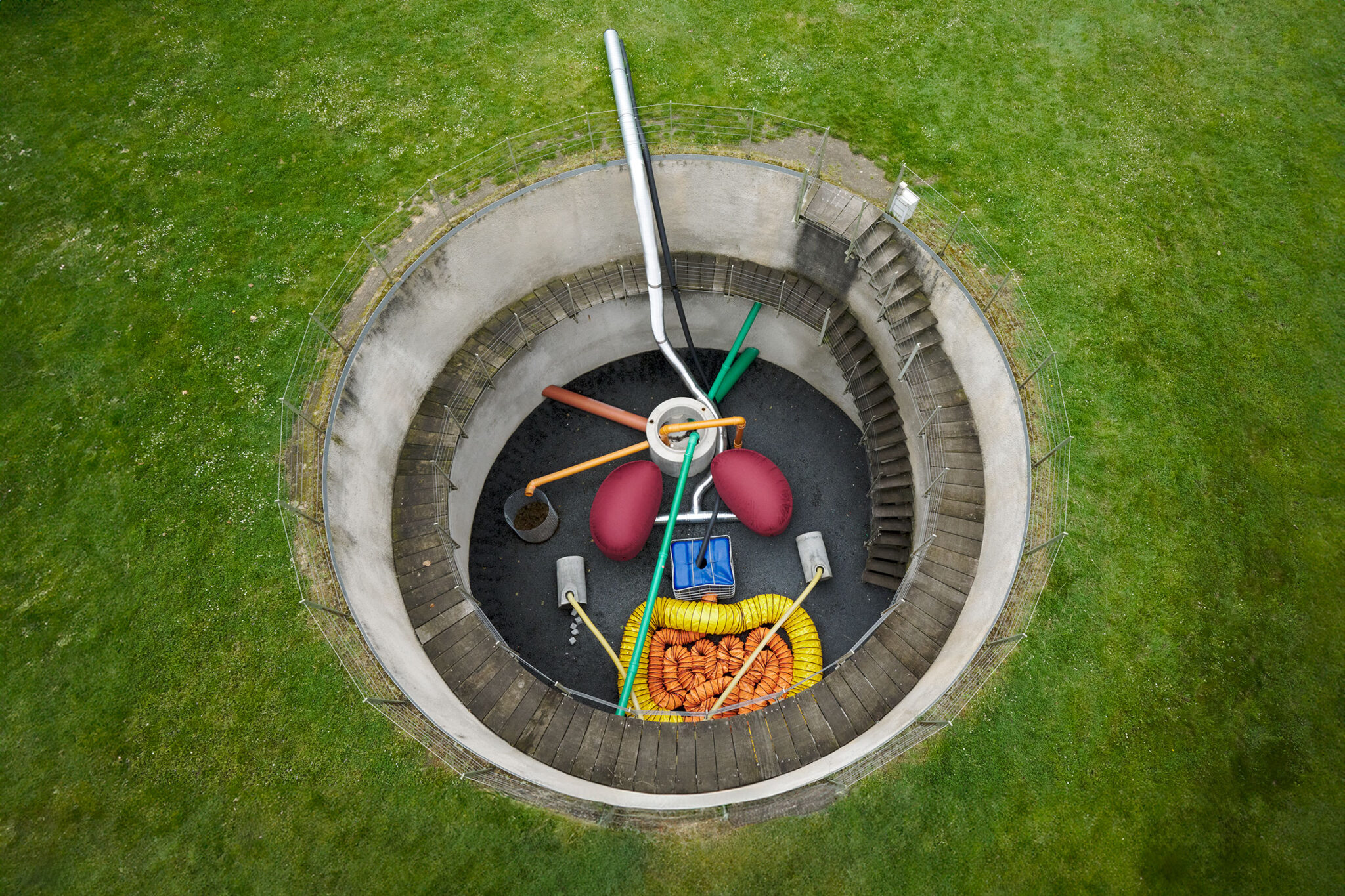
Marte Eknæs: Insides, 2024
Recycled materials such as spiralled ventilator hose, concrete sewage shafts, PVC sewage pipes, IBC water tank, spiral pipe, PVC sewer pipe, wooden panels, stones, steel composter, aluminium flex duct, PVC inflatables, connectors, fasteners
The idea for Insides came from an anatomical teaching doll whose torso can be zipped open to reveal the inner organs: heart, lungs, liver, kidneys, stomach and intestines. Eknæs has now recreated this open torso in a hole prepared for an earlier installation in the sculpture park. It represents more an imaginary continuum than a self-contained body. Reused building materials, a composter and inflatable objects each play their own role in this play of construction and infrastructure, and reflect the complex anatomy of a city.
*1966 in Berlin/Germany, lives and works in Berlin/Germany
Participant of KölnSkulptur # 11
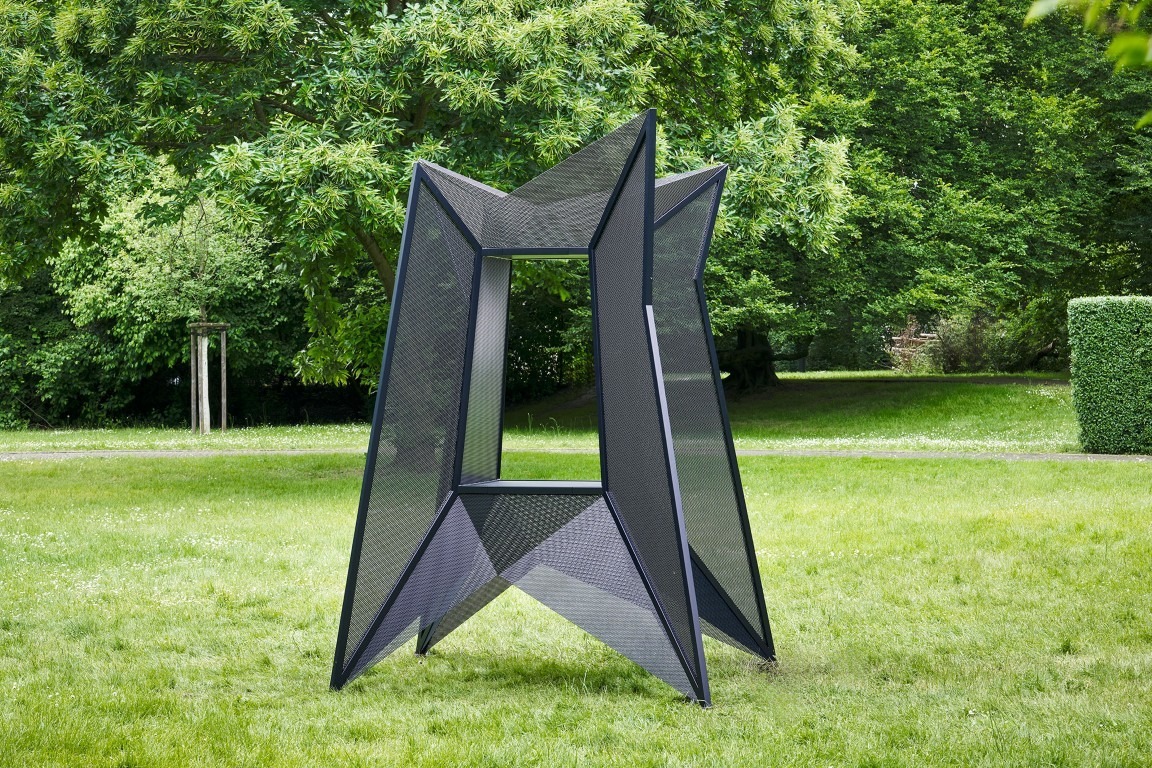
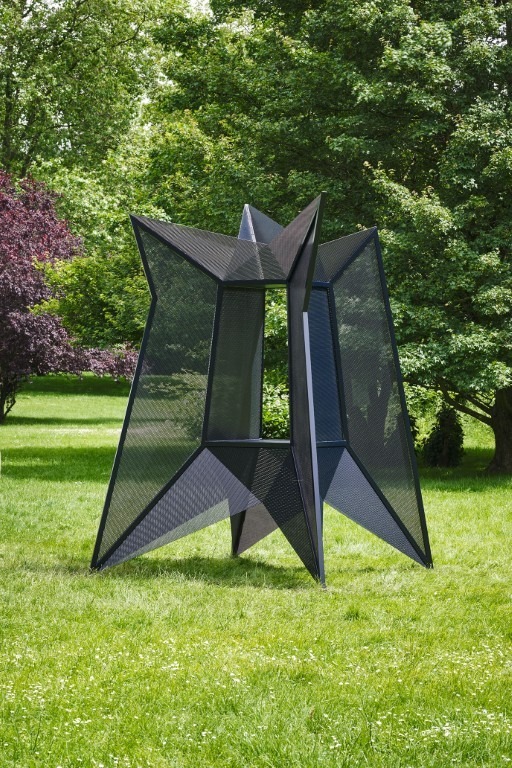
Julian Göthe: Within the realm of a dying sun, 2024
Galvanised steel, powder coated
Supported on four limbs, the four-sided towering figure radiates a performative character. If at first it seems abstract, rigid and coolly metallic, on closer inspection it reveals an insect-like or creaturely quality, as if wanting to run off. With its sweeping forms the sculpture communicates with its surroundings, and appears to be set in motion by outside influences, such as us viewers or the light and shadow cast by its perforated metal plates.
*1969 in Karlsruhe/Germany, lives and works in Berlin/Germany
Participant of KölnSkulptur # 11
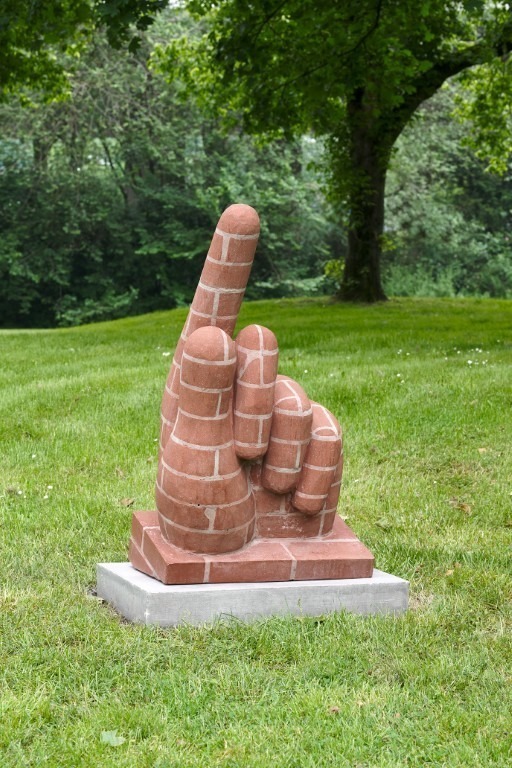
Judith Hopf: Untitled (Pointing Hand 3), 2017
Bricks, cement
Photographer: Mareike Tocha · Courtesy of the artist; Deborah Schamoni, Munich · © VG Bild-Kunst, Bonn, 2024, Stiftung Skulpturenpark Köln, 2024
Made of bricks, which are primarily used as building material in architecture, the sculptural form contradicts its industrial material. The finger of this hand sculpture points in comic-book aesthetic at an indeterminate target, apparently drawing attention, through its cheerful prompting, to its human and non-human environment in the park. In the context of current debating culture, in which complex issues are often simplified, the monumental hand can be read as a call to adopt a different perspective.
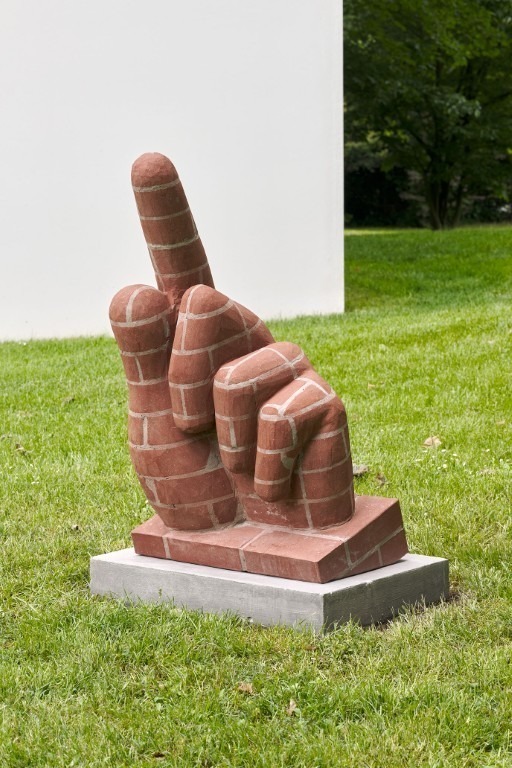
Judith Hopf: Untitled (Pointing Hand 3), 2017
Bricks, cement
Photographer: Mareike Tocha · Courtesy of the artist; Deborah Schamoni, Munich · © VG Bild-Kunst, Bonn, 2024, Stiftung Skulpturenpark Köln, 2024
Made of bricks, which are primarily used as building material in architecture, the sculptural form contradicts its industrial material. The finger of this hand sculpture points in comic-book aesthetic at an indeterminate target, apparently drawing attention, through its cheerful prompting, to its human and non-human environment in the park. In the context of current debating culture, in which complex issues are often simplified, the monumental hand can be read as a call to adopt a different perspective.
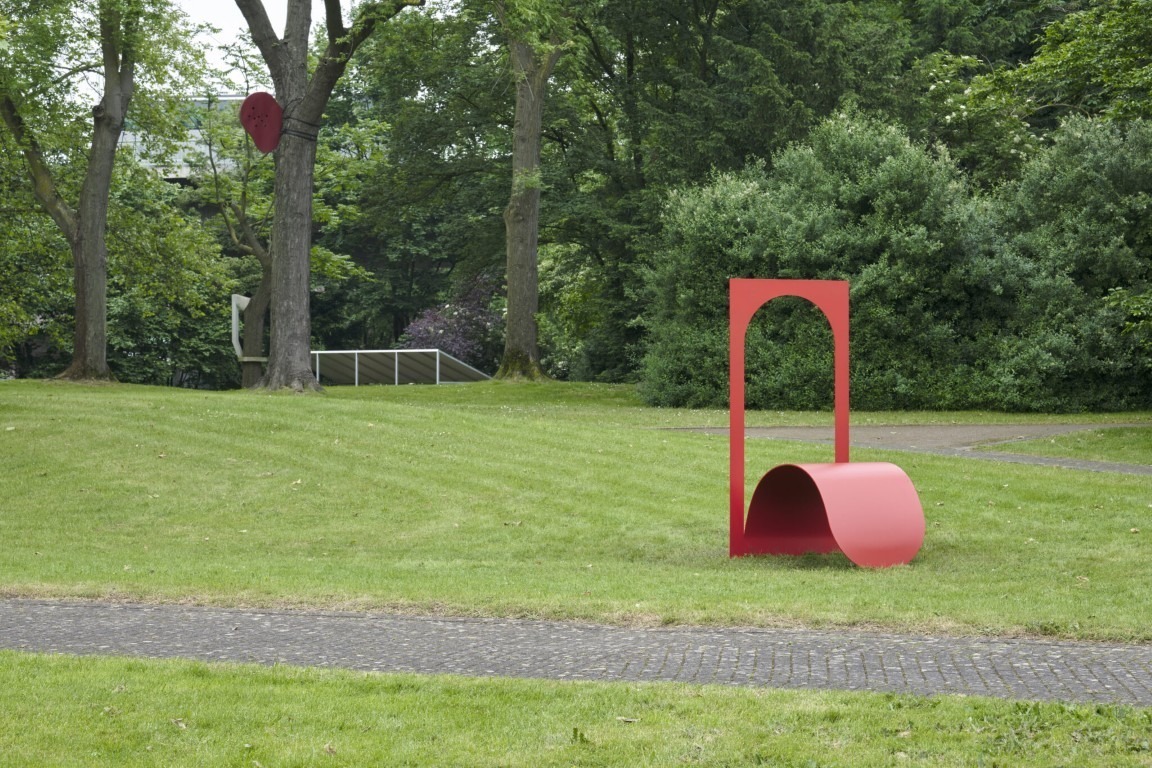
Judith Hopf: Untitled (Tongue Rolling – Outdoor) , 2024
Coated steel
Photographer: Mareike Tocha · Courtesy of the artist; Deborah Schamoni, Munich · © VG Bild-Kunst, Bonn, 2024, Stiftung Skulpturenpark Köln, 2024
This sculpture is part of a series of oversized tongues in gleaming red steel, an allusion to architectural elements of Italian fascism, similarly found on the Palazzo della Civiltà Italiana in Rome, for example. The tongue as the human organ of communication, here portrayed in its basic form, is understood by the artist not only as a comment but also as a call to a lively discussion about the aesthetic, political and social meanings and preconditions of architecture.
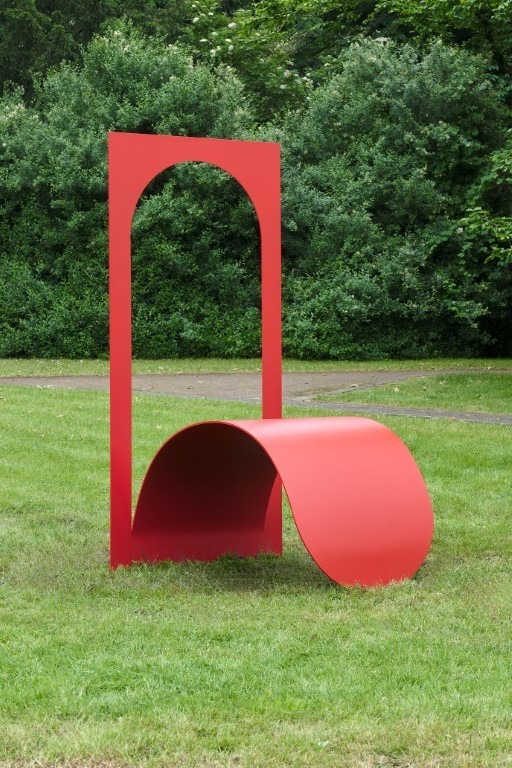
Judith Hopf: Untitled (Tongue Rolling – Outdoor) , 2024
Coated steel
Photographer: Mareike Tocha · Courtesy of the artist; Deborah Schamoni, Munich · © VG Bild-Kunst, Bonn, 2024, Stiftung Skulpturenpark Köln, 2024
This sculpture is part of a series of oversized tongues in gleaming red steel, an allusion to architectural elements of Italian fascism, similarly found on the Palazzo della Civiltà Italiana in Rome, for example. The tongue as the human organ of communication, here portrayed in its basic form, is understood by the artist not only as a comment but also as a call to a lively discussion about the aesthetic, political and social meanings and preconditions of architecture.
*1976 in Gdansk/Poland, lives and works in Rabka-Zdroj and Krakow/Poland
Participant of KölnSkulptur # 11
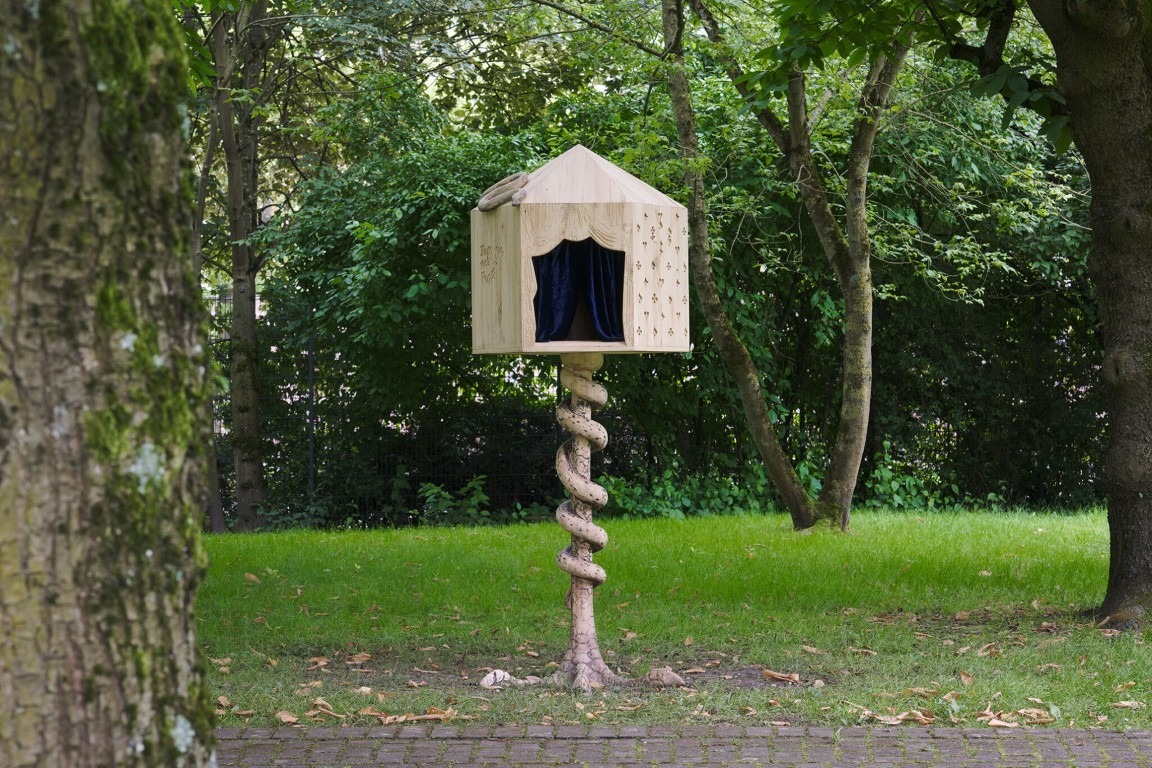
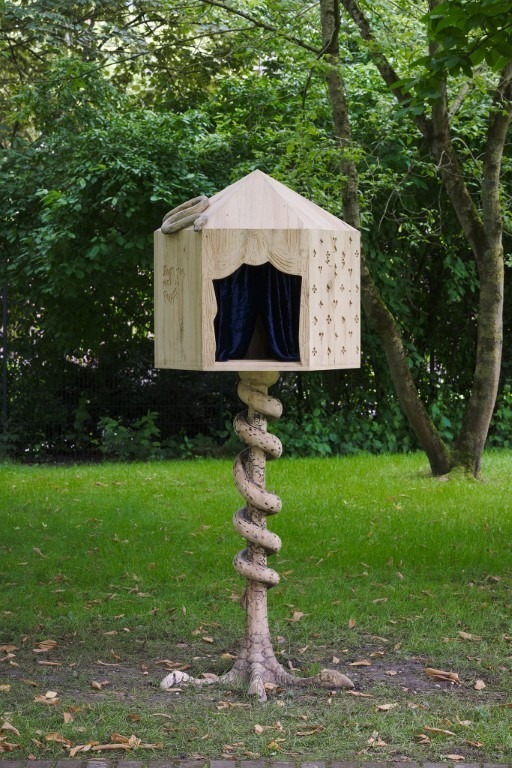
Paulina Olowska: Pavilionesque Kiosk, 2024
Wood, metal, fabric, newspaper
Pavilionesque is a magazine founded by Paulina Olowska in 2015 and devoted to the overlapping aspects of modern art and puppet theatre. Four editions have appeared to date. For the 11th edition of KölnSkulptur a newspaper is being published, containing a living archive of documentation primarily on the subject of puppetry – an artform that exaggerates and animates all parts of the body. The newspaper is on display behind the curtain of the little kiosk, which is designed as a miniature stage like a Black Forest cuckoo clock, and can be taken away by visitors.
*1979 in Athens/Greece, lives and works in Athens/Greece
Participant of KölnSkulptur # 11
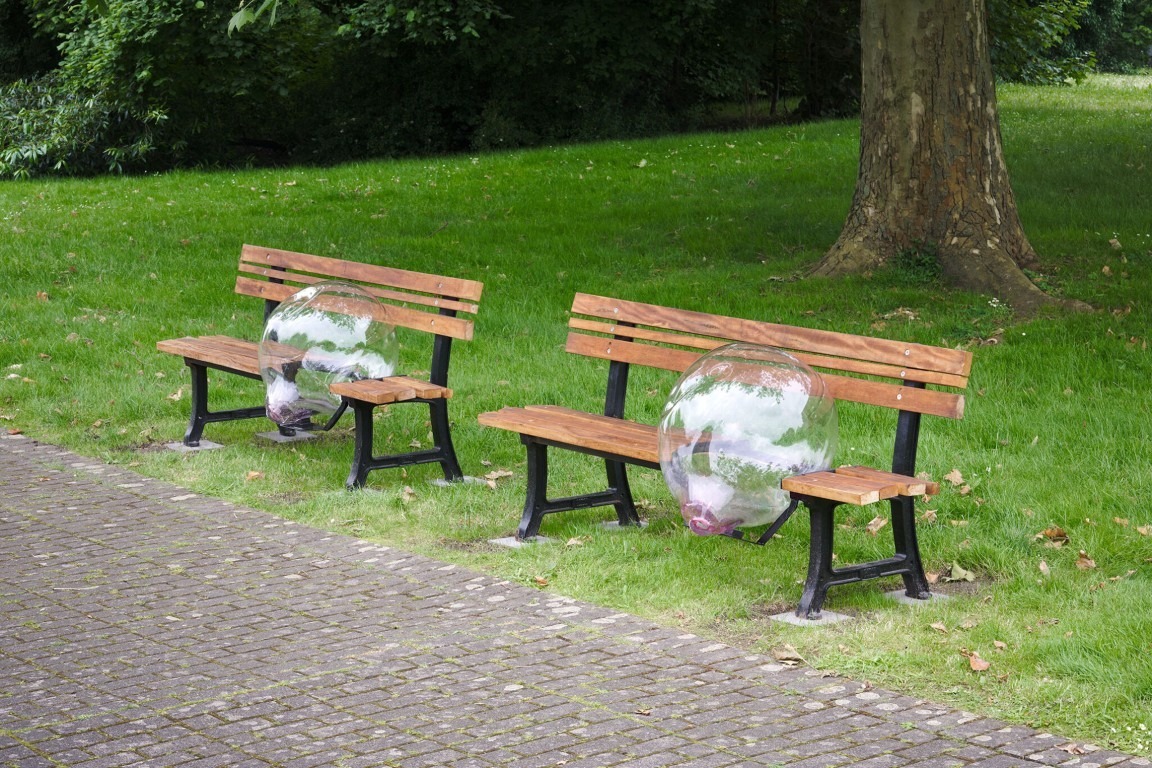
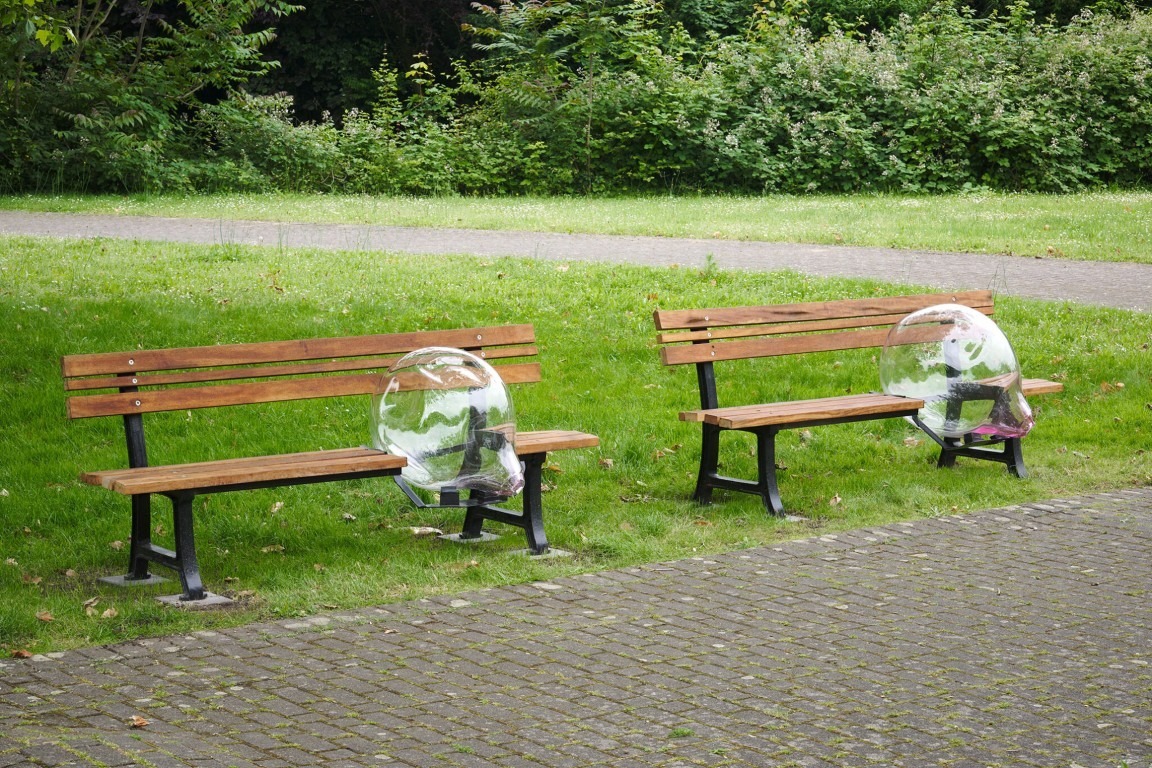
Georgia Sagri: Sitting with my Breath, 2024
Blown glass, wood, iron
Georgia Sagri invites visitors to take a seat on either of the two park benches relocated from the city of Athens. Each bench has been transformed by the inclusion of a unique handcrafted glass-work. The blown glass does more than adorn; it is a physical manifestation of the breath, offering a materialised moment of the artist’s process. This sculptural work of Sagri’s is informed by the act of meditation and resonates with the broader politics of her artistic practice, which explores the fragility of our social fabric and the forces that shape our interactions.
*1962 in Washington DC/USA, lives and works in Cologne/Germany
Participant of KölnSkulptur # 11
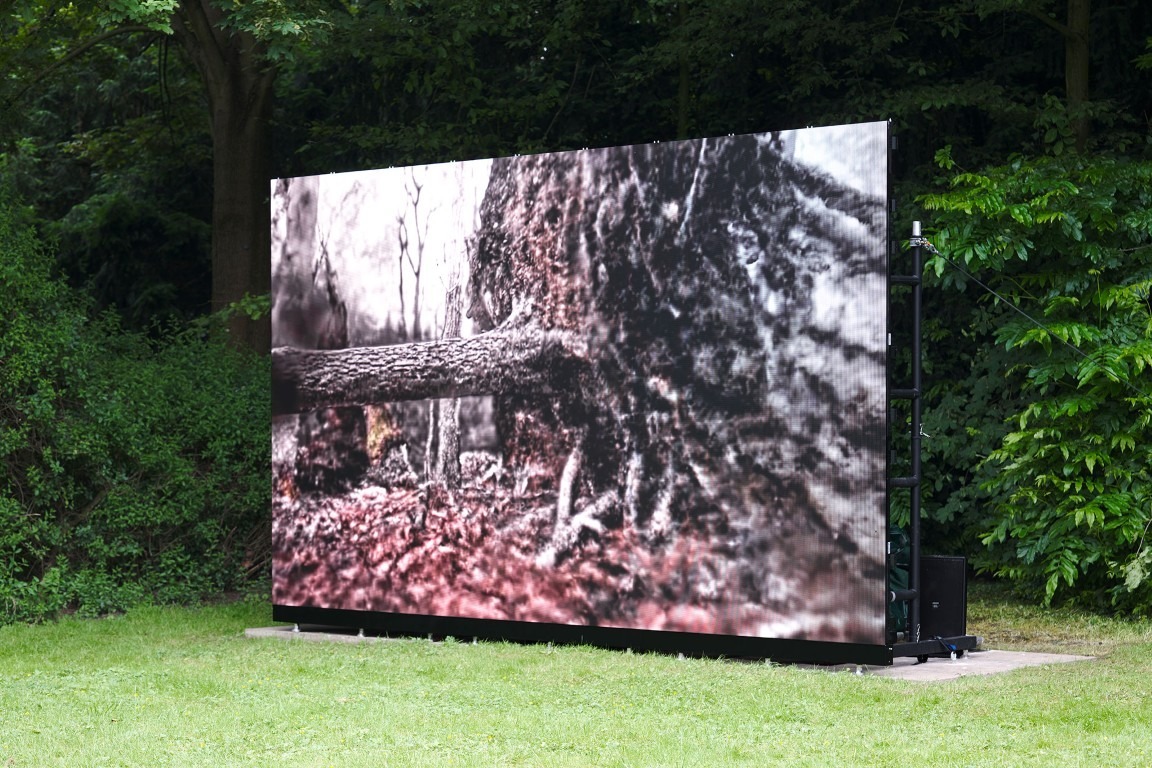
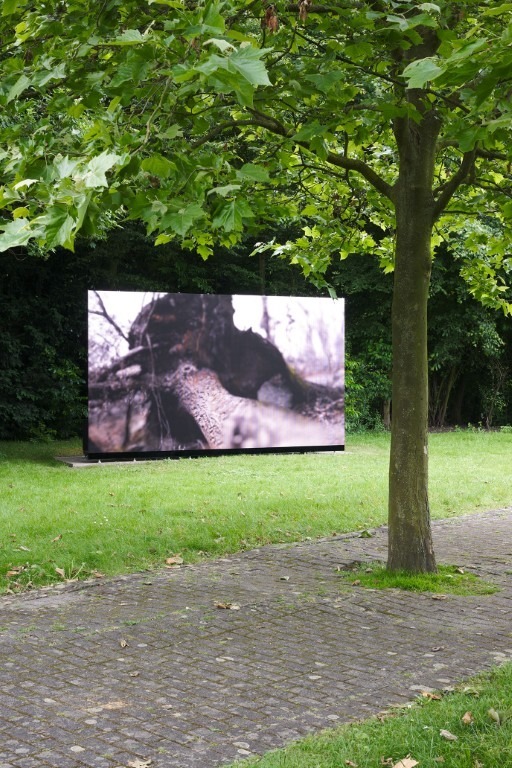
Frances Scholz: Earth Wall (Pandora’s Box, Silver Arm, Stone Hugger), 2024
Neural Radiance Fields, 14:14 min.
Earth Wall consists of film footage showing uprooted trees from a former quarry in New England, artificially augmented and imagined by means of neural radiance fields. The trees become performers who make vibrating potentialities visible, acting beyond the boundaries of sculpture and technology, of life and death. The calculated yet devised materiality of the NeRFs extends the visual material onto a sculptural level of its media reality. The work obtains a particular physicality through its reference to the natural world of the park.
*1979 in Hannover/Germany, lives and works in Berlin/Germany
Participant of KölnSkulptur # 11
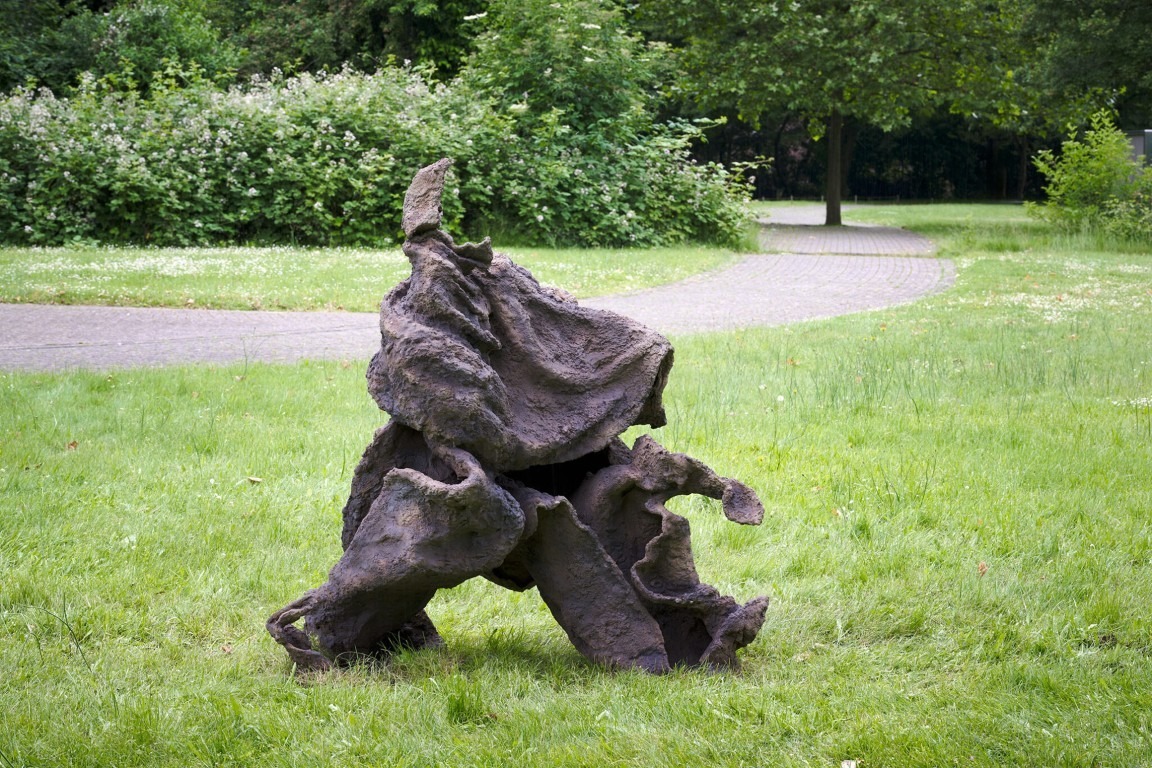
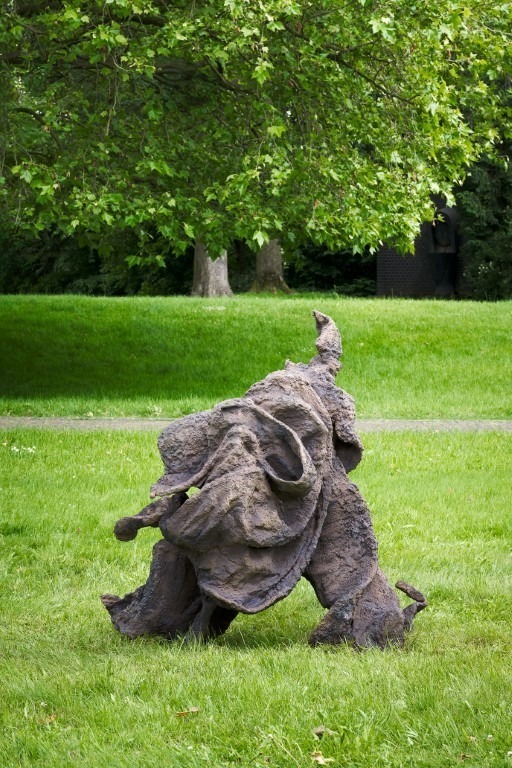
Peter Wächtler: Ärztehaus, Schöffengericht, Atrium, 2024
Bronze
Peter Wächtler’s sculpture shows a body image in transformation, apparently neither abstract nor figurative. It seems both dynamic and rigid. Its motion, generated by the folds of a draped fabric, is contrasted by a ‘mossy’, ‘pock-marked’ surface structure whose dynamic thwarted by the patina. And so the somewhat slowed down, heavy movement gives the impression of an ‘absconding pietà’, who doesn’t fully trust the processes of change.
Stock positions
*September 7, 1934 in Frankfurt am Main/Germany
†March 2, 2023 in Bergisch Gladbach/Germany
Participant of KölnSkulptur # 10, 11
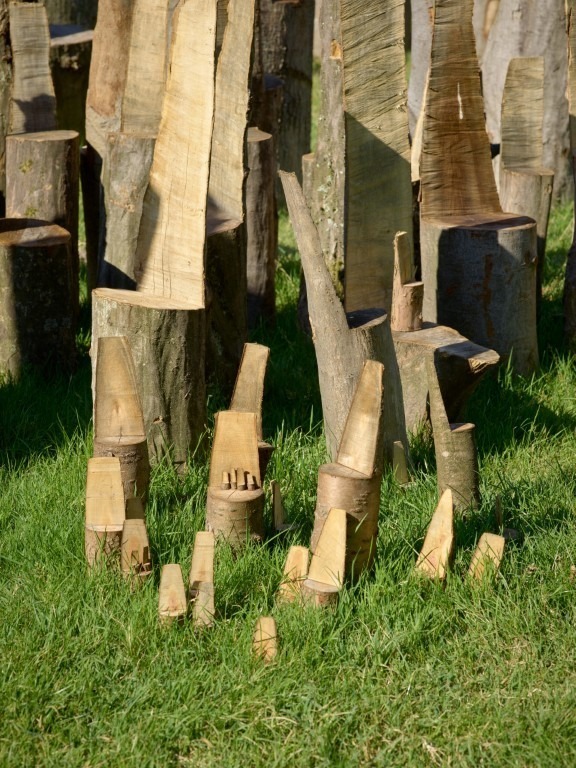
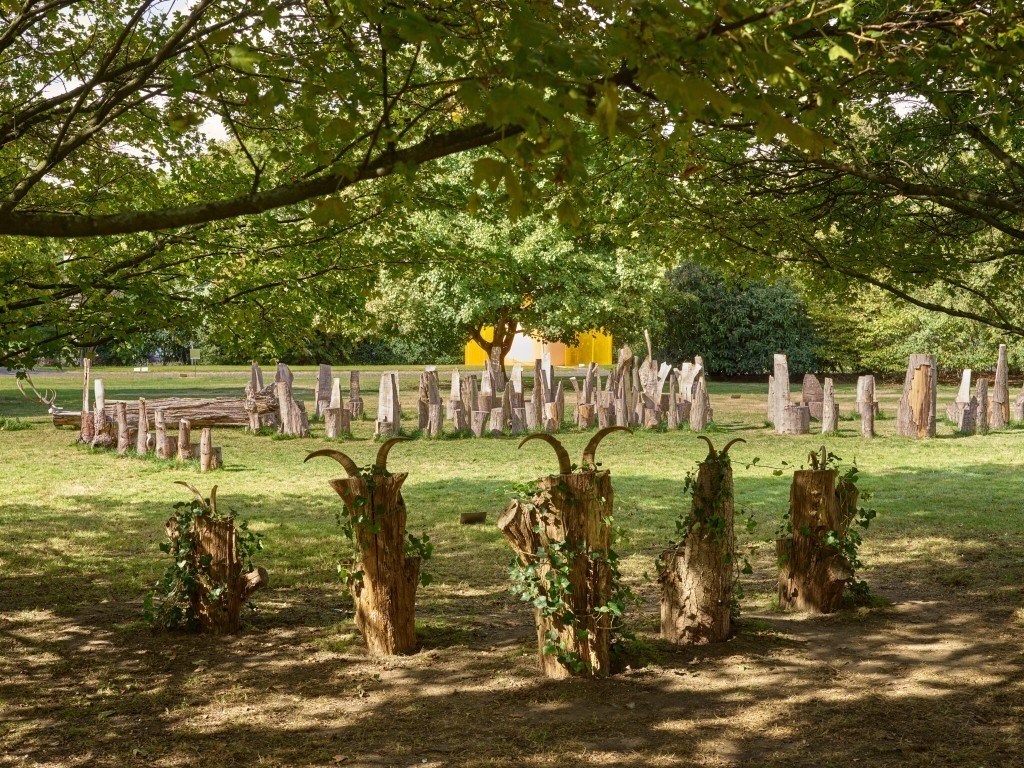
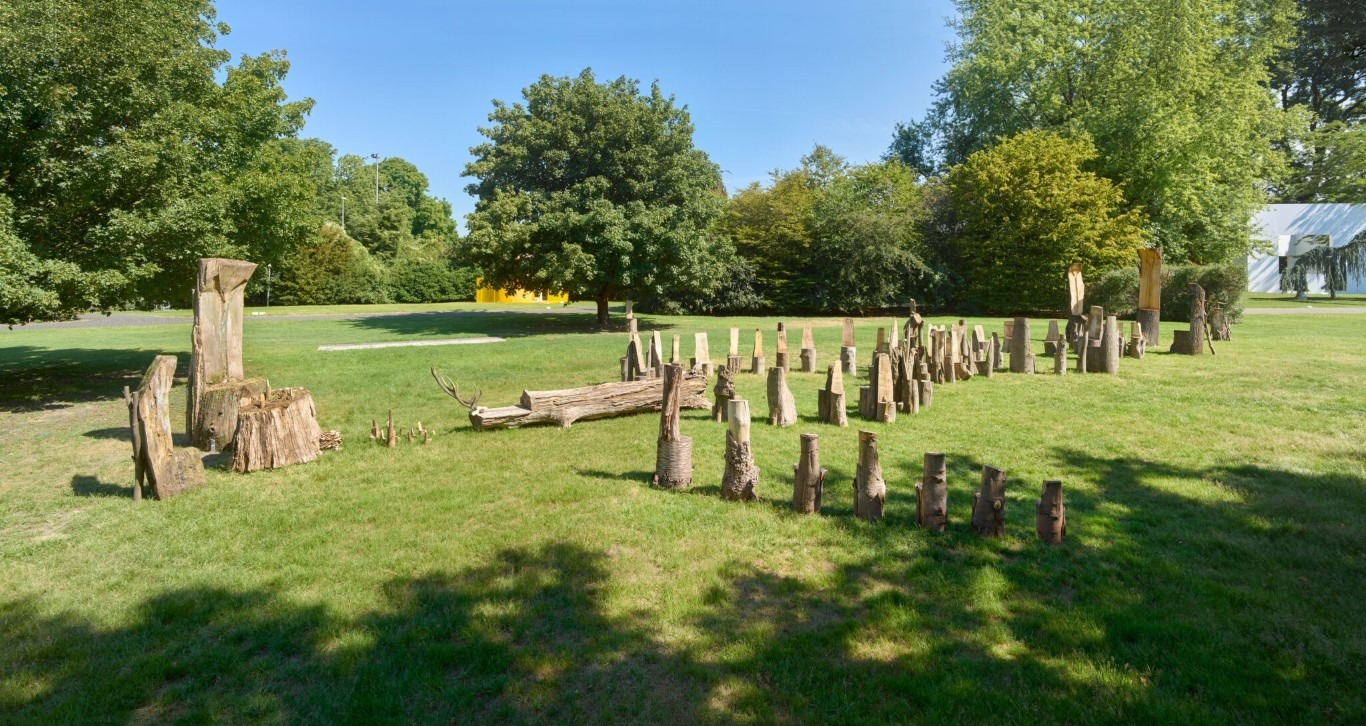
Mary Bauermeister: Rübezahl, 2020
Natural materials, tree trunk, tree fungus, antlers, approx. 130 wooden chairs
Some of the 130 tree trunks that feature in Mary Bauermeister’s installation Rübezahl have served the artist for many years as places to sit in magic circles. Others were worked specifically for the Skulpturenpark Köln. The title of this piece refers to the eponymous mountain troll Rübezahl, who embodies the unpredictability of nature and influences the fate of humankind via the natural world. Bauermeister’s installation was conceived as a new heart for the park, inviting visitors to linger awhile and contemplate the power of their environment.
*1963 in New Haven/USA, lives and works in New York and Connecticut/USA
Participant of KölnSkulptur # 8, 9, 10, 11
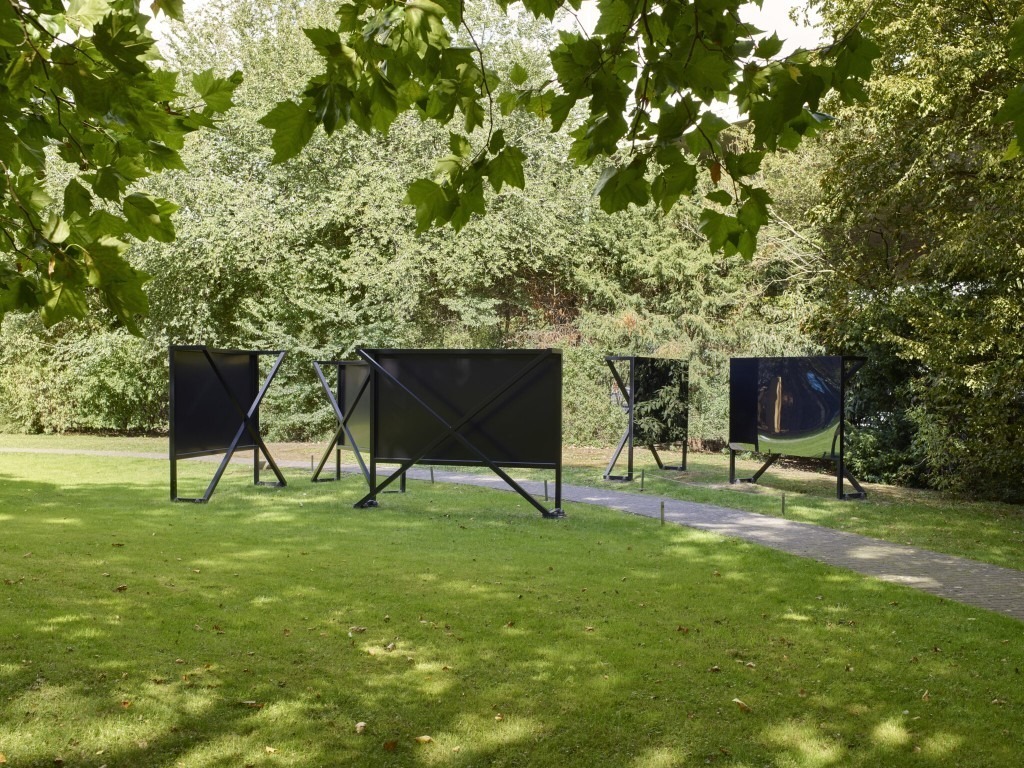
Tom Burr: No Access: cluster one (B, D, E, I, M), 2015/2017
Polished and blacked out stainless steel, alucobond, aluminum
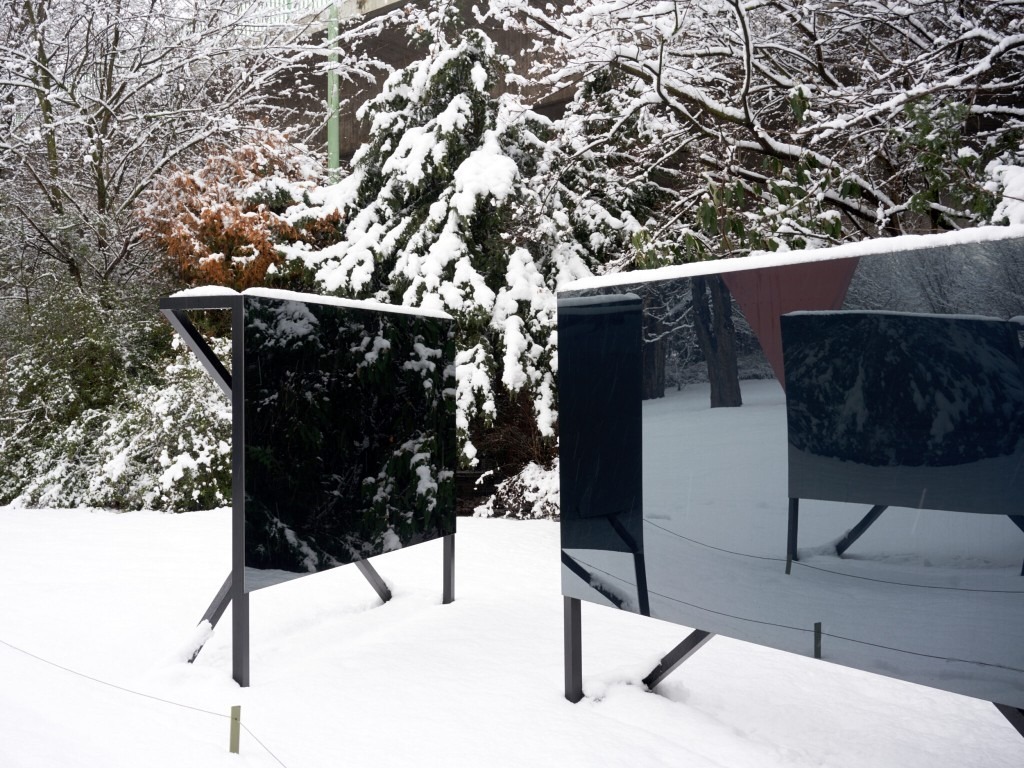
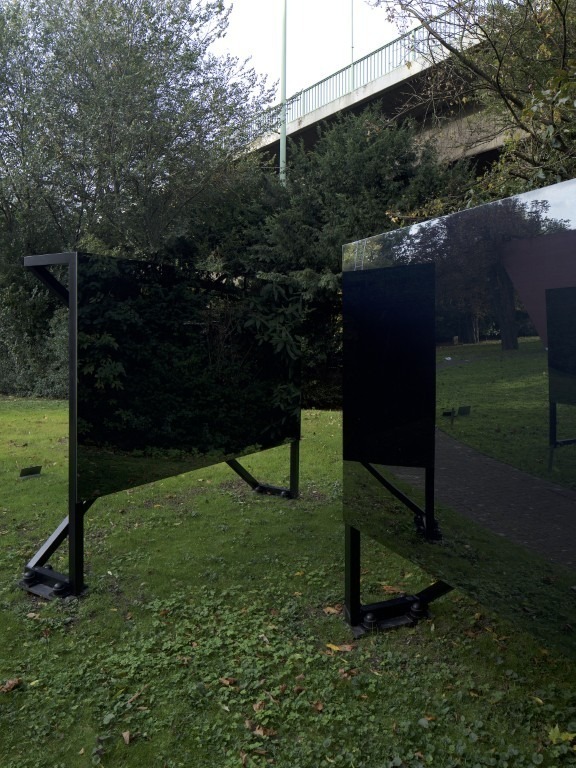
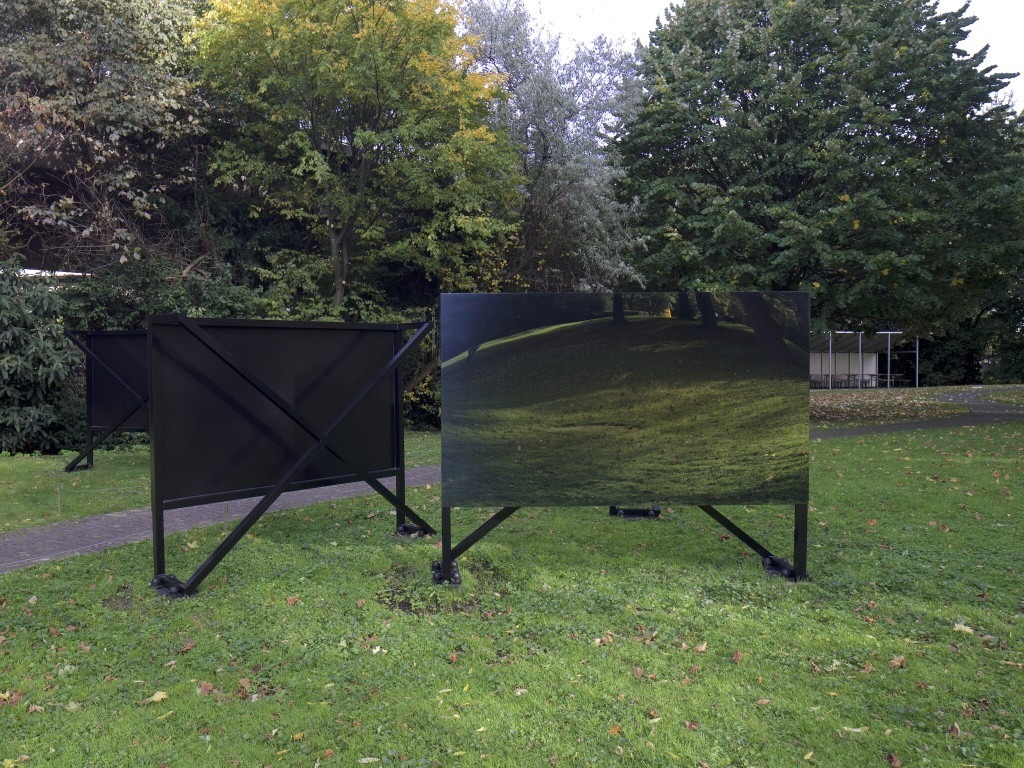
Tom Burr is among the most relevant contemporary conceptual artists. His work shows contextual links with urban aesthetics, gay subculture, minimal art and avant-garde film. For KölnSkulptur #8, Burr assembled 26 black screens in a defined cluster in an area about the size of a handball field. Their number is derived from the alphabet. After the end of KölnSkulptur #8 the screens with the letters B, D, E, I and M are staying under the name No Access: Cluster one at a new place in the park. The objects were developed especially for this site. Their fronts show highly polished, darkened mirrors. On the back an ”X” of painted steel statically supports the construction. With No Access, Tom Burr unmistakably points to the digital surfaces of today. This is why he called the original ensemble also a Cluster of 26 Dead iPhones. The painters of the 17th and 18th century were already using framed mirrors, so-called ”Claude glasses”, to select views for their landscape paintings. Burr blows them up to create simple, stereometric and haunting shapes. This results in puzzling mirror reflections and bizarre spatial experiences.
*April 10, 1932 in Detroit/USA
†May 23, 1997 in Cairo/Egypt
Participant of KölnSkulptur # 4, 5, 6, 7, 8, 9, 10, 11
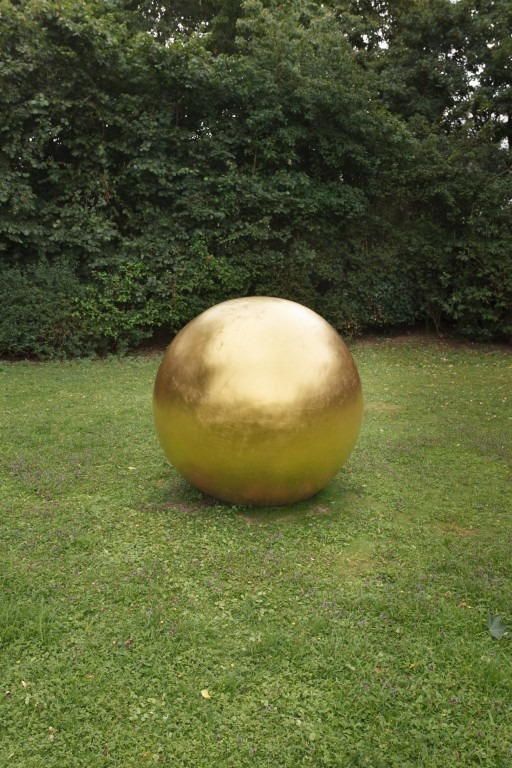
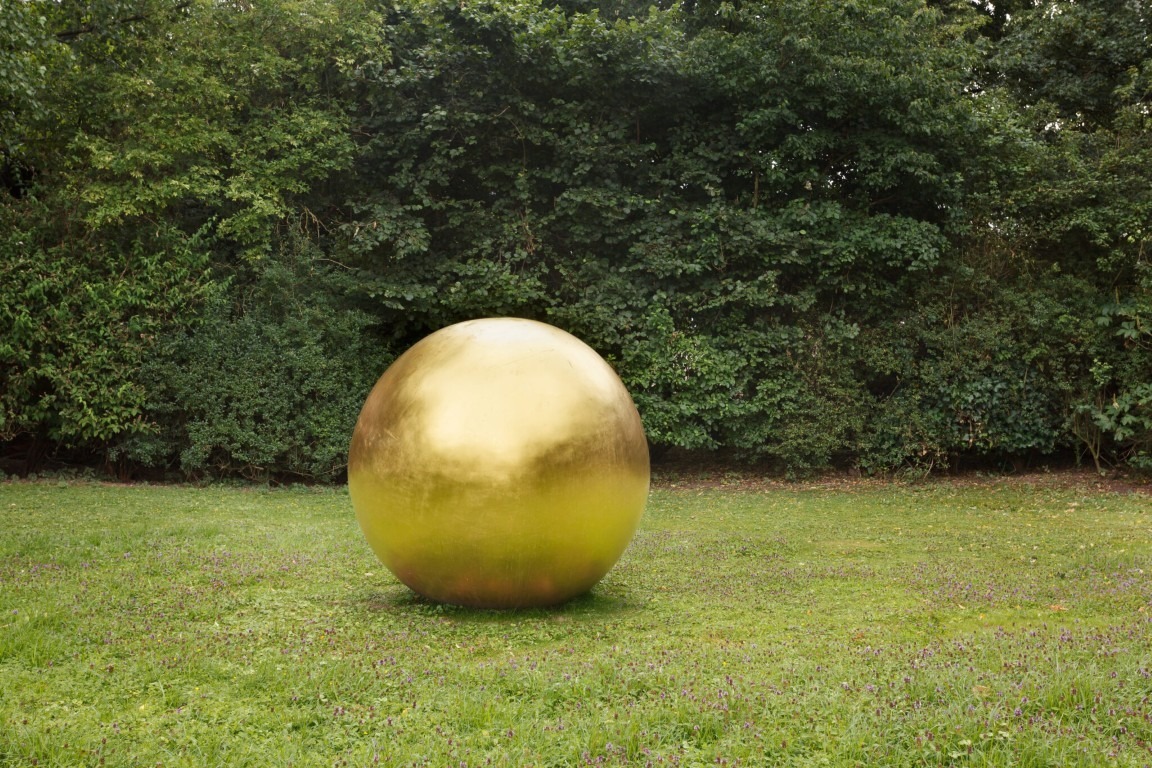
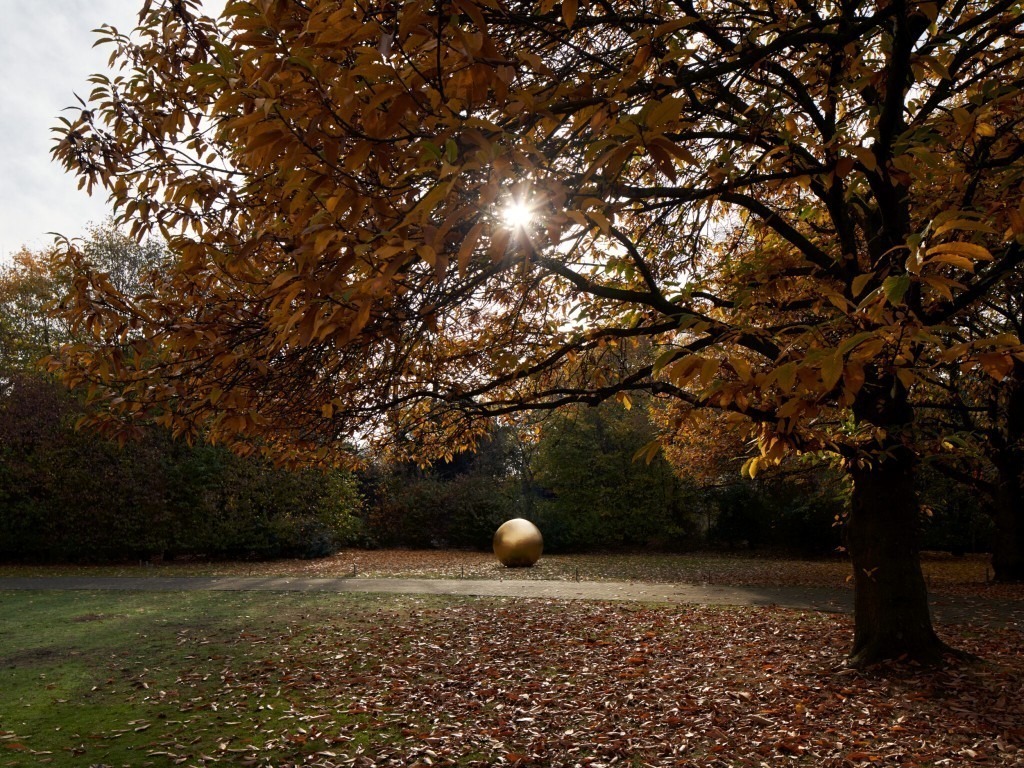
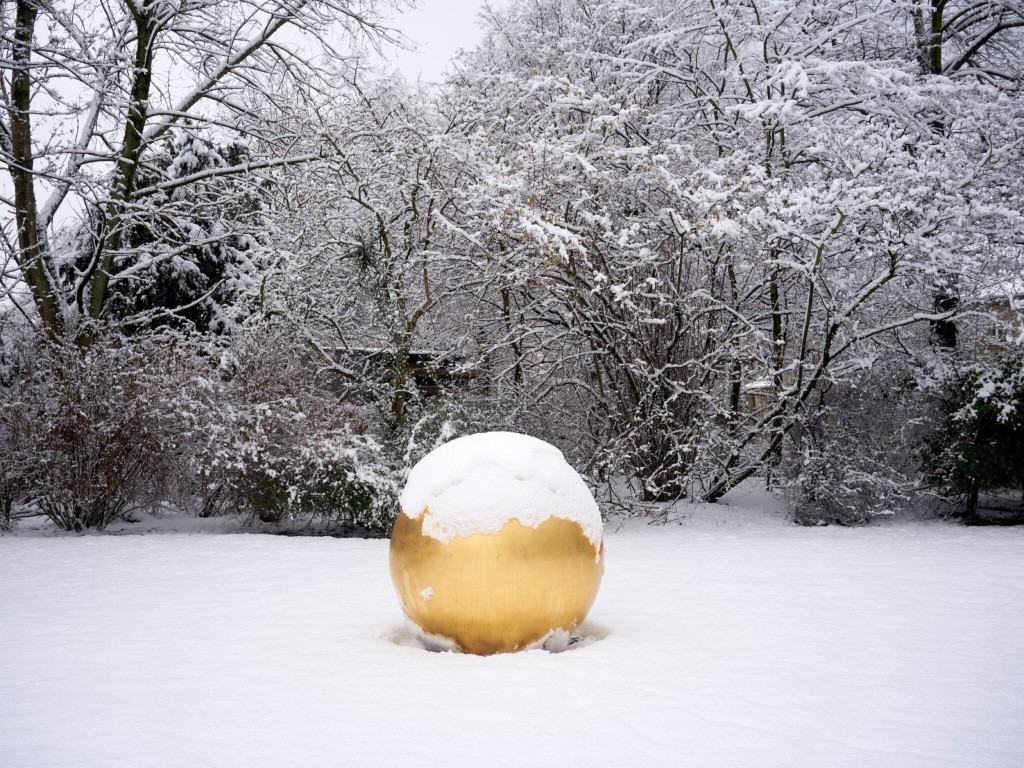
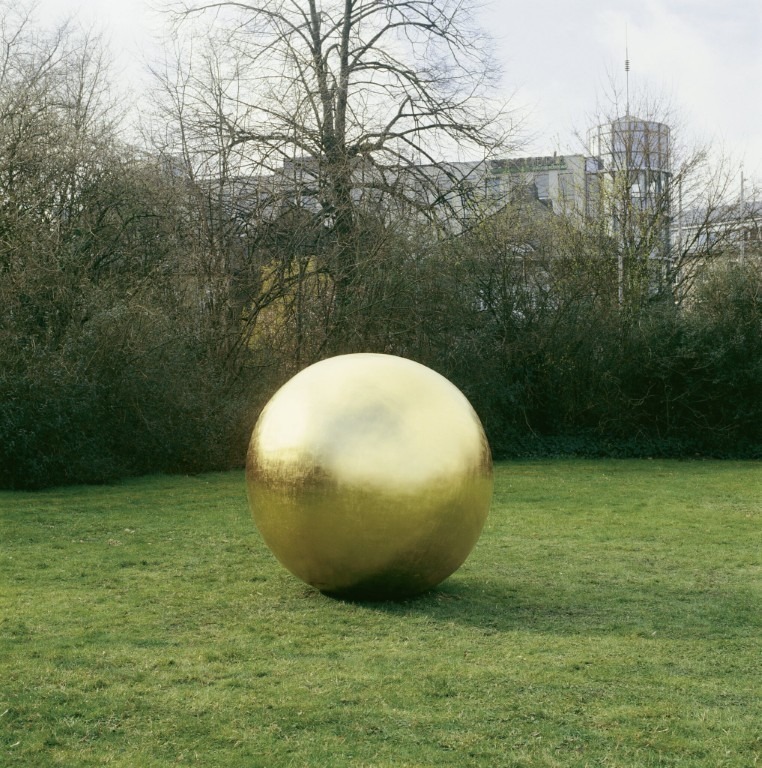
James Lee Byars: Untitled (Sigmund Freud), 1989
Bronze, vergoldet
James Lee Byars began his intensive investigation of Zen-Buddhism in 1957. He incorporated his findings into his artistic work, which represents a symbiosis of Conceptual Art, Minimalism and Fluxus. Early on Byars attempted visual representations of existential concepts with the intention of enabling the viewer to experience silence and emptiness. Byars reduced his sculptural œuvre to forms with an obvious symbolism (cone, circle, sickle, cuboid) which he invested with a mystical dimension by painting them in red, gold or black. Perfection, beauty and immateriality are among the central concepts of this “magician of silence”.
*1979 in Växjö/Sweden
Participant of KölnSkulptur # 7, 8, 9, 10, 11
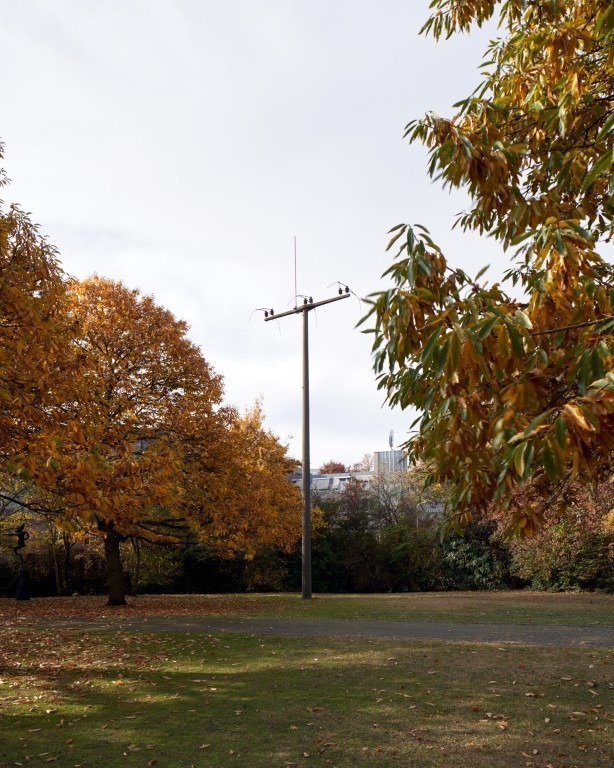
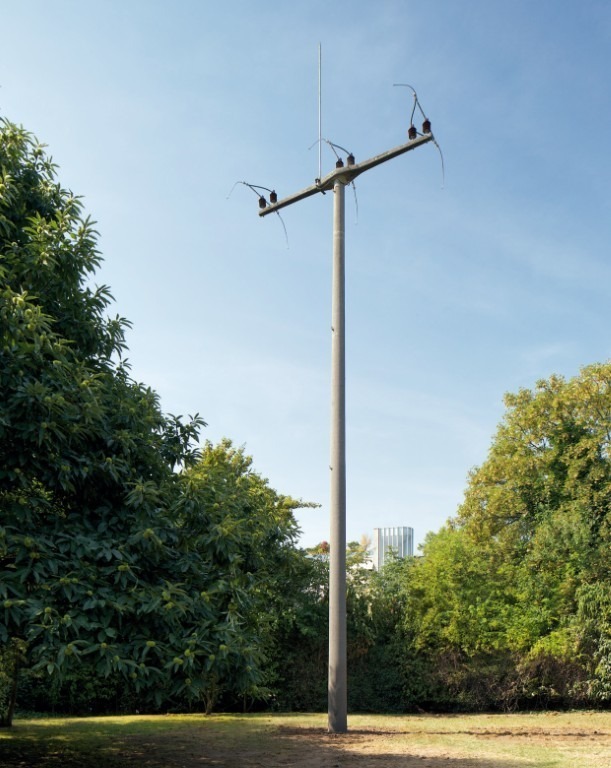
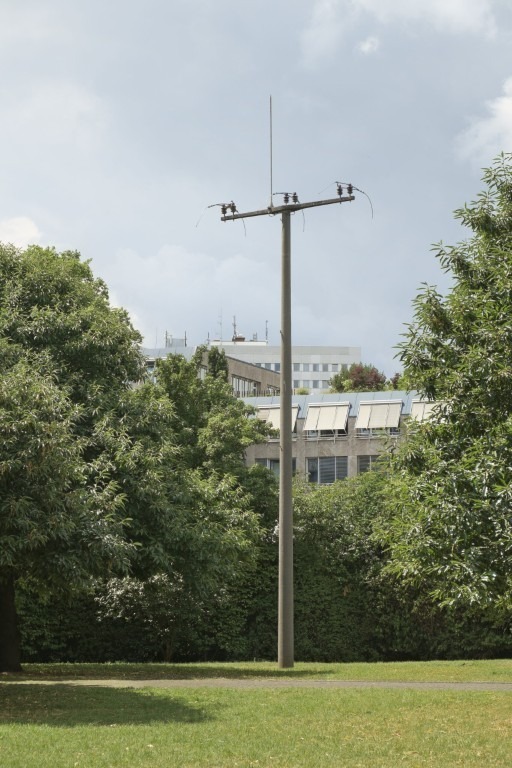
Nina Canell: Power (Powerless), 2013
Power pole, reinforced concrete
Nina Canell’s works are characterized by an immediate fragility; plants, cable, glass, even powder are materials she uses in her sculptures. To these the artist has added electricity, which becomes visible in the form of lamps and neon tubes and, via the open structure of the way they are depicted, an element of danger is always allowed to resonate. With her giant installation Power (Powerless), Nina Canell—after her contribution to the exhibition Made in Germany in Hannover one year ago—now appears a second time in public space. Installed at the Skulpturenpark Köln, a veteran power pole is able to bring a state of powerlessness to expression via its monumentality and isolation as a single freestanding pylon. Utility poles in the serial alignment of many masts are an image that defines an industrial landscape. Our society’s network of maintenance is herein articulated. But when suddenly isolated, the object becomes a metaphor for an antithesis to energy and power. In the context of the park, this aspect is just as suddenly given a new meaning: the sculpture becomes the epitome of the un- or dis-connected. Isolated from the group system, the object is an expression of a place that is no longer in the loop, appears in isolation and so becomes an image of another world, here specifically targeted.
*June 14, 1960 in Ypres/Belgium, lives and works in Tournai/Belgium and Berlin/Germany
Participant of KölnSkulptur # 8, 9, 10, 11
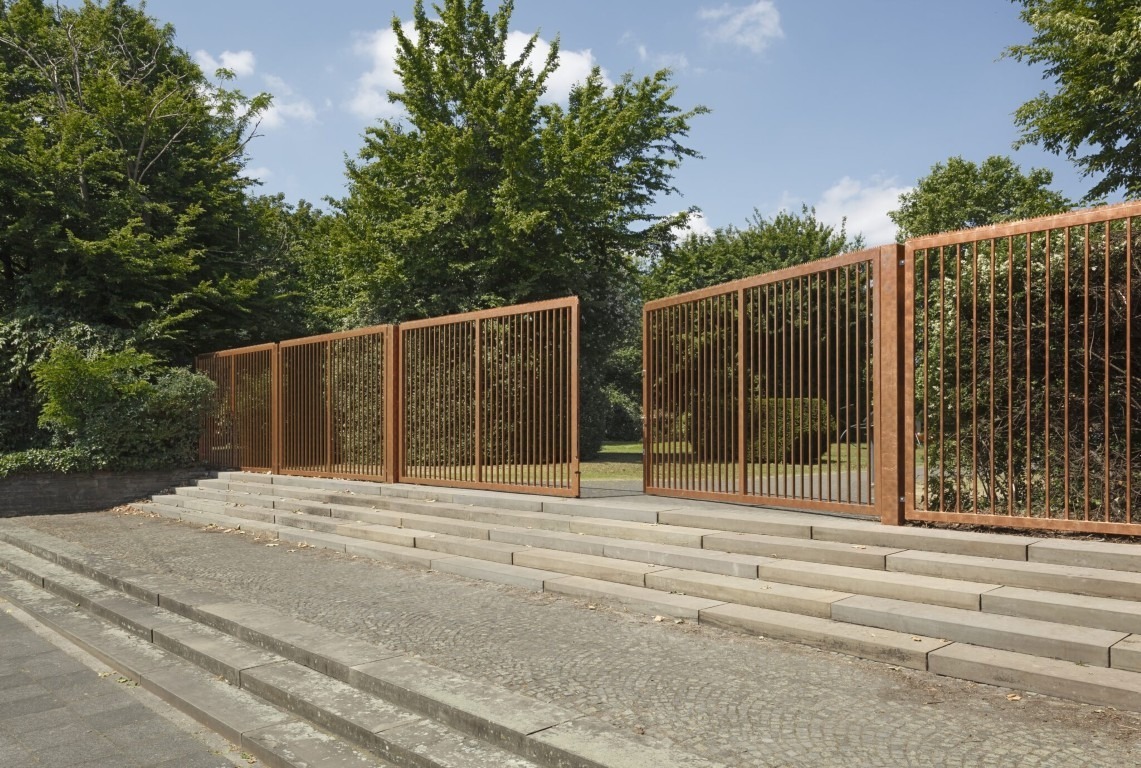
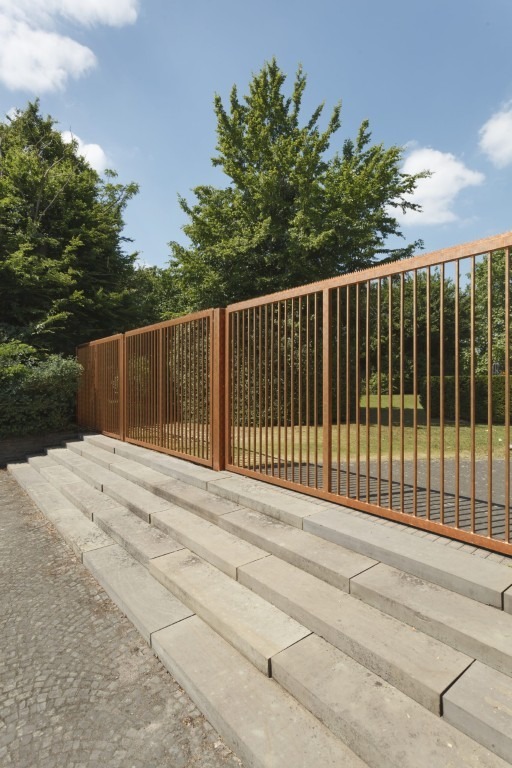
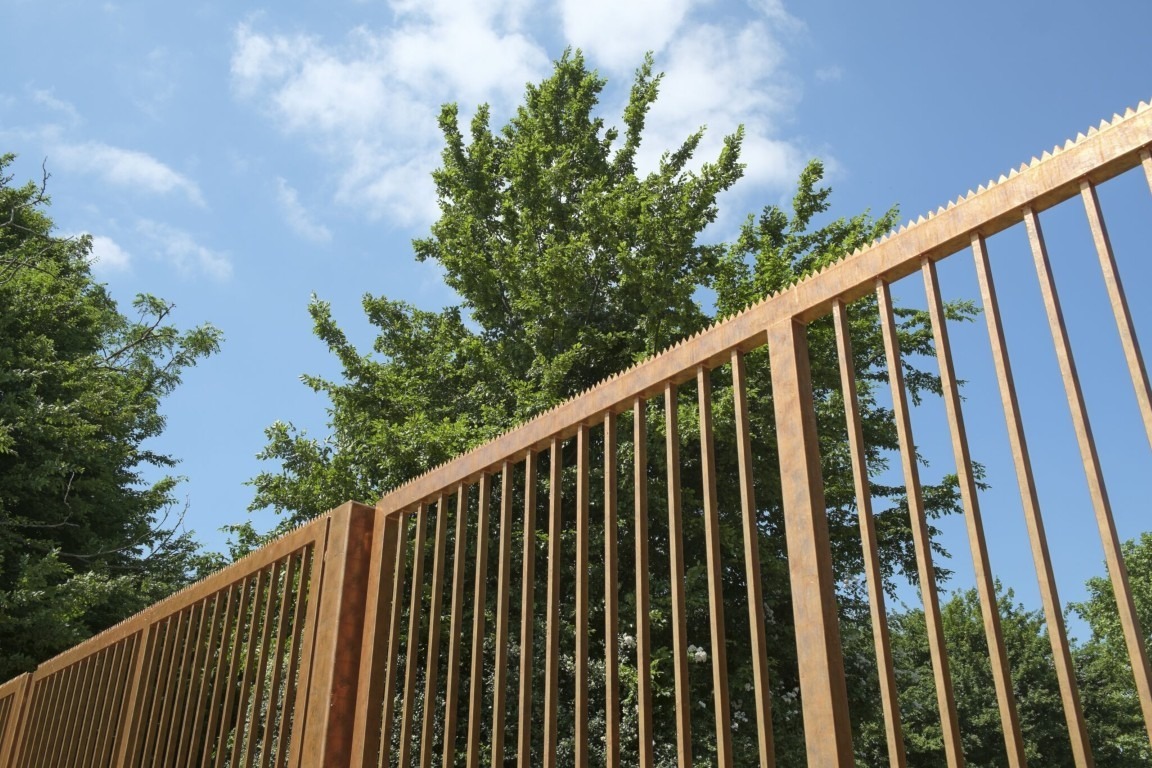
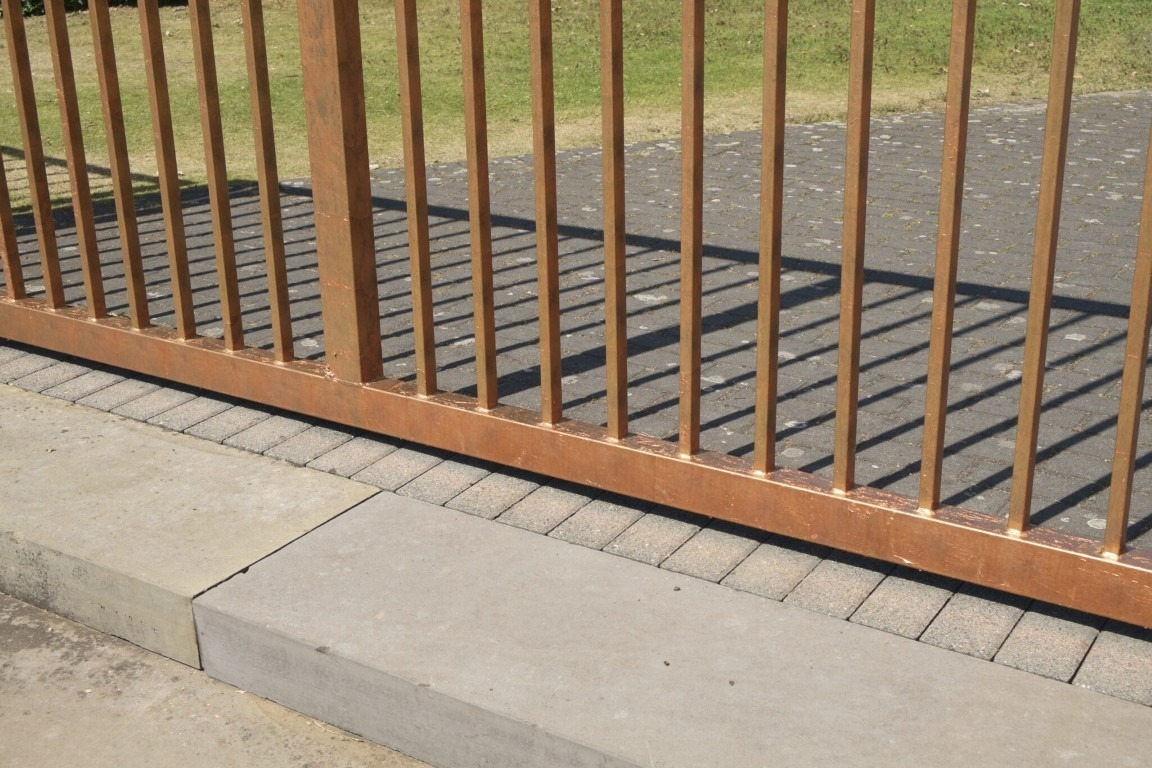
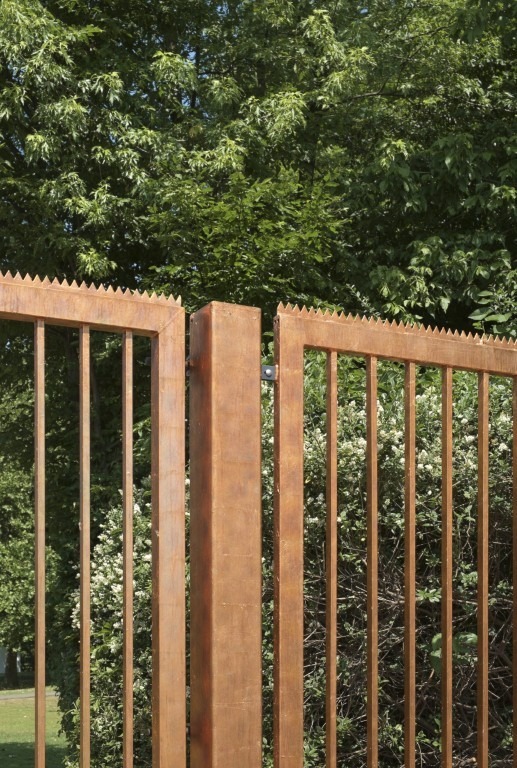
Edith Dekyndt: The Fences, 2015
Kupferfolie
Edith Dekyndt is a Belgian artist who deals with ephemeral and transitory phenomena. In some of her works she explores the workings of light, wind and tidal movements. For her, sculpture means succinct and quiet intervention, not snappy or possession-taking edification. This is why she works with what already exists as part of the park-environment. She applies copper foil to the high metal grids of the entrance gates. At the beginning the gates shine like majestic trellises, but as time passes they will eventually turn a blueish verdigris, caused by patina oxidation. Dekyndt shows us the dichotomies of value and decay, time and disappearance, substance and appearance.
*May 29, 1950 in Maribor, Slovenia
Participant of KölnSkulptur # 1, 2, 3, 4, 5, 6, 7, 8, 9, 10, 11
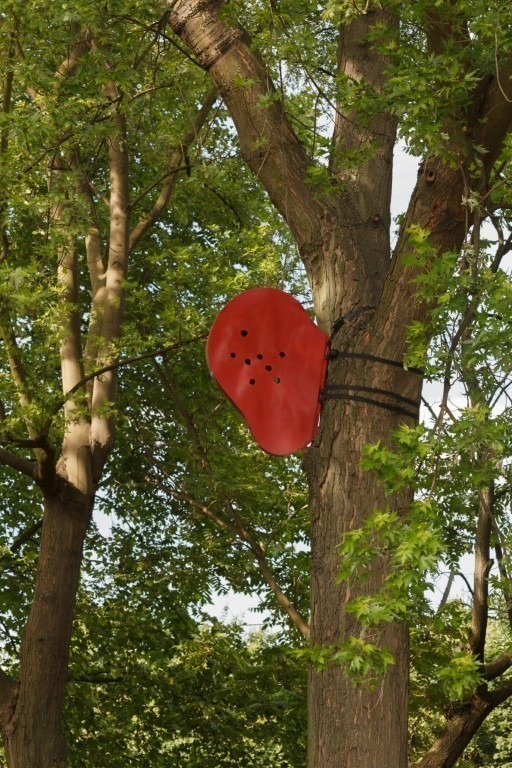
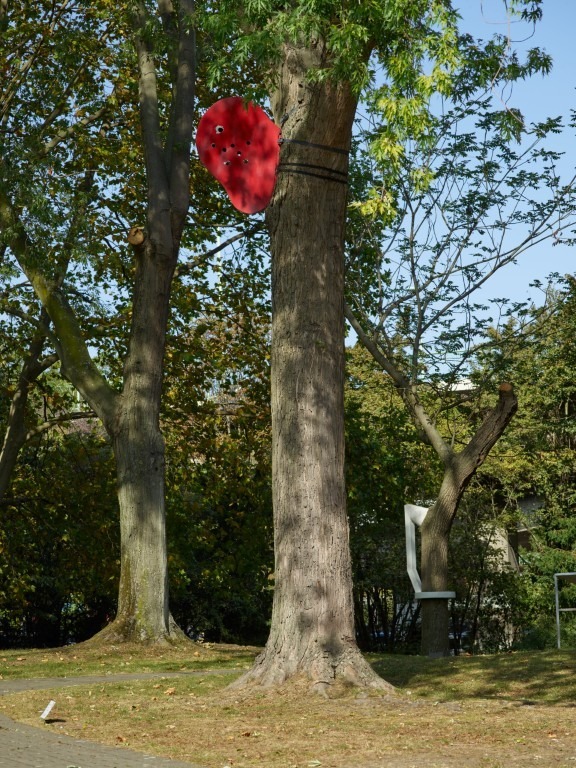
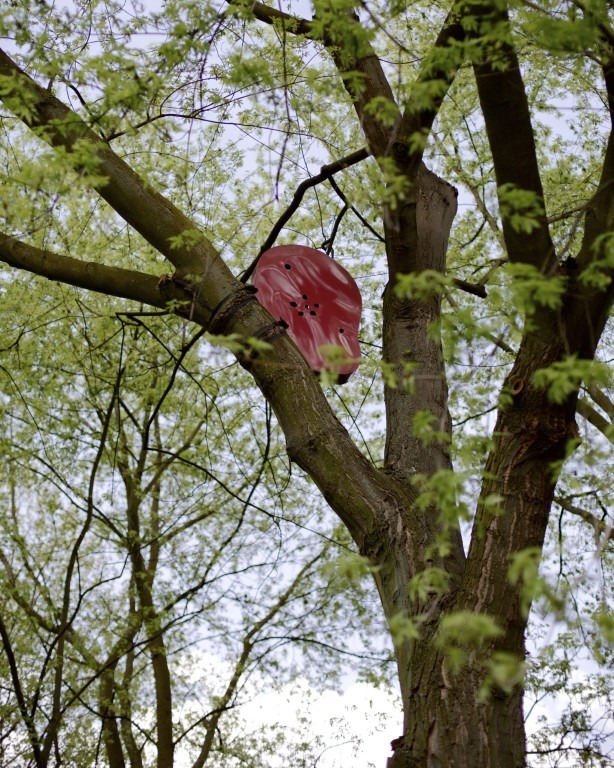
Bogomir Ecker: Ohr, 1986
Sheet iron, lacquered
Bogomir Ecker who has shown at documenta and is a member of the Berlin Akademie der Künste, made his name with art in public spaces and context-related sculptures and installations. His works are characterised by an input of scientific points of view. Their themes are sense perception and communication, in particular sight and hearing, and they are frequently technical or apparatus-like in character, without being centred on technology for its own sake. It is rather the medium through whose putative recognition-value the viewer is induced to adopt unaccustomed perspectives.
*1949 in Istanbul/Turkey, lives and works in Berlin/Germany and Istanbul/Turkey
Participant of KölnSkulptur # 10, 11
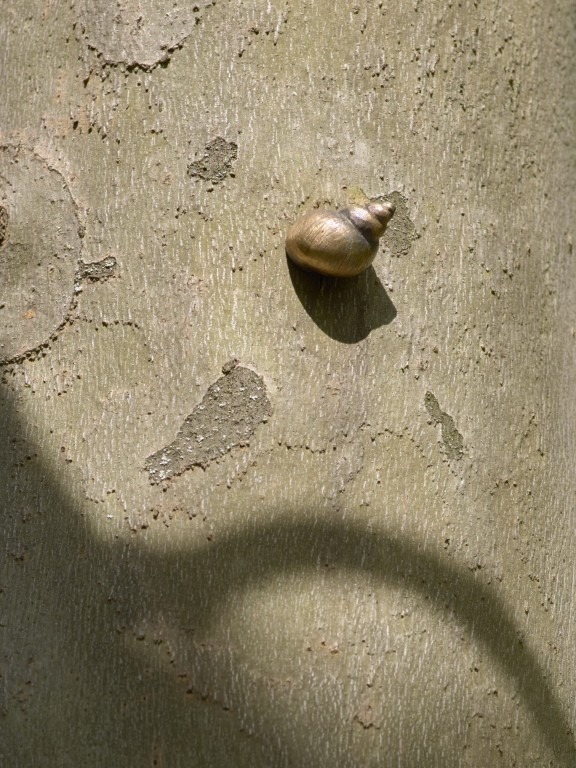
Ayşe Erkmen: Lonesome George, 2020
Bronze
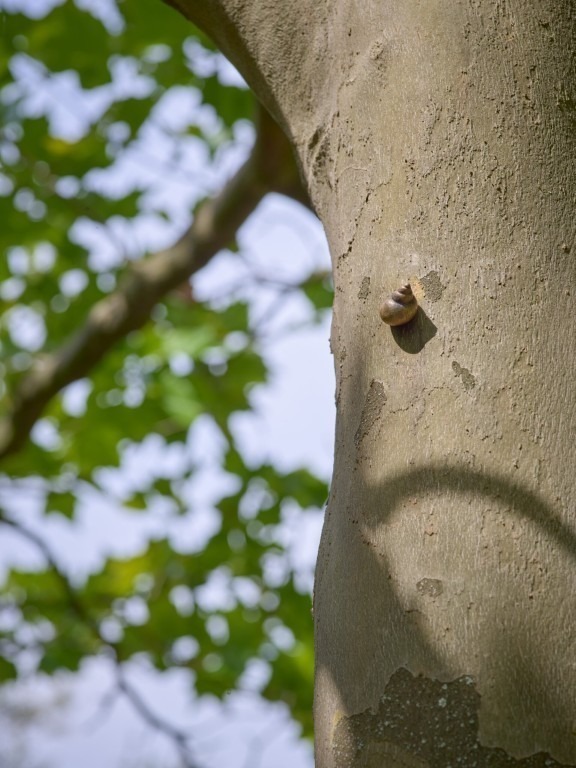
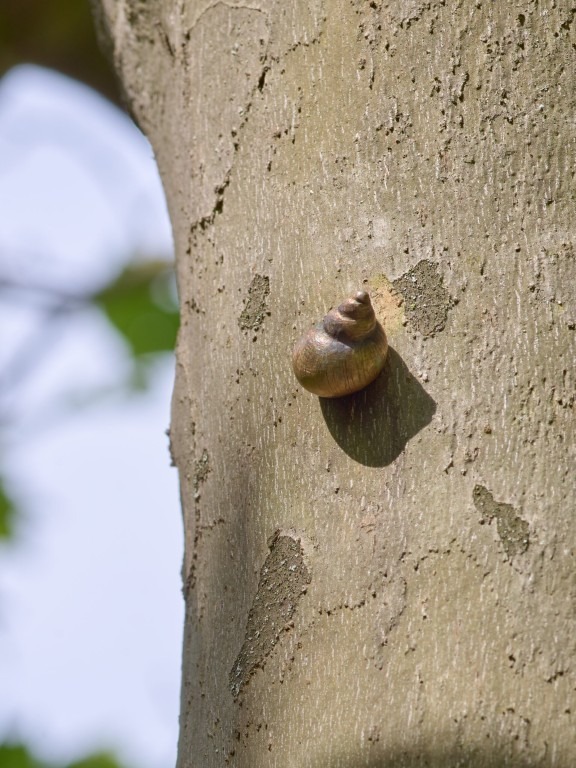
For fourteen years, Lonely George, the loneliest snail in the world, lived in a laboratory on Hawaii. For this entire period, scientists tried unsuccessfully to find it a mate. When he died in 2019, the species he belonged to, Achatinella apexfulva, died out with him. Erkmen’s Lonesome George is the smallest sculpture ever to be shown at the Skulpturenpark Köln. Her work refers to species extinction and acts as a memorial to the mollusc, which attracted a great deal of attention, albeit futile, once he became the sole representative of his kind.
Over the course of two years, the smallest sculpture in the Skulpturenpark Köln was encapsulated by the London plane tree (Platanus hispanica) and embedded in the tree. Lonesome George exists on, protected and invisible inside the tree in the sculpture park.
Peter Fischli
*8. Juni 1952 in Zürich/Schweiz
David Weiss
*21. Juni 1946 in Zürich/Schweiz
†27. April 2012 ebenda
Teilnahme an KölnSkulptur # 2, 3, 4, 5, 6, 7, 8, 9, 10, 11
Fischli/Weiss: Garten, 1997/1999
Concrete, stones
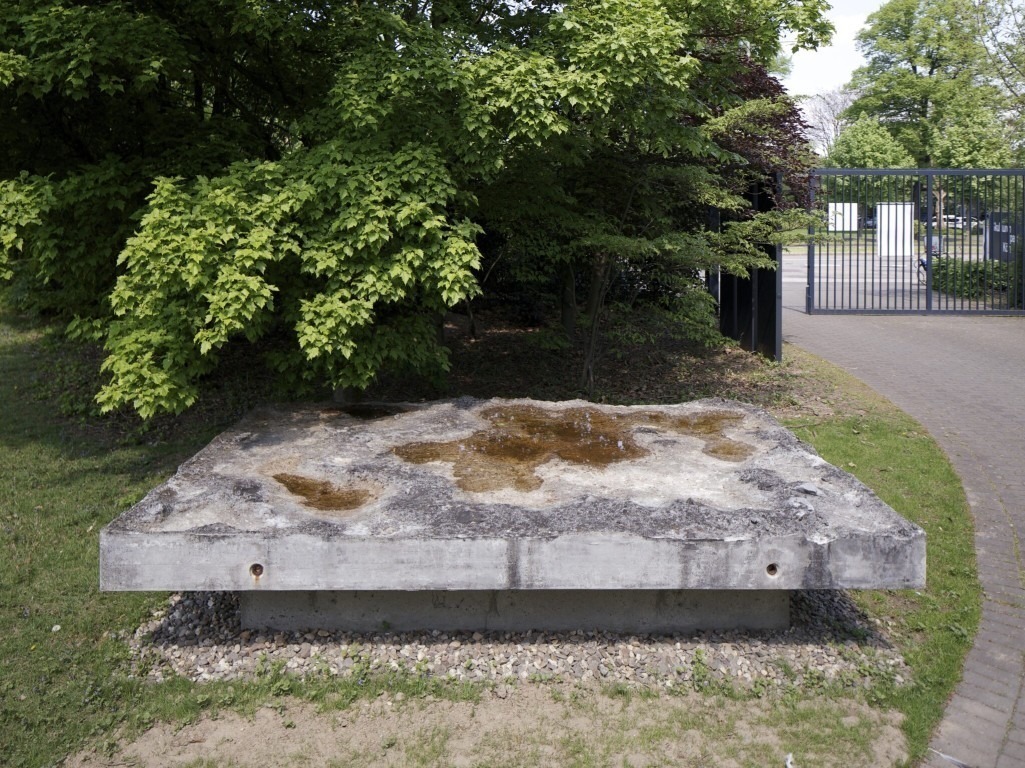
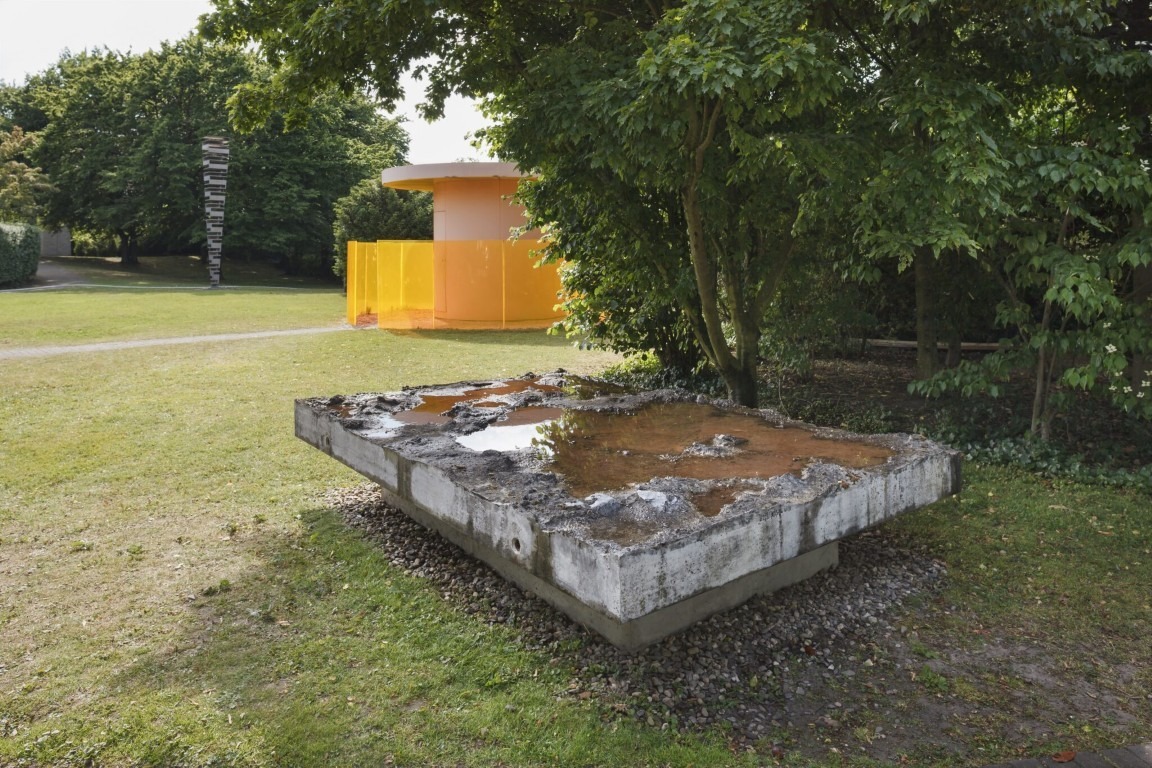
Peter Fischli and David Weiss have worked as an artistic team, always with a healthy dash of self-irony and humour, since 1979, and they are among the most influential contemporary artists in the multi-media field in Switzerland. The two Zurichers first attracted international notice at documenta 8 in 1987 with their film Der Lauf der Dinge. Garten is one of a series of Concrete Landscapes, of which the first, smaller, versions appeared in 1984. With their somehow crude and archaic feel, these landscapes seem to have been exposed to erosion since the dawn of time, and yet the material is a modern one, which – to the great delight of the artists – merely has to be left in a raw, untreated state to look so old.
*August 4, 1971 in Hokkaidō/Japan
Participant of KölnSkulptur # 6, 7, 8, 9, 10, 11
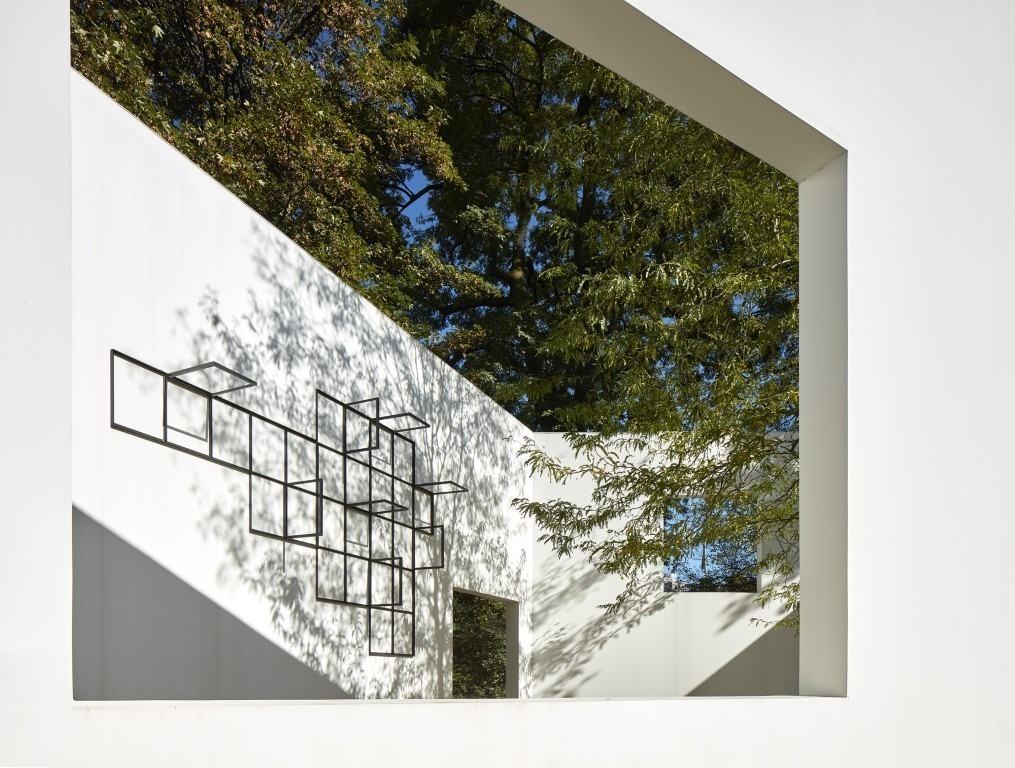
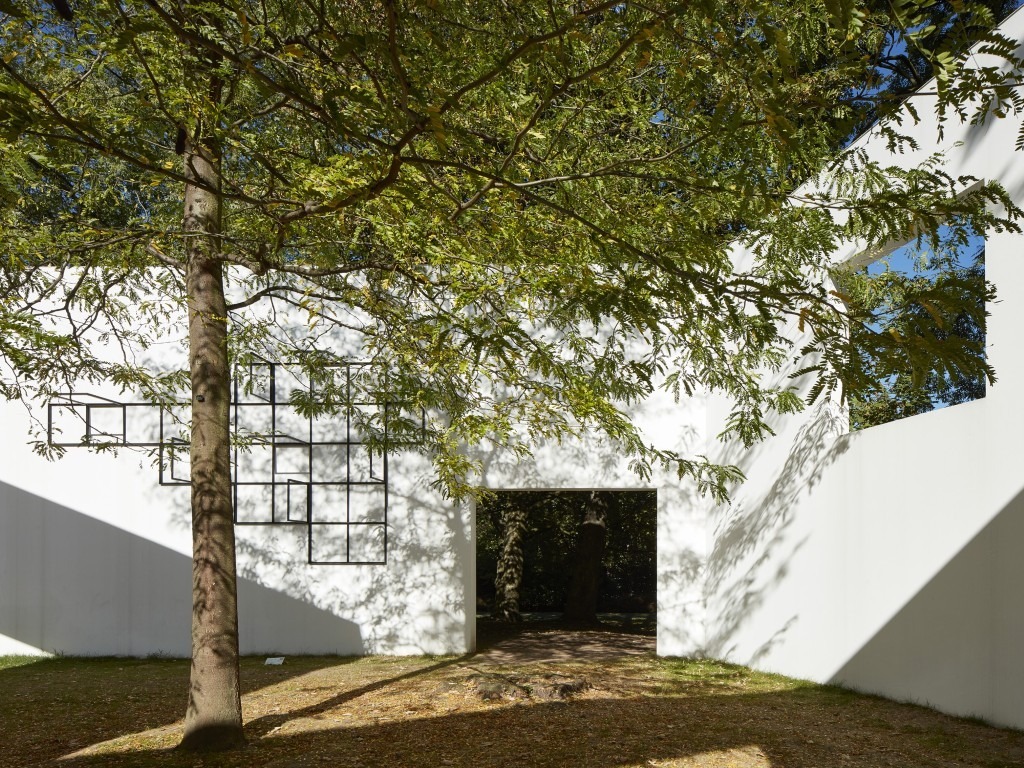
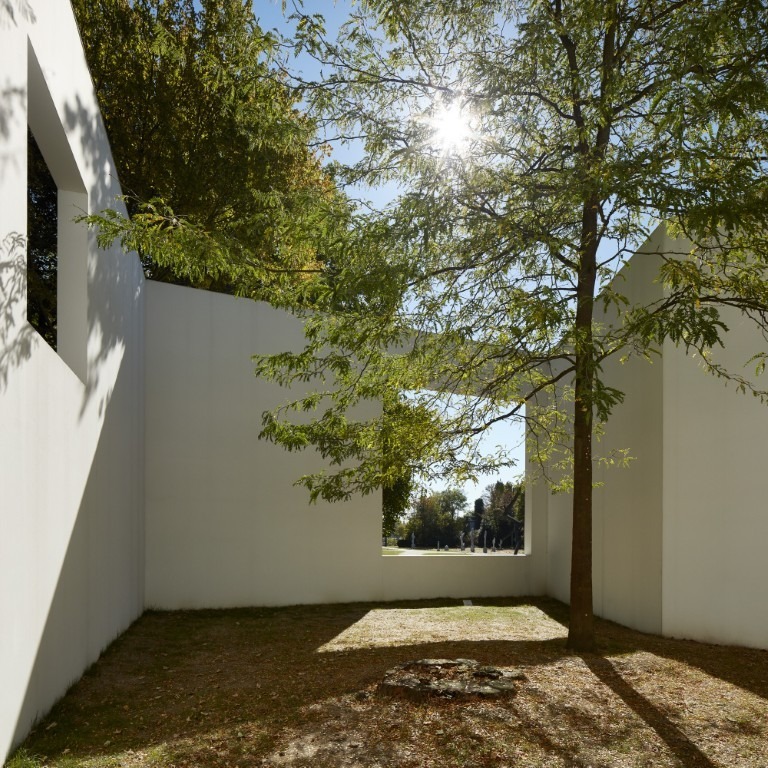
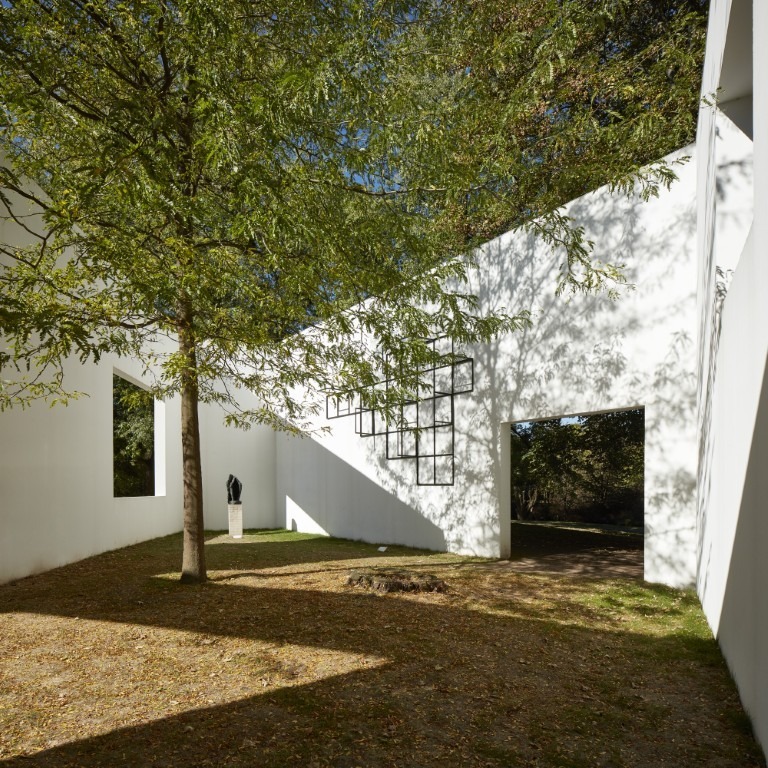
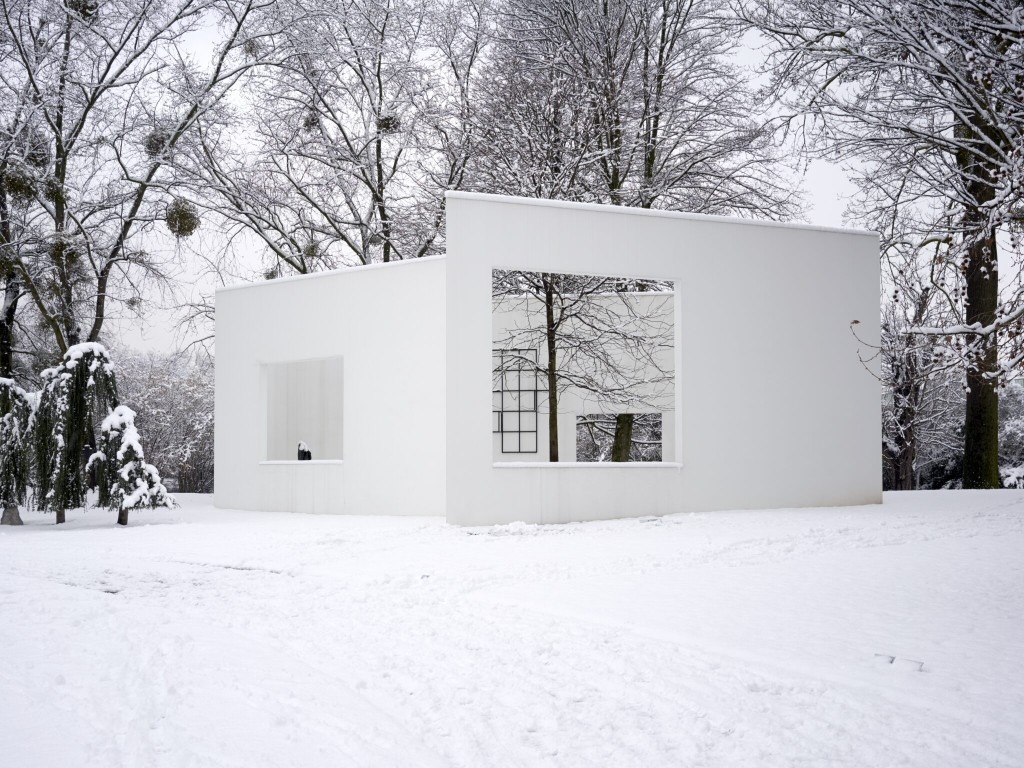
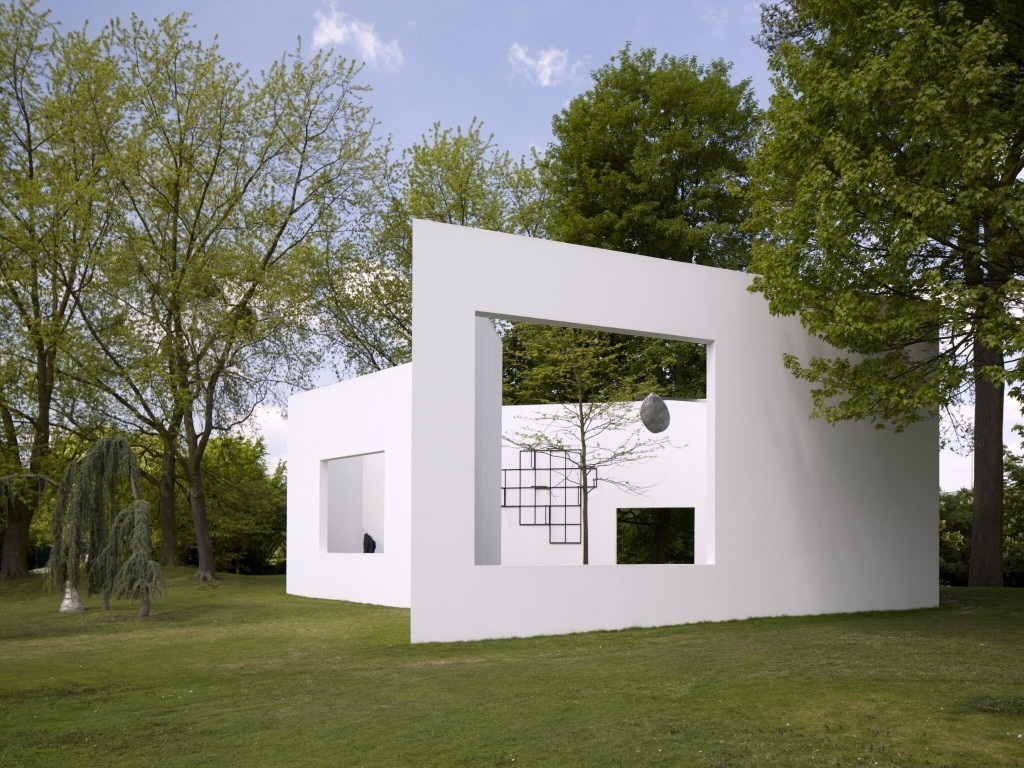
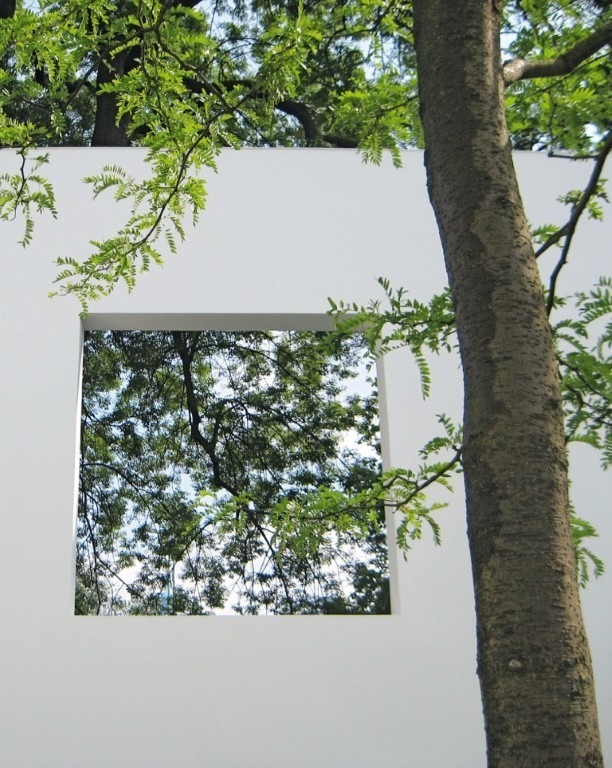
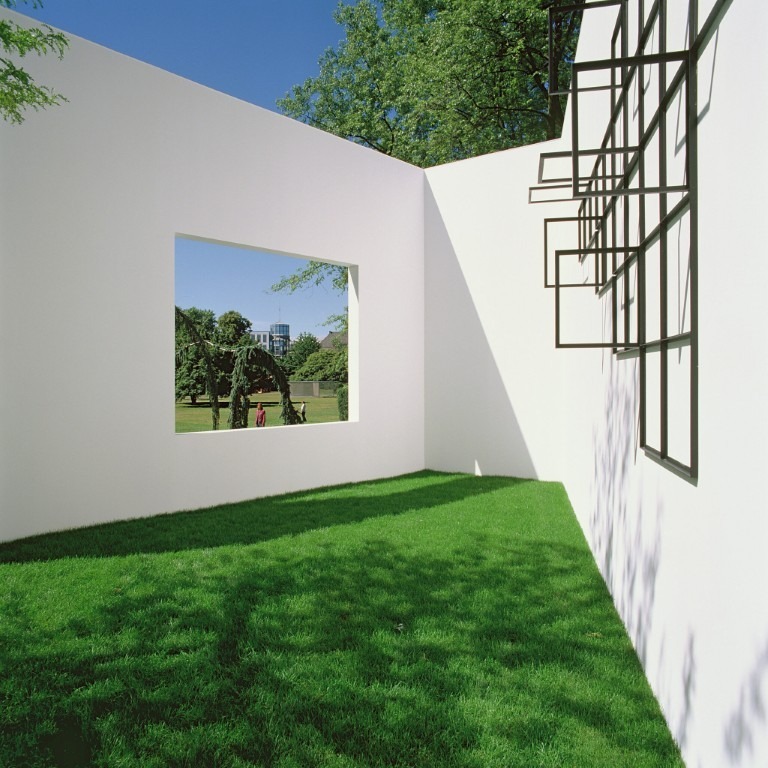
Sou Fujimoto: Garden Gallery, 2011
Concrete
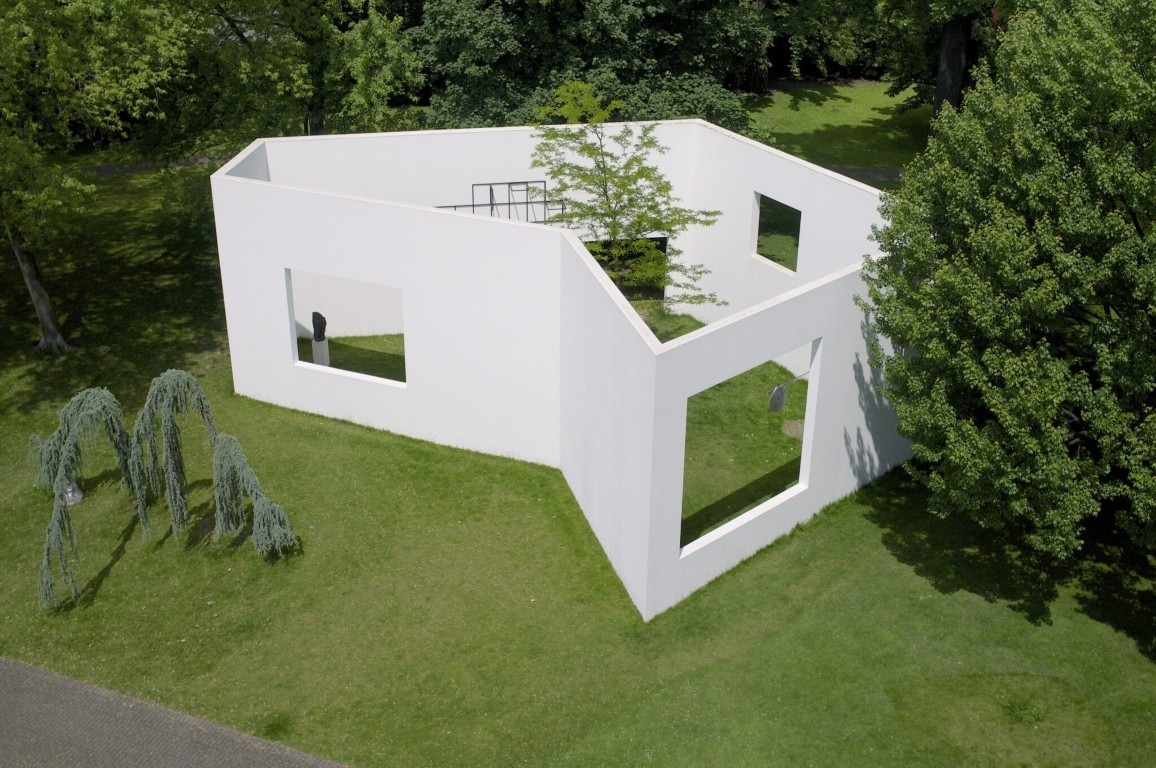
The Garden Gallery of Sou Fujimoto can be viewed as the Sculpture Park’s new trademark. In any case the architectural structure, in its size and proportion, sets a new criterion for the park including the works of sculpture found in it. From inside the structure, new sight lines open up and views of the park from its windows appear like framed landscapes, while, on the other hand, the visitor is lured into its enclosure by the tree and Rheinwein, the relief sculpture by Hubert Kiecol. The ground has been left in its natural unpaved state and in this way retains the tension between inside and outside space. In its relationship to the park, the Garden Gallery represents an architectural counterpart to the Foundation’s building; Sou Fujimoto’s work creates a balance between the two dominating buildings on the grounds. This is Sou Fujimoto’s first architectural structure in Europe. Sou Fujimoto has also designed the Serpentine Gallery Pavilion 2013 in Kensington Gardens/London.
*March 31, 1942 in Urbana, Illinois/USA
† February 19, 2022 in New York/USA
Participant of KölnSkulptur # 3, 4, 5, 6, 7, 8, 9, 10, 11
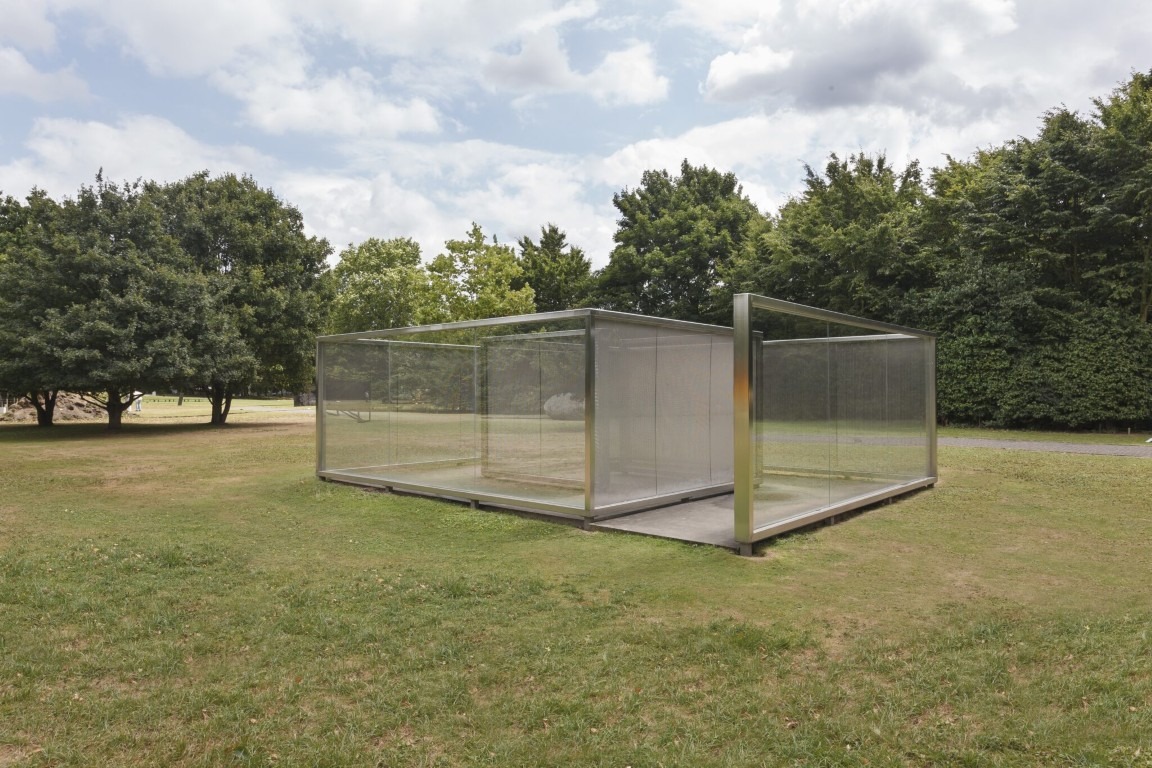
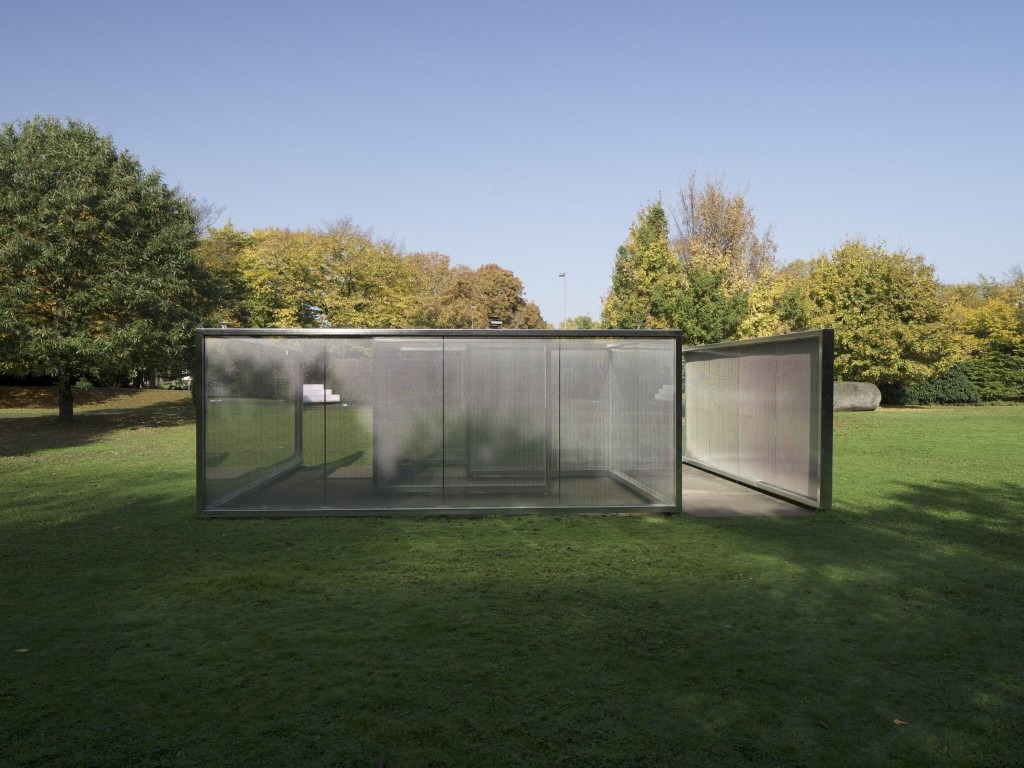
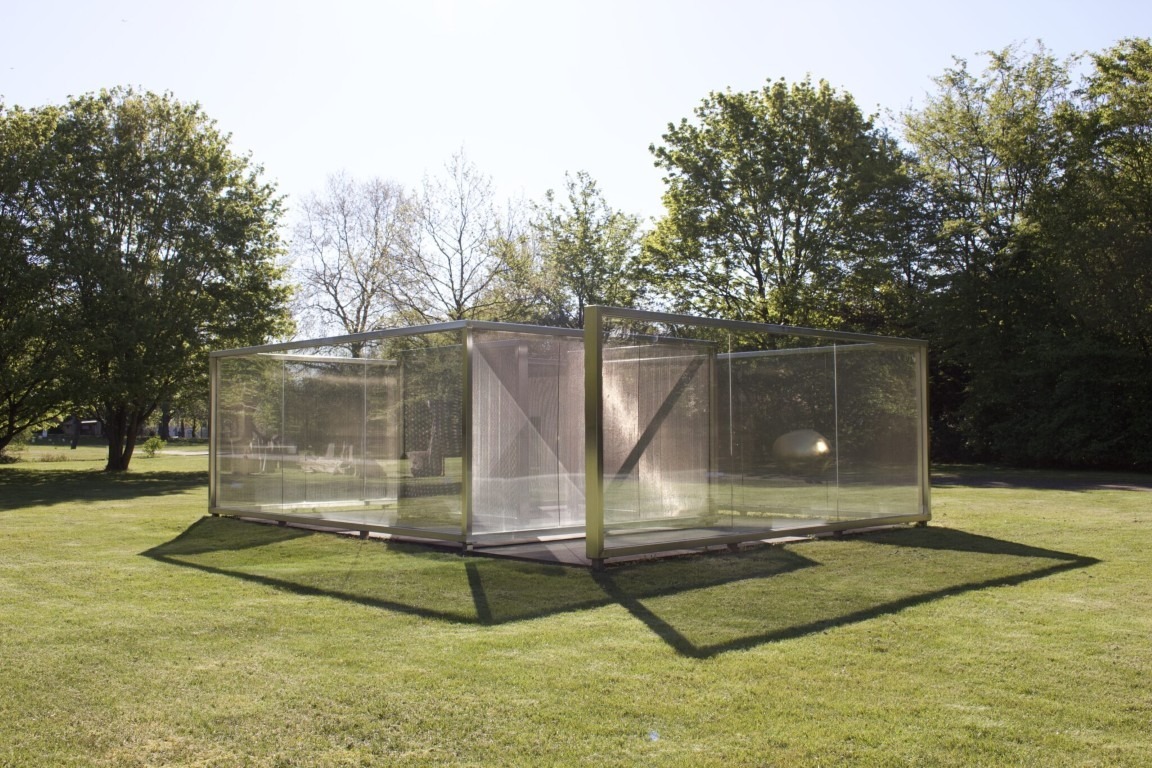
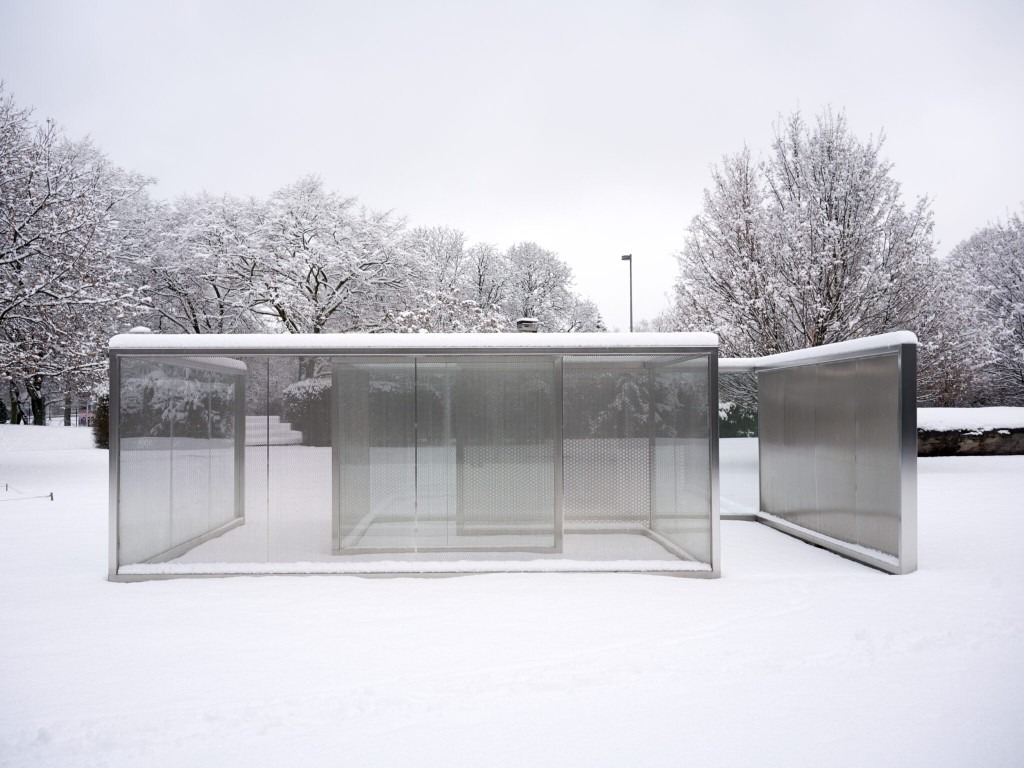
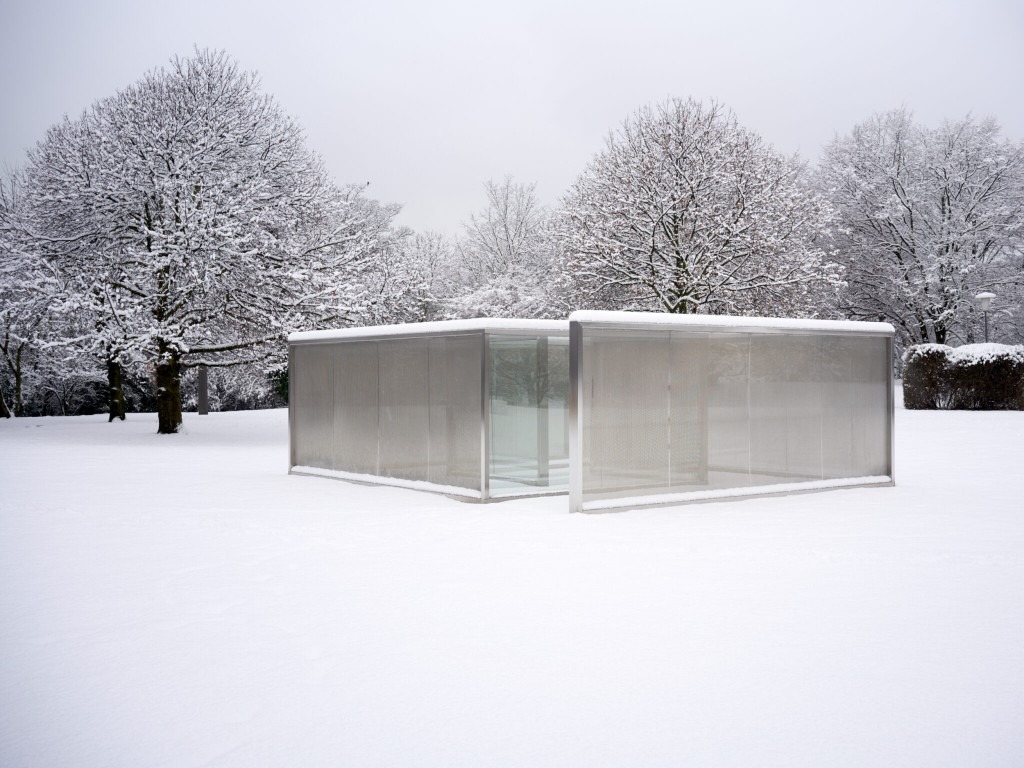
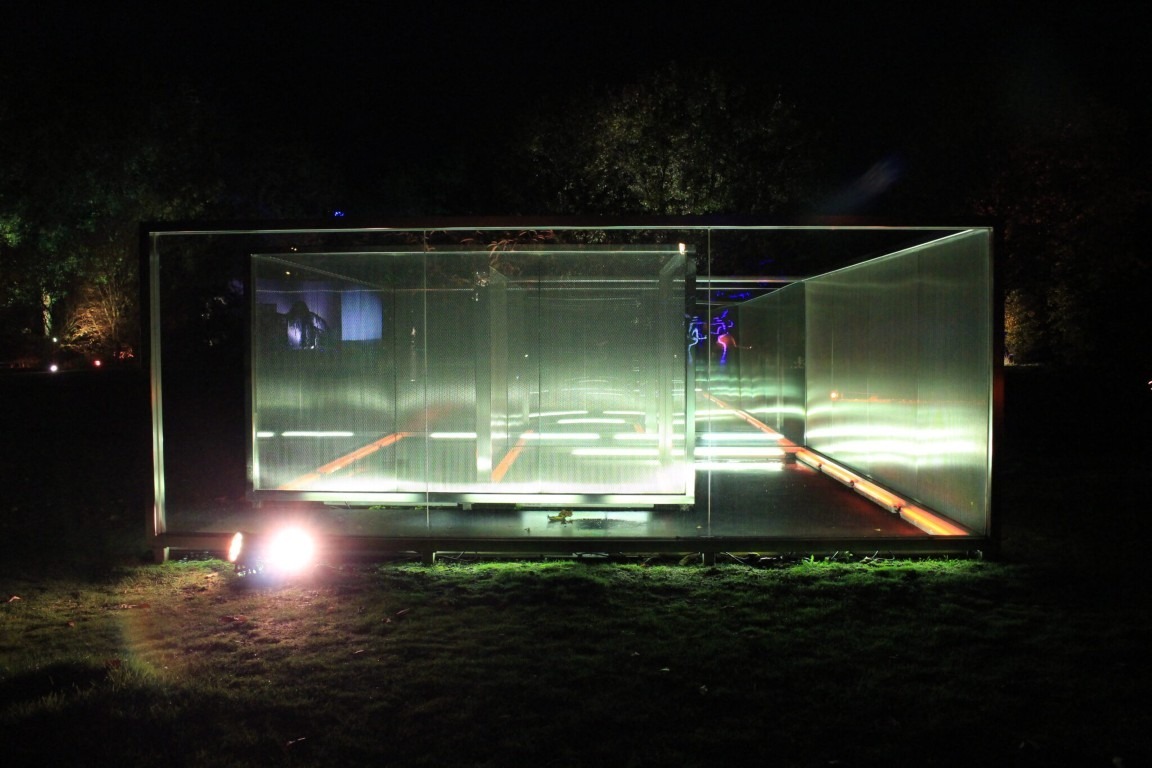
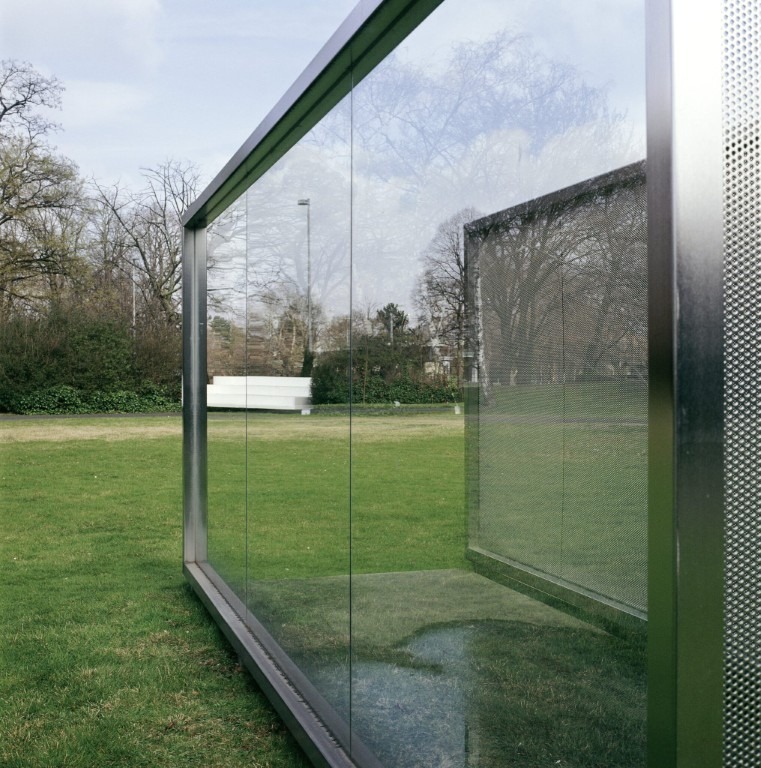
Dan Graham: Greek Cross Labyrinth, 2001
Two-way mirror-glass, stainless steel frame, stainless steel perforated sheets
After working as journalist, photographer, art-theorist and gallery owner, Dan Graham only turned to a career in the arts in the mid-1960s. His first efforts were literary works with a conceptual background, then films and performances, and from 1970 video installations in which the viewer himself became the object of his own reflection. Since the 1976 Venice Biennale he has worked in terms of open-air installations, using walls of glass and mirror glass to create complex, partly isolating effects of self-observation. The formal elegance and the depth of meaning of his work makes him one of the most important conceptual artists of the present day.
*1982 in Warburg/Germany
Participant of KölnSkulptur # 7, 8, 9, 10, 11
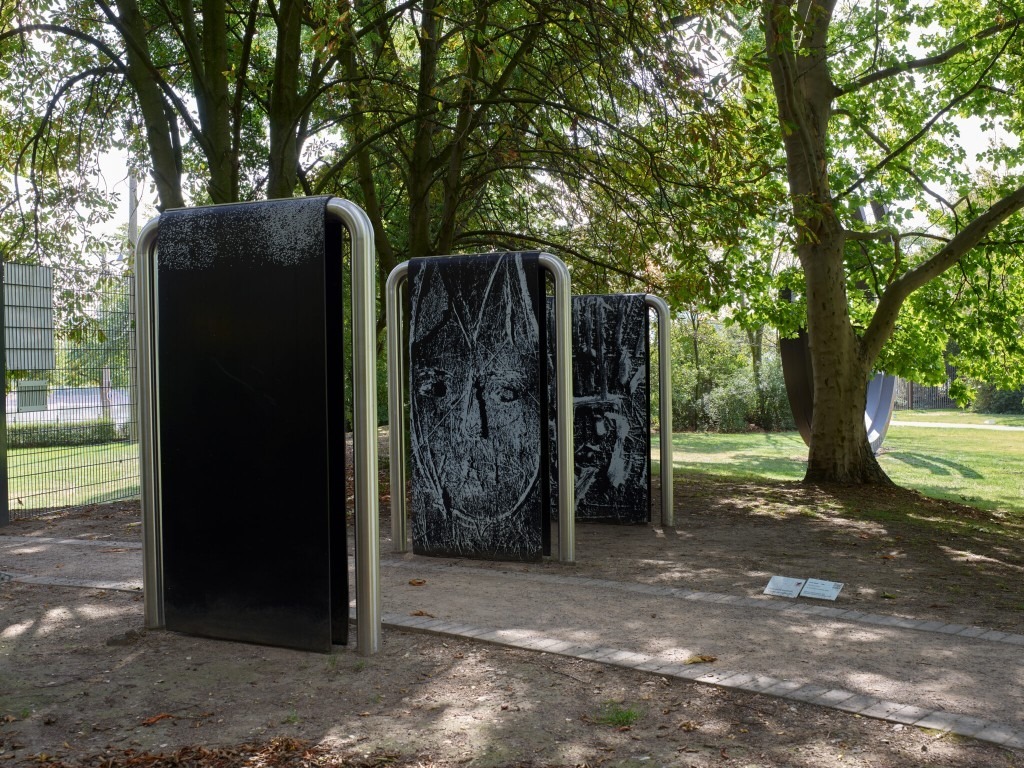
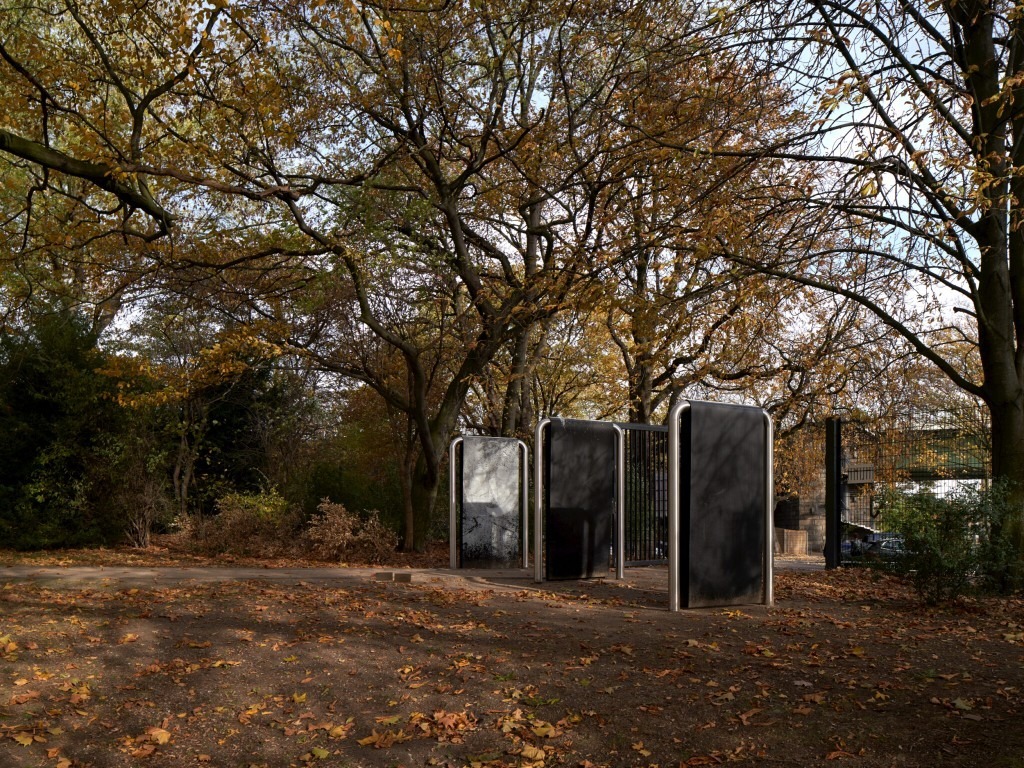
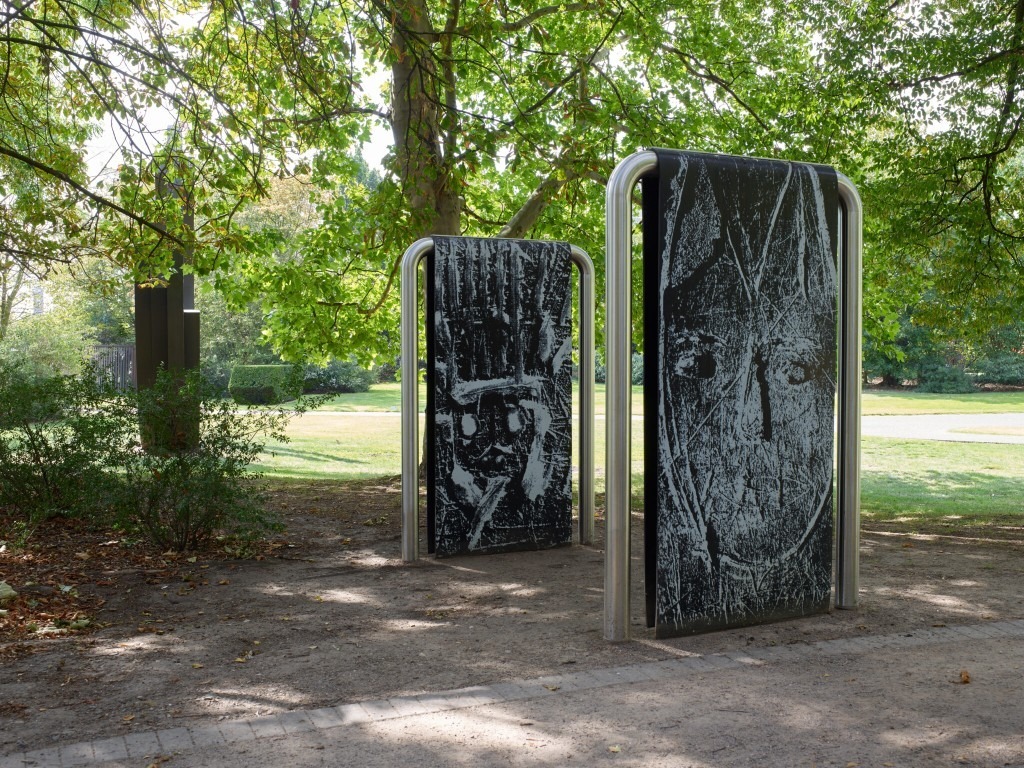
Lena Henke: The Doors, 2013
UV print on plastic, steel
Lena Henke’s work brings quite unusual materials into the Skulpturenpark Köln, which stand out clearly against the nature reference of most of the other works. Stainless steel frames and printed rubber mats are motifs derived from an urban life of experience. In the park these seem to be citing another world. The images show graffiti depicting some famous photographs by George Brassaï that, when enlarged, look on the one hand like archaic creatures, while the flow of the rubber mats and their repetition, on the other hand, remind us of film clips.
*July 29, 1950 in Gallipolis, Ohio/USA
Participant of KölnSkulptur # 1, 2, 3, 4, 5, 6, 7, 8, 9, 10, 11
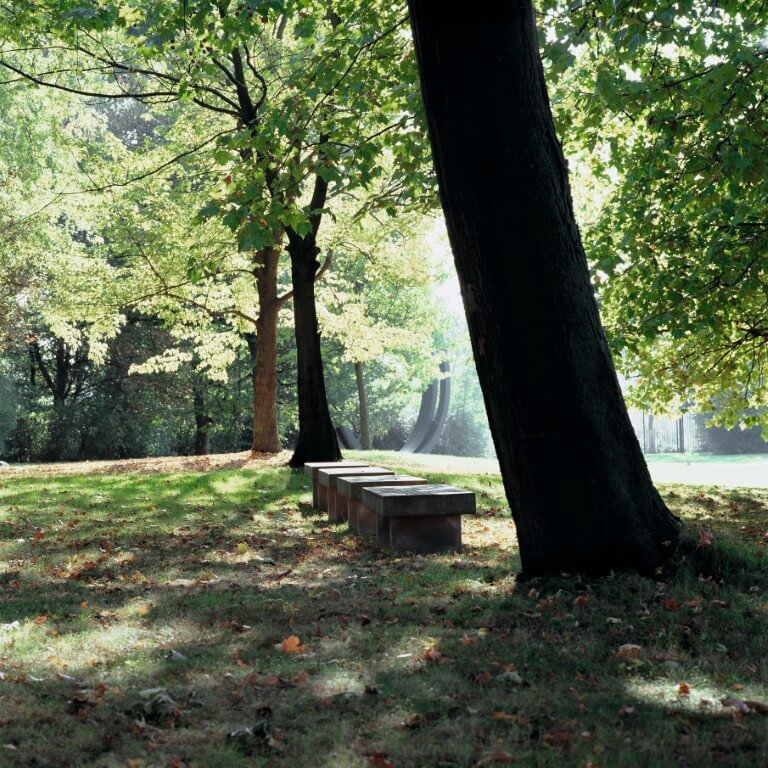
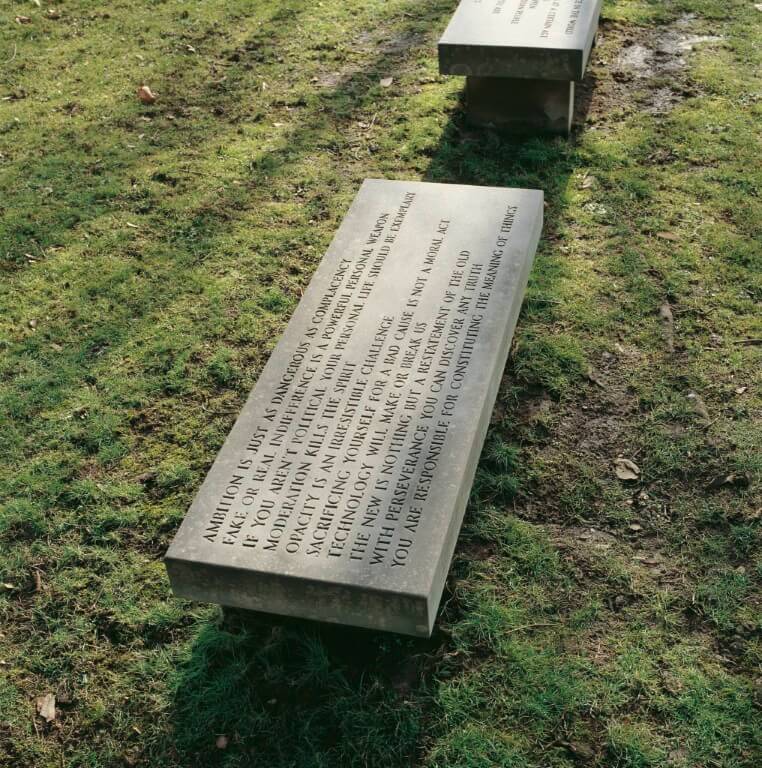
Jenny Holzer: Ambition is just …, 1997
Sandstone, four benches
The work of Jenny Holzer is always addressed to a broad public. In 1977 she carried out her first anonymous poster campaign with so-called Truisms, self-evident truths and “sound, common sense” statements. Other mediums such as benches, stickers or T-shirts were soon added. In 1982 she used the electronic signboard on Times Square in New York. In her works she pursues the goal of subverting the messages of the advertising and media worlds, exploiting the reading and seeing habits of passers-by to confront them with surprising messages. In 1990 she received the Golden Lion as the first American artist at the Venice Biennale.
*August 22, 1951 in Tsu/Japan
Participant of KölnSkulptur # 2, 3, 4, 5, 6, 7, 8, 9, 10, 11
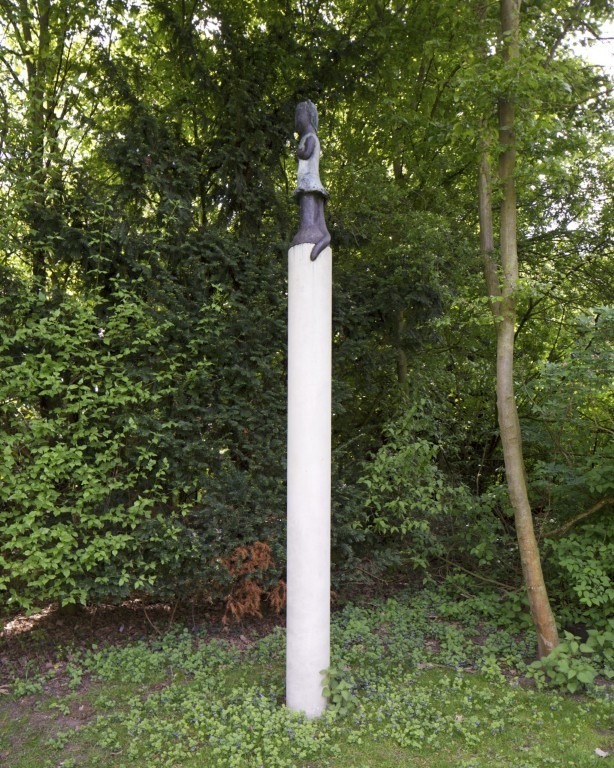
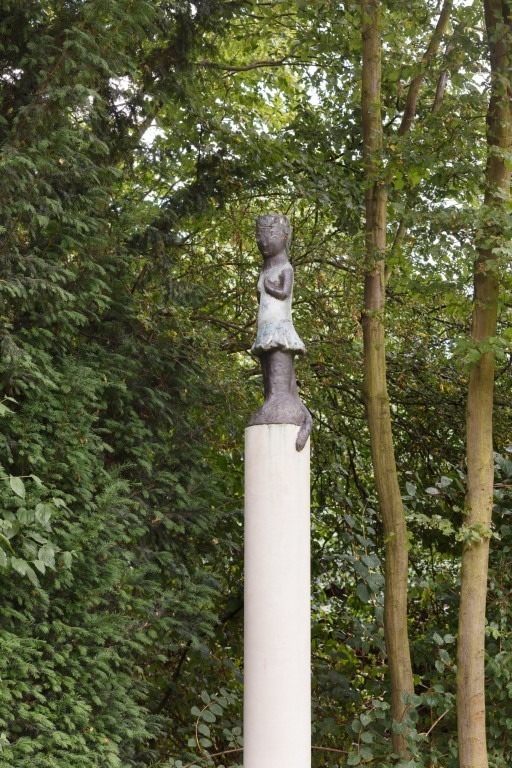
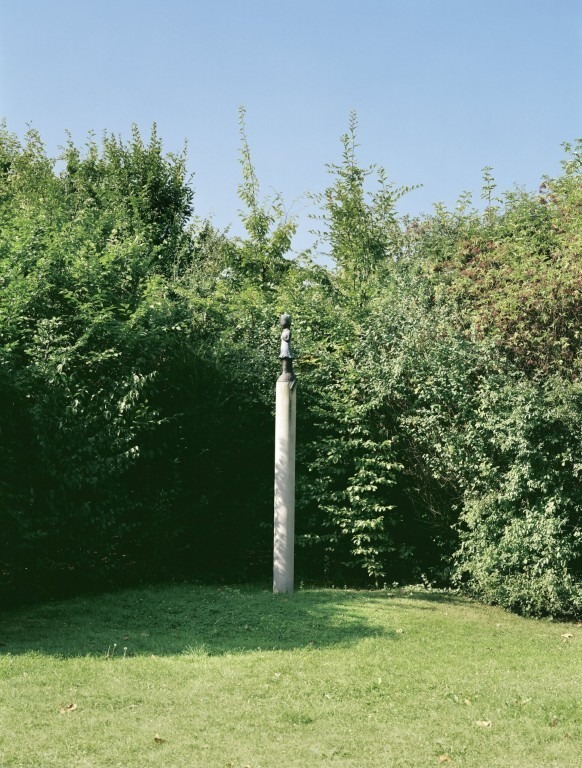
Leiko Ikemura: Katzenmädchen mit r(h)ein-Blick, 1999
Bronze, concrete
Leiko Ikemura studied sculpture and painting in Spain, and in 1979 settled in Zürich, before finally moving to Cologne in 1985. After beginning with lively, dreamlike drawings and paintings she turned in 1987 to sculpture as her central medium. Since then she has made figures – mostly female – who fluctuate between two conditions, on the one hand they seem unfinished, on the other still in a state of becoming. Their undecided condition thematizes her fear of losing her cultural identity, and also a deep understanding of human nature – her figures are also commuters across the border, mediators between Japanese and Western culture.
*March 12, 1954 in Mumbai/India
Participant of KölnSkulptur # 2, 3, 4, 5, 6, 7, 8, 9, 10, 11
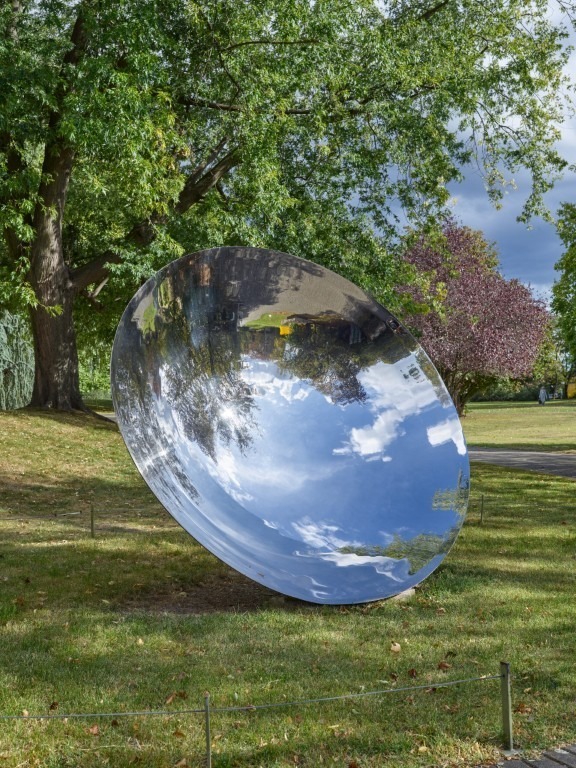
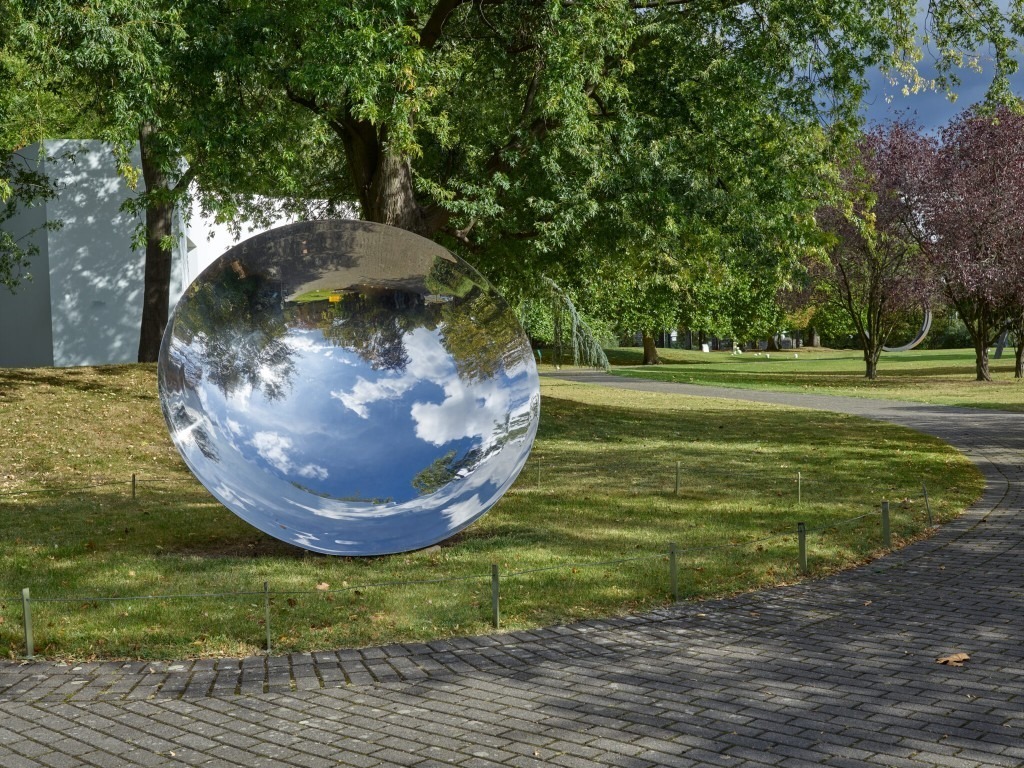
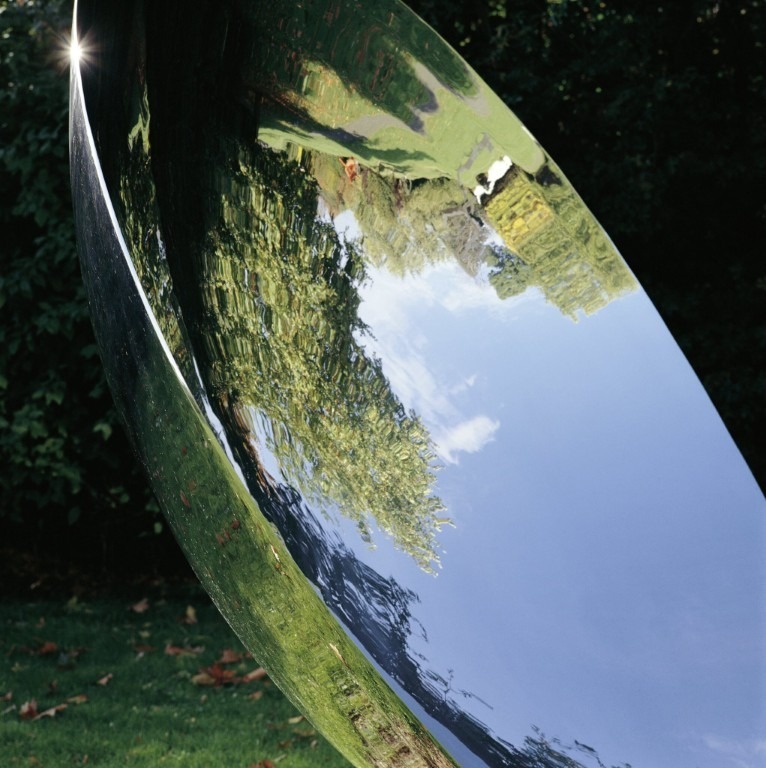
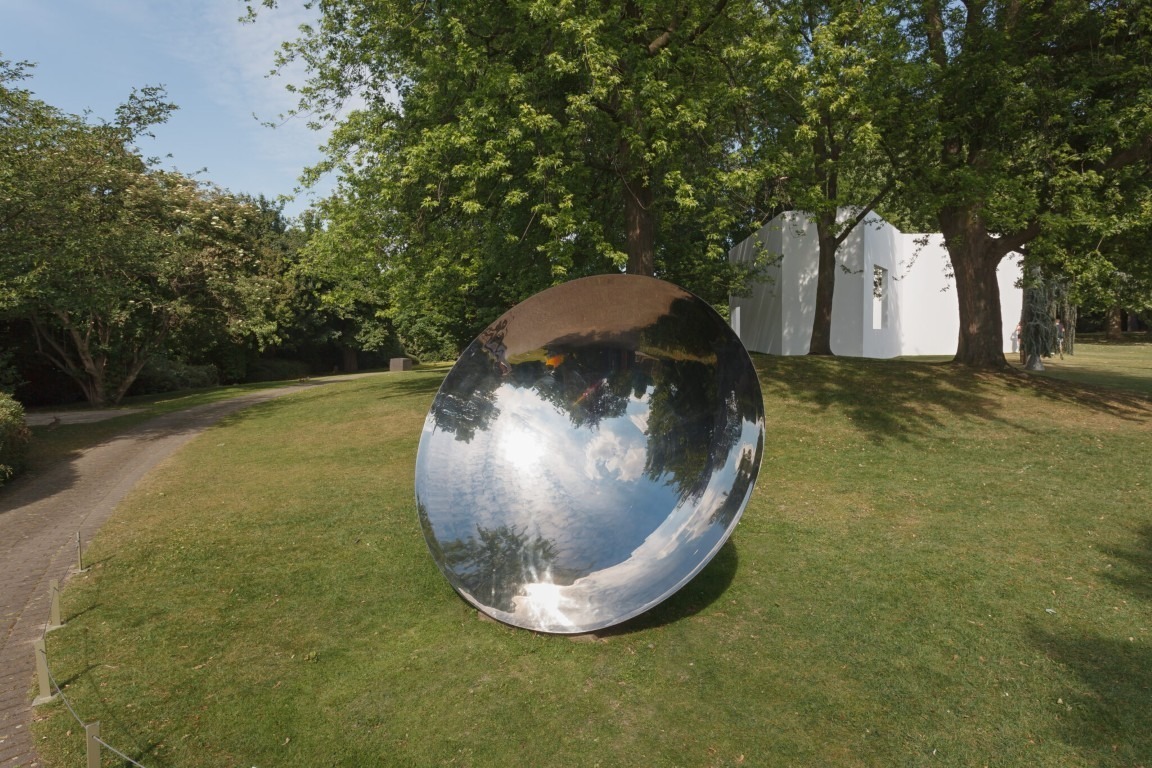
Anish Kapoor: Untitled, 1997
Steel, polished
At the Venice Biennale in 1990 Anish Kapoor represented Great Britain, and today he is one of the most prominent artists working in British Sculpture. The many-sided work of the 1991 Turner Prize winner is highly regarded internationally, not least because he combines the spiritual traditions of India with the idea of the sublime from the Western tradition in art. Since his first sculptures using colour pigments Kapoor has always crossed the borders between the genres. His method of working is that of a sculptor, but the themes of his sculptures – emptiness, transformation, immateriality, faith or passion – go far beyond questions of form and derive from painting.
*1966 in Hamburg/Germany
Participant of KölnSkulptur # 1, 2, 3, 4, 5, 6, 7, 8, 9, 10, 11
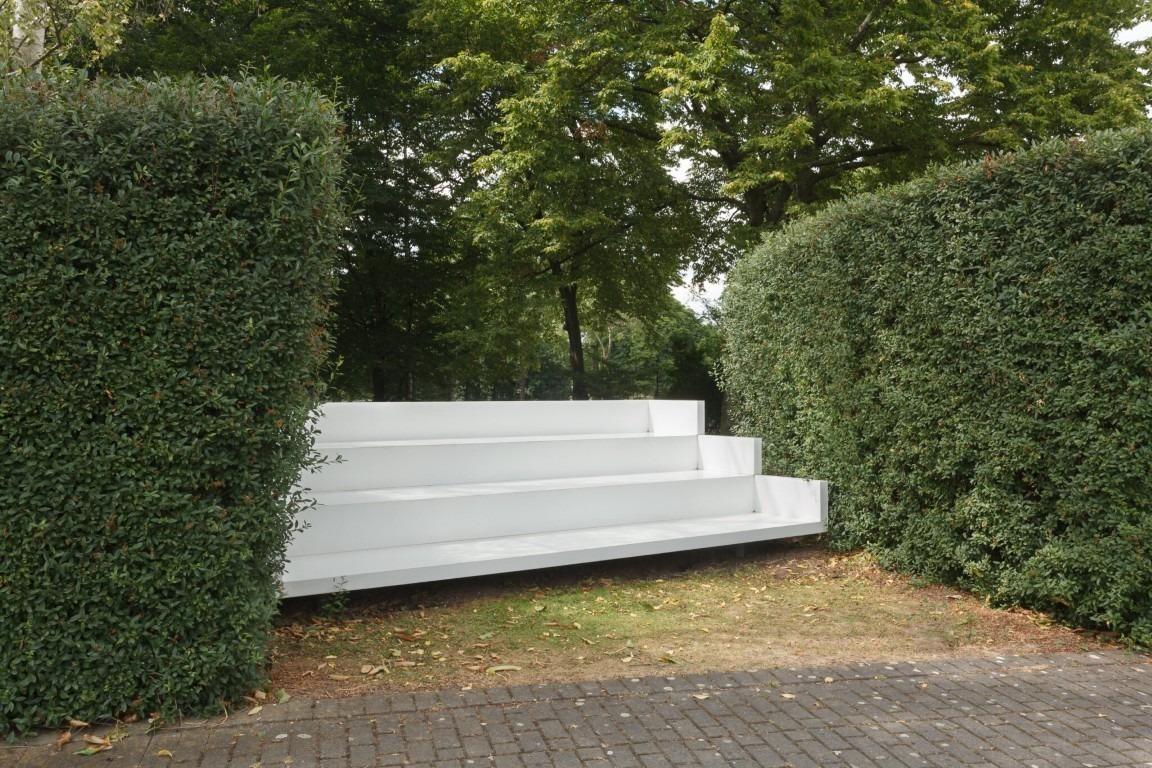
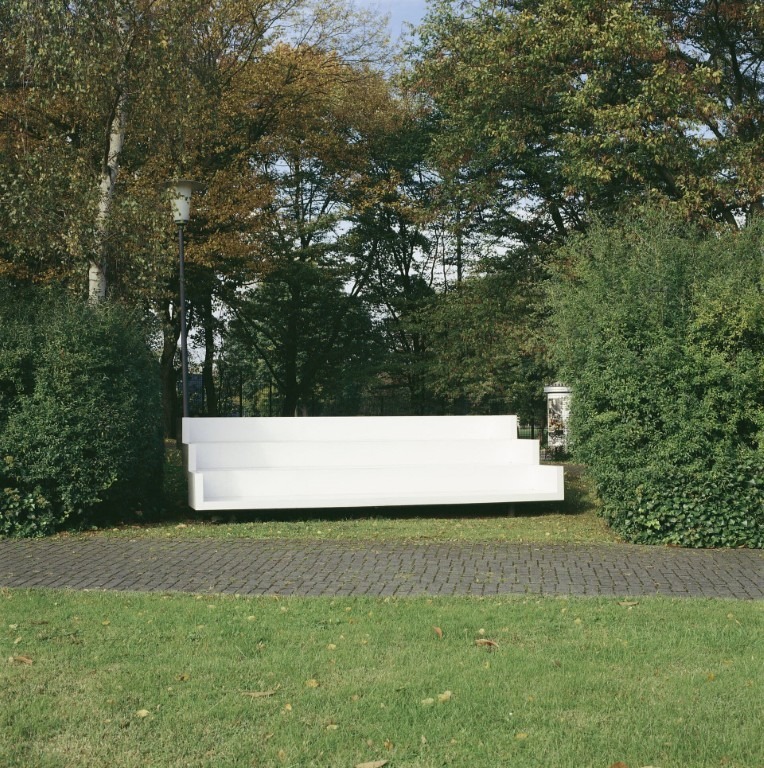
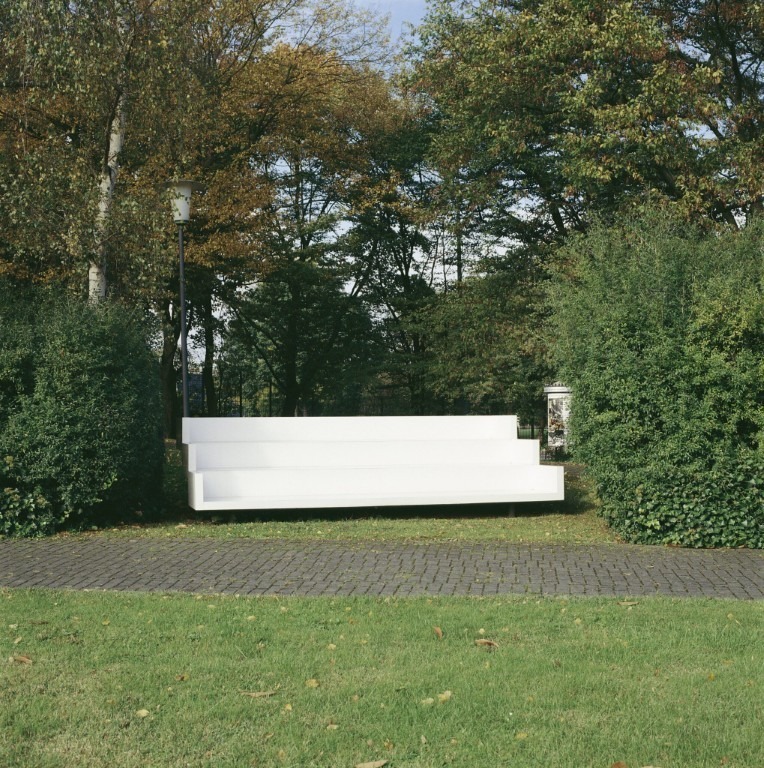
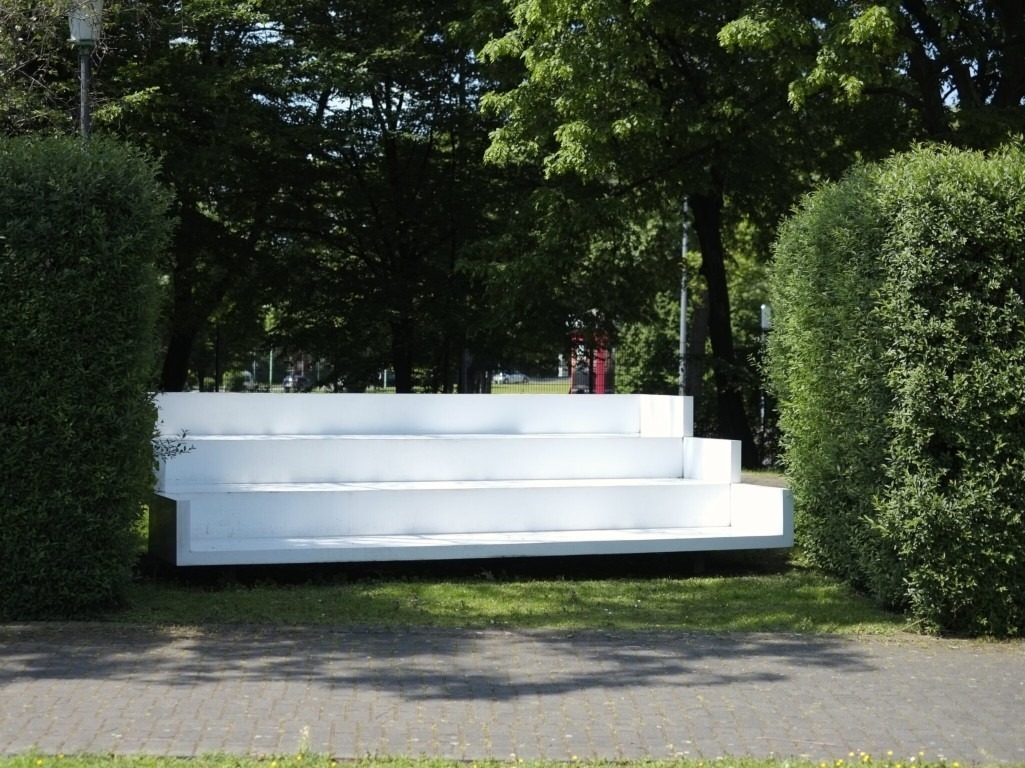
Stefan Kern: Ohne Titel (Tribüne), 1996
Aluminum, lacquer, steel
Stefan Kern locates his works with fine irony on the borderline between art and design, between the pure aesthetics of the object and practical usefulness, thus addressing the old question of the “function” of art. His works are formally related to models such as Donald Judd, Sol LeWitt or Carl Andre, but they seriously subvert the excessively theory-bound strategies of Minimal Art, in that Kern makes art in the form of “furnishings” accessible and available for practical use. His works are mostly objects or installations, e.g. speaker’s lectern or a form of seating of decidedly communicative and physically responsive character.
*October 26, 1950 in Bremen-Blumenthal/Germany
Participant of KölnSkulptur # 1, 6, 7, 8, 9, 10, 11
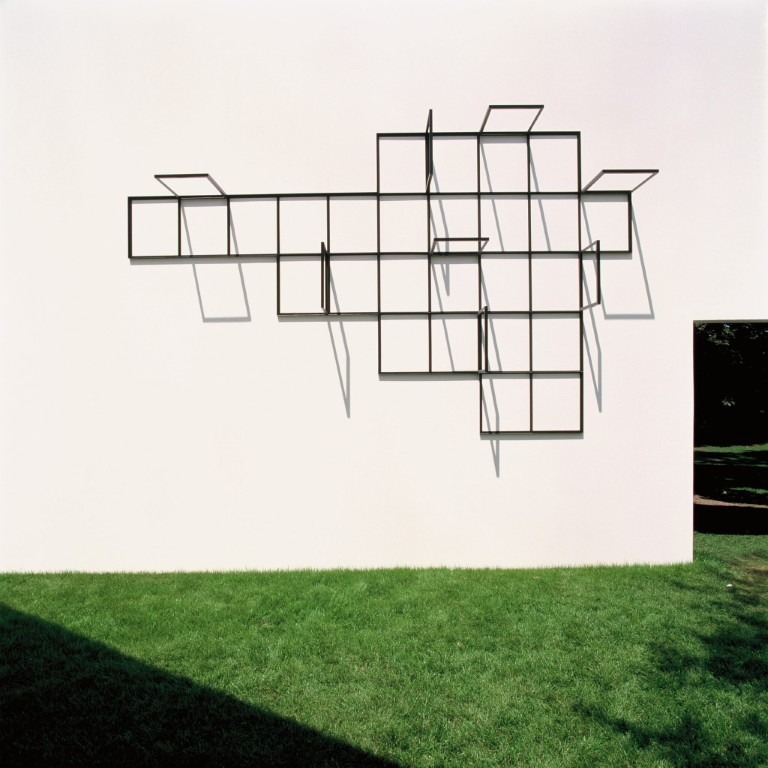
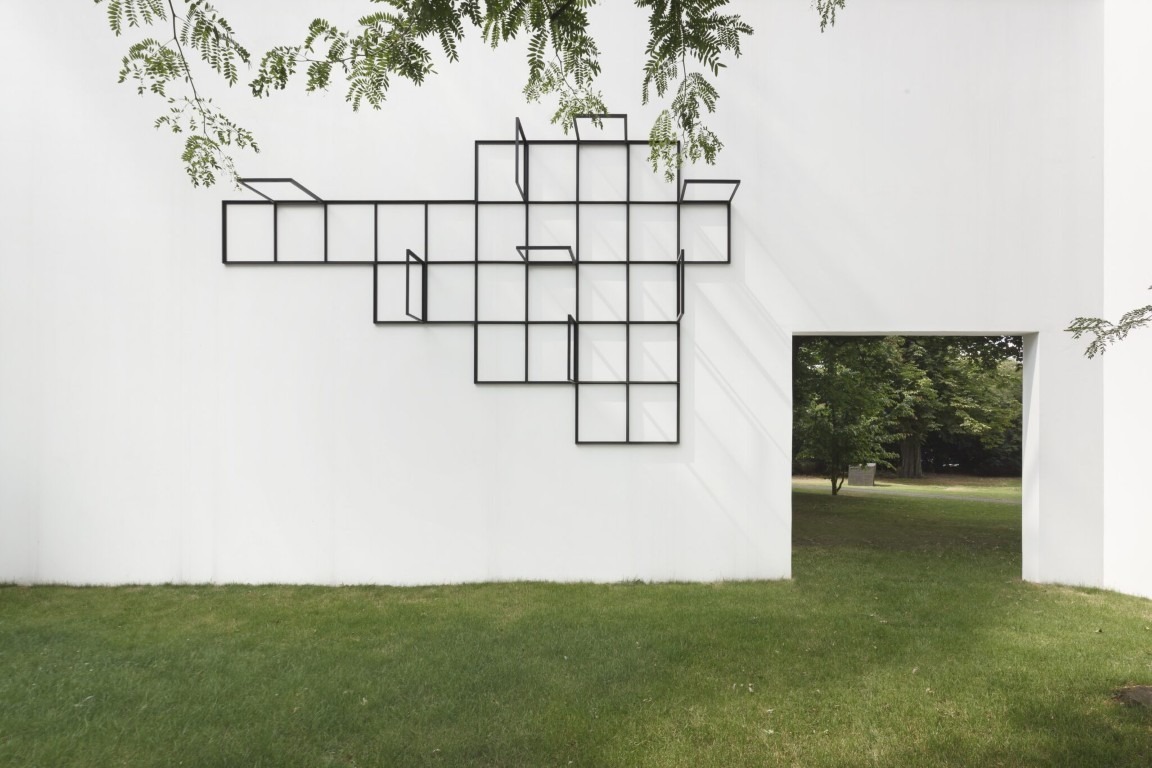
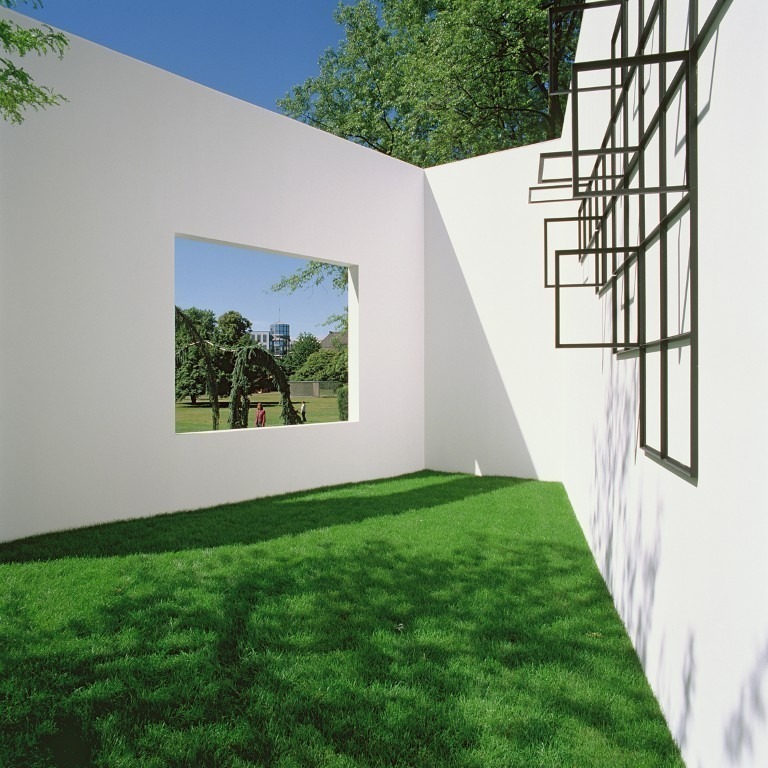
Hubert Kiecol: Rheinwein, 2011
Steel, powder-coated
The work Rheinwein was created for the interior wall of the Garden Gallery by Fujimoto and, with its black frame elements, represents a graphic contrast to the architecture, whose window motifs it also quotes. The recognizability of the motif is intended to establish a connection between the Garden Gallery and the park and create a relationship across the dimensions of the park.
*1979 in Stockholm/Sweden
Participant of KölnSkulptur # 7, 8, 9, 10, 11
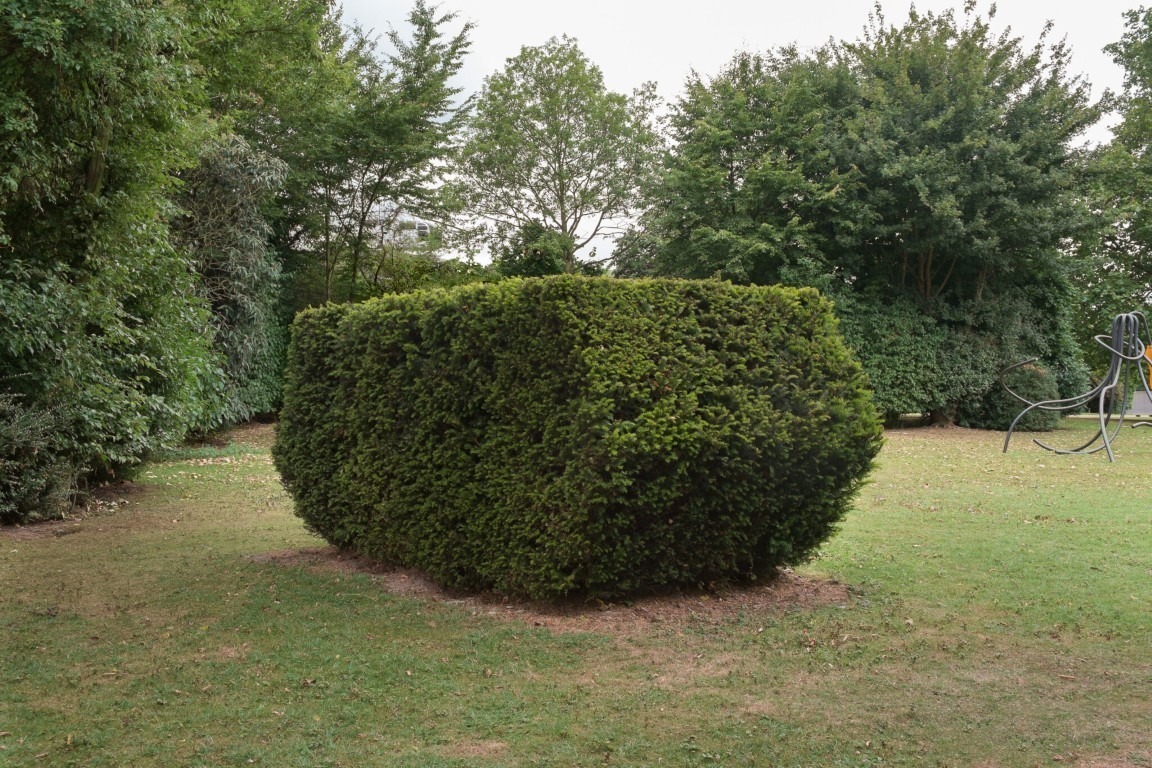
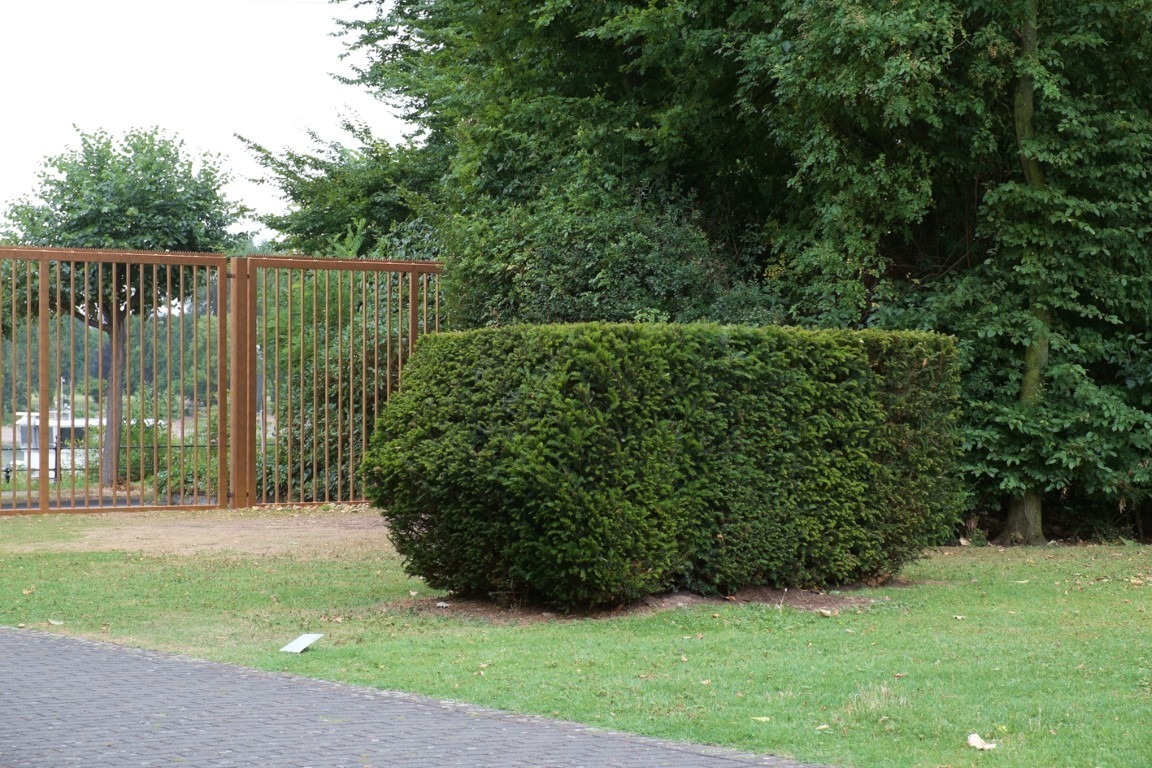
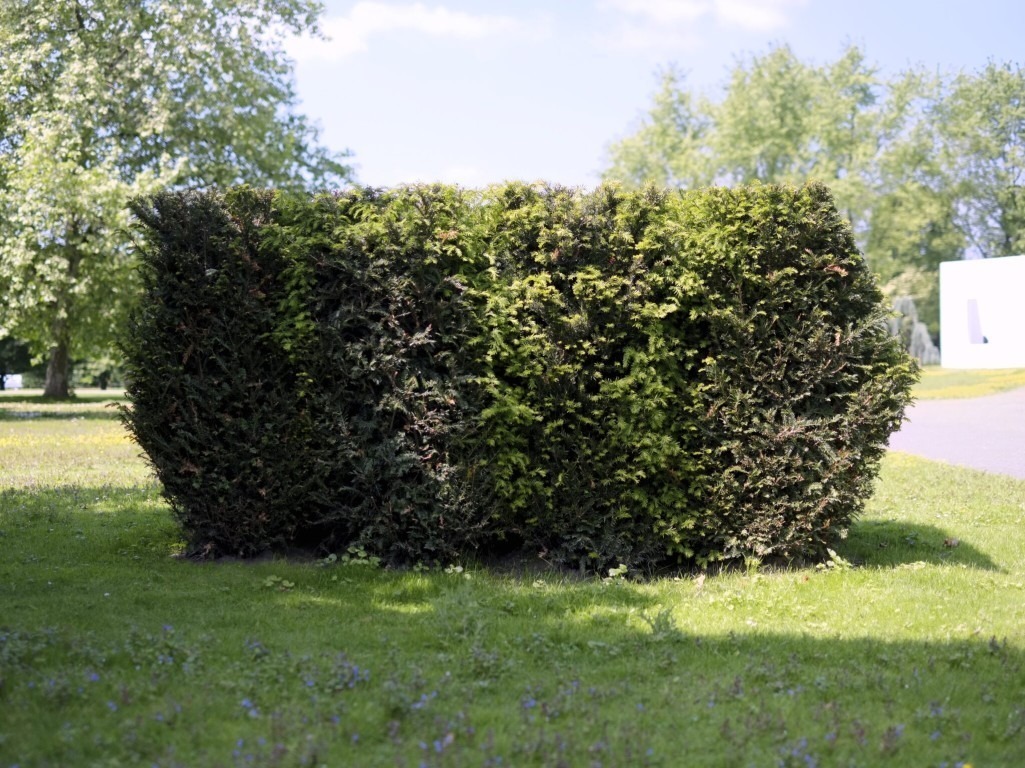
Klara Lidén: Harvest Moon, 2013
Yew (Taxus baccata)
In 2011 Klara Lidén was nominated for the prize of the National Gallery in Berlin. On this occasion, she produced a work for the outdoor area of Berlin’s Hamburger Bahnhof, a yew hedge, trimmed to the contours of a dumpster. Since the yews in Berlin do not allow transplantation, a new yew hedge was planted here with the help of a Cologne landscape gardener, so that now the work is on show in a second version. At this site a container sculpture by Sofia Hultén had formerly stood for KölnSkulptur #6. Now in the exact same place, Klara Lidén’s work stands and in this way links visitors’ memories.
*1974 in Tamaki Makaurau Auckland/Aotearoa New Zealand
Participant of KölnSkulptur # 10, 11
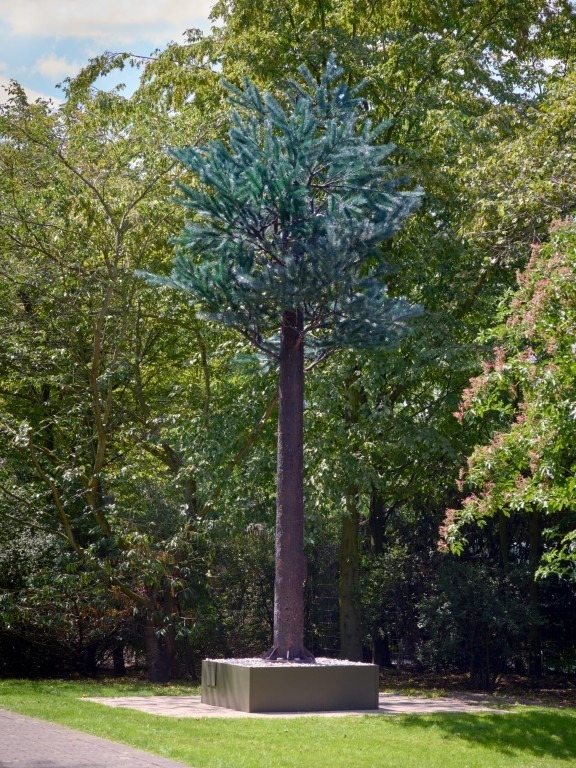
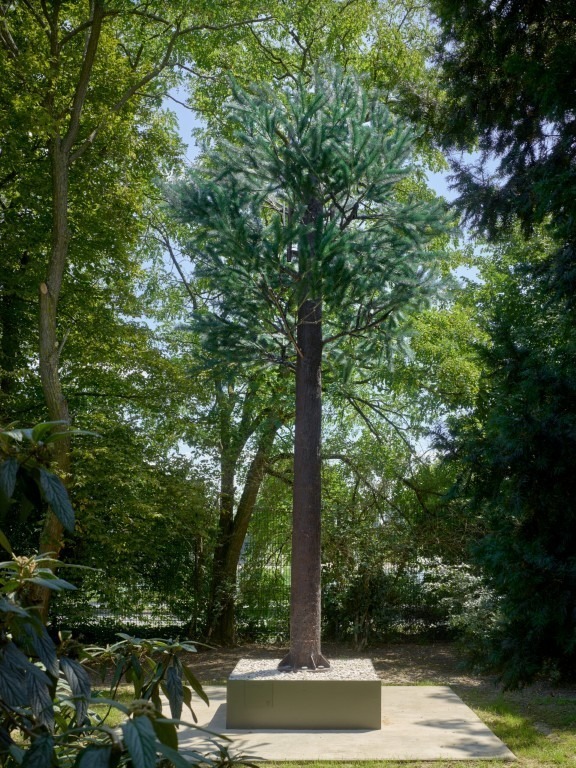
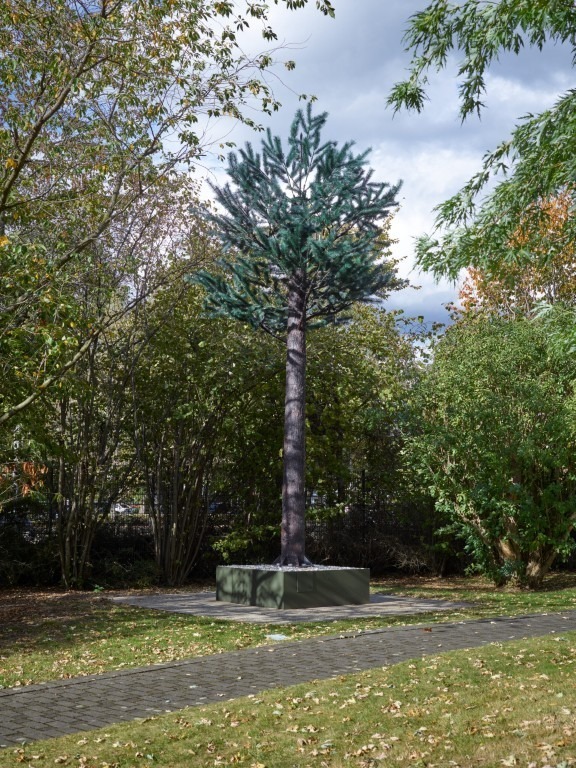
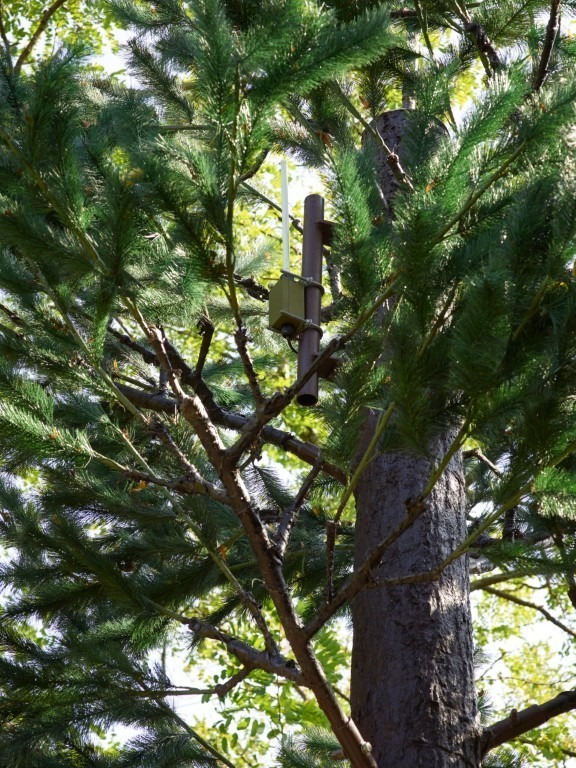
Dane Mitchell: Post hoc, 2019/2020
Two cell tower pine trees, each comprising: galvanized steel, mild steel, aluminium, plastic, antenna, solid state drive, mesh network, MP3 player, amplifier, speakers and electrical components
Dane Mitchell has worked with a company who produce fake-tree telecommunication towers, used across the world by the telecommunication and surveillance industries to camouflage technology in the landscape, to realise a work that announces and transmits a list handmade by the artist of lost, extinct and disappeared entities and phenomena (approximately 260 categories). The list, which takes over six months to read, is uttered by an electronic voice and can be heard from the two trees in the park or listened to by way of the WIFI network generated by the cell-trees. Post hoc takes a look at the implications of the disappearance. To join the network, select the Posthoc network, open a browser and type posthoc.co.
*1963 in Havana/Cuba
Participant of KölnSkulptur # 1, 2, 3, 4, 5, 6, 7, 8, 9, 10, 11
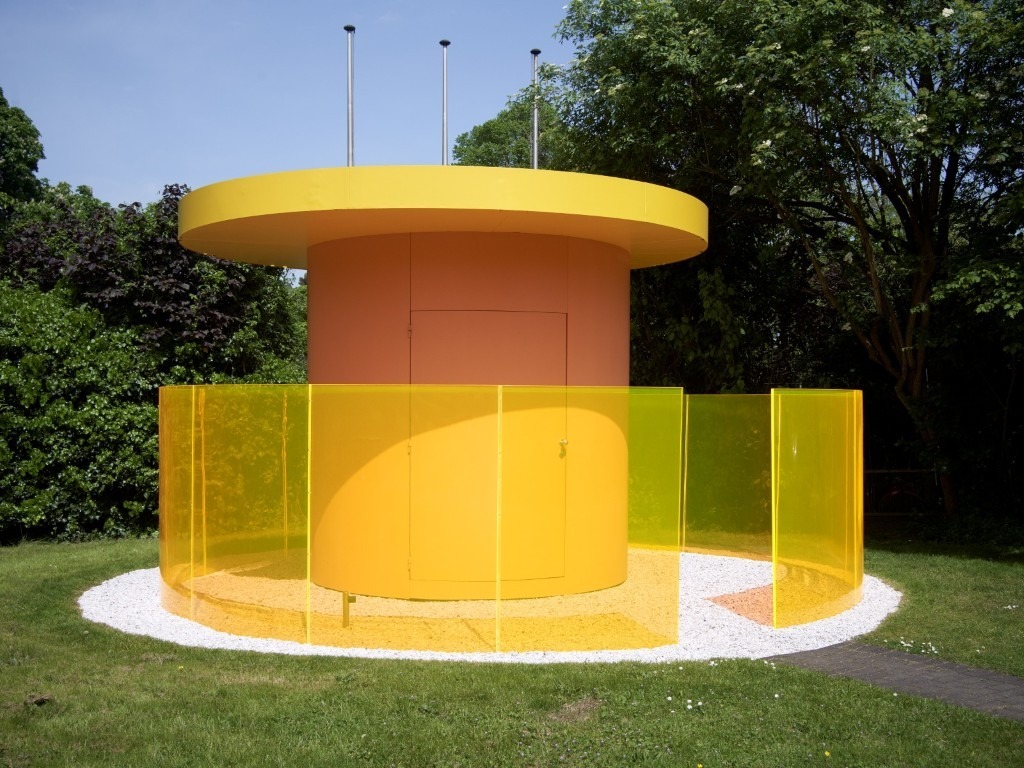
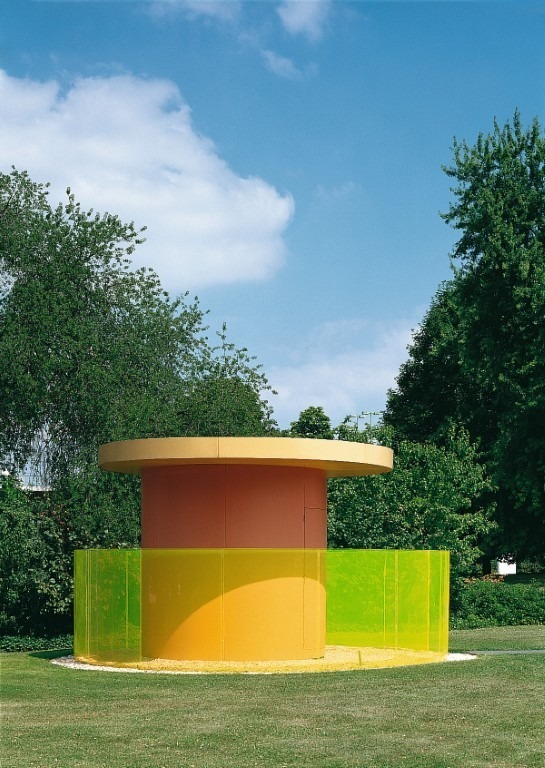
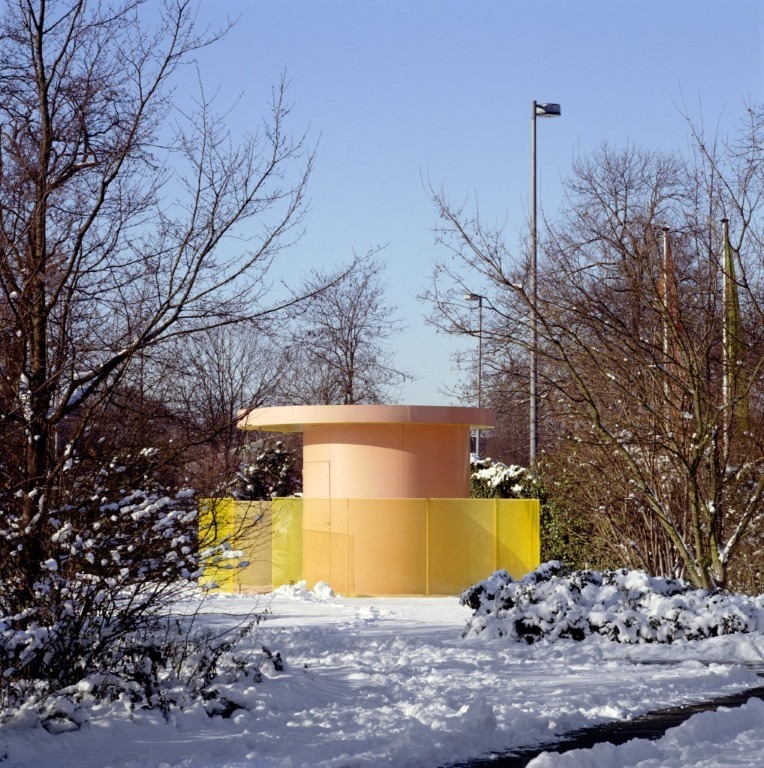
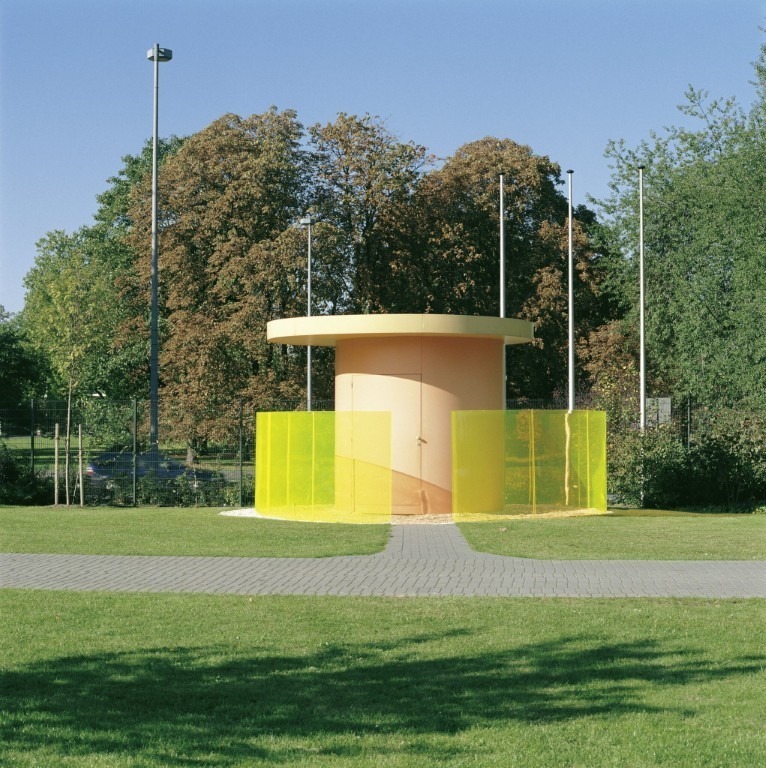
Jorge Pardo: Tomatensuppe, 1997
Plexiglass, iron, lacquer
Deep probing examination of the borders between art and architecture, design and sculpture, the everyday and aesthetic autonomy is characteristic of the work of Jorge Pardo. Living today in Los Angeles and New York, he moves majestically between genres. His objects, installations and pictures seem to be familiar and draw in the viewer, and yet they open up a wide field of associations. Are they readymades, designer objects or architectural sculpture? Pardo calls the nature of his work into question by integrating everyday life into his art in beautiful colours, “very cool, not at all emotional”.
*1975 in Nqutu/South Africa
Participant of KölnSkulptur # 6, 7, 8, 9, 10, 11
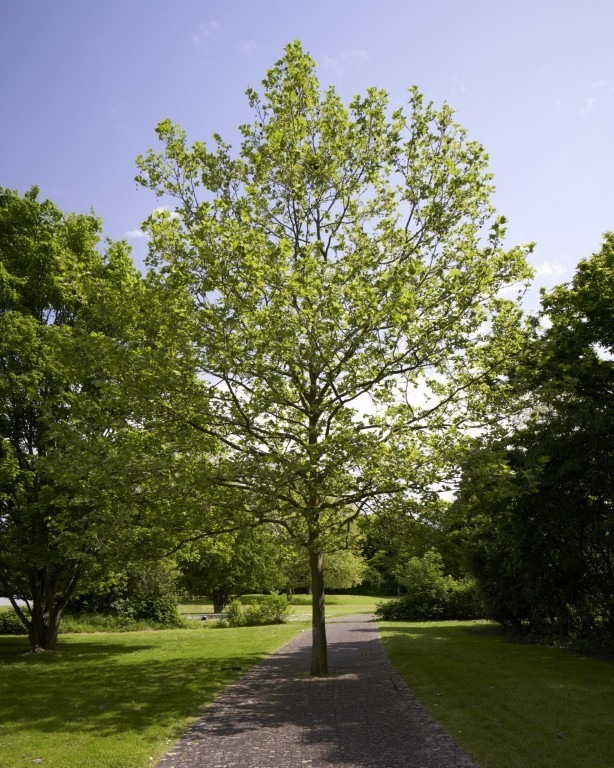
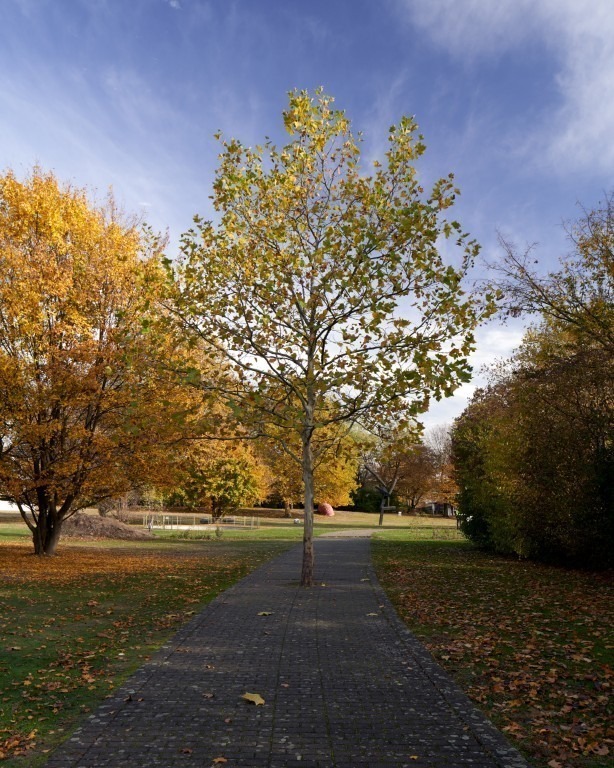
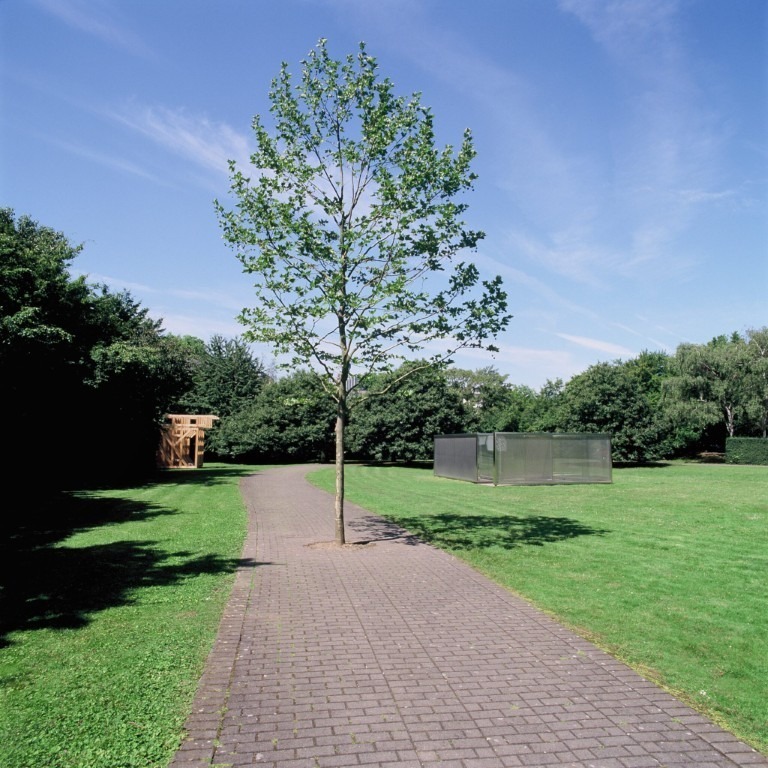
Mandla Reuter: Der Park, 2011
Platanus hispanica
Mandla Reuter has planted a tree in the park and given the work the title The Park. What seems like a tautology is, at a closer look, a depiction that inquires into the origin of the park, whether it or this tree was there first, a tree the visitors encounter in the middle of their path. The plane tree introduces this question à-la-Magritte that queries our perception of reality.
*September 30, 1938 in Düsseldorf/Germany
Participant of KölnSkulptur # 3, 4, 5, 6, 7, 8, 9, 10, 11
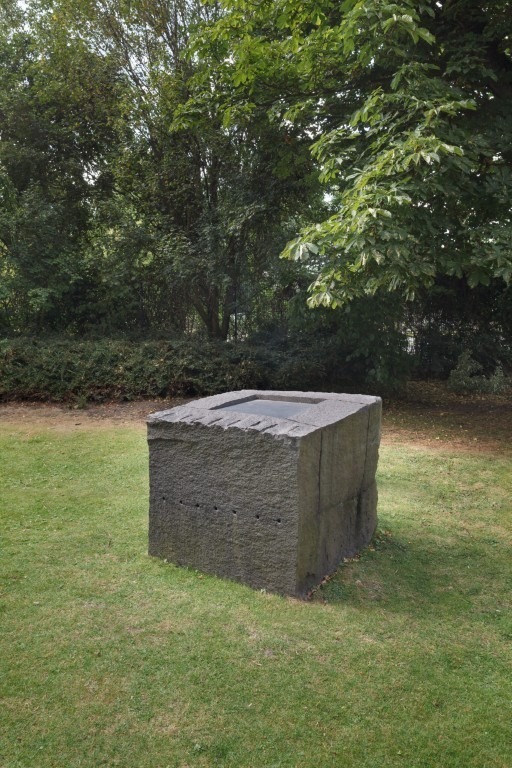
Ulrich Rückriem: Granit, schwarz, Schweden, gespalten, geschnitten, geschliffen, 1986
Ulrich Rückriem can be understood as the sculptor who made the genesis and visual recapitulation of a work component of his sculpture. In this black granite piece, the artist shows all the possible technical methods of production – the splitting, cutting and sanding of the stone – whose volume parts he then fuses together to a block from within whose interior the most elementary geometric form is produced by serial partitioning. His work – represented in the Skulpturenpark Köln by another sculpture out of granite – can be seen as a matrix for conceiving of new creative ways and as a leitmotif for inviting young artists and their innovative artistic conceptions.
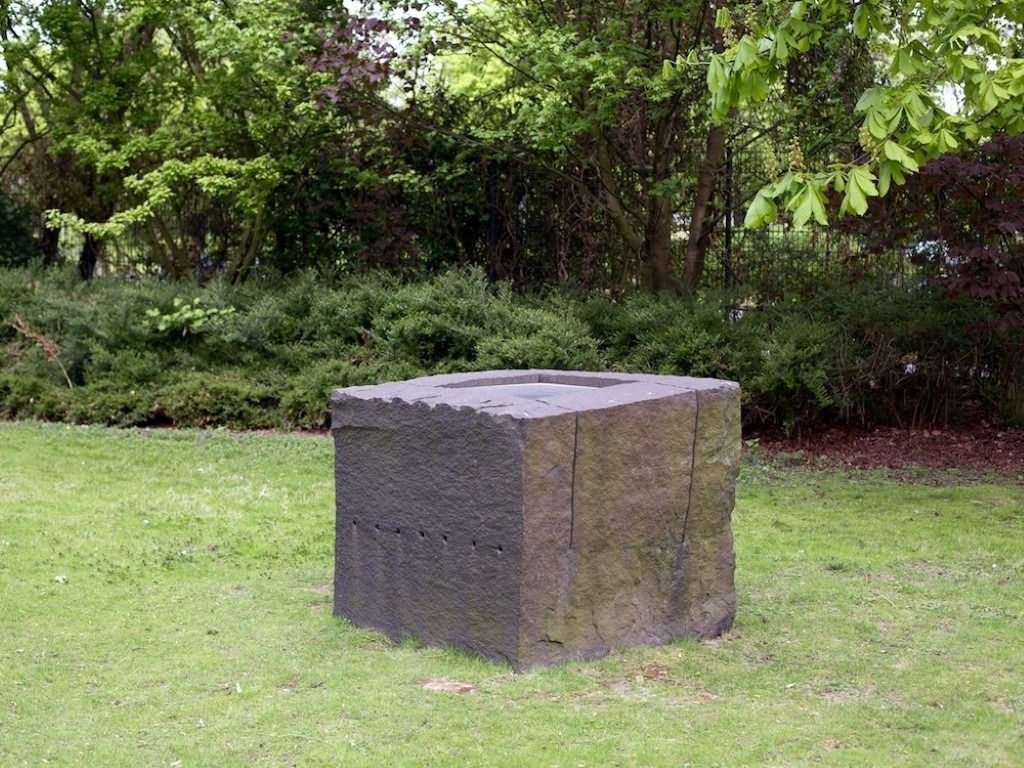
Ulrich Rückriem: Granit, schwarz, Schweden, gespalten, geschnitten, geschliffen, 1986
Ulrich Rückriem can be understood as the sculptor who made the genesis and visual recapitulation of a work component of his sculpture. In this black granite piece, the artist shows all the possible technical methods of production – the splitting, cutting and sanding of the stone – whose volume parts he then fuses together to a block from within whose interior the most elementary geometric form is produced by serial partitioning. His work – represented in the Skulpturenpark Köln by another sculpture out of granite – can be seen as a matrix for conceiving of new creative ways and as a leitmotif for inviting young artists and their innovative artistic conceptions.
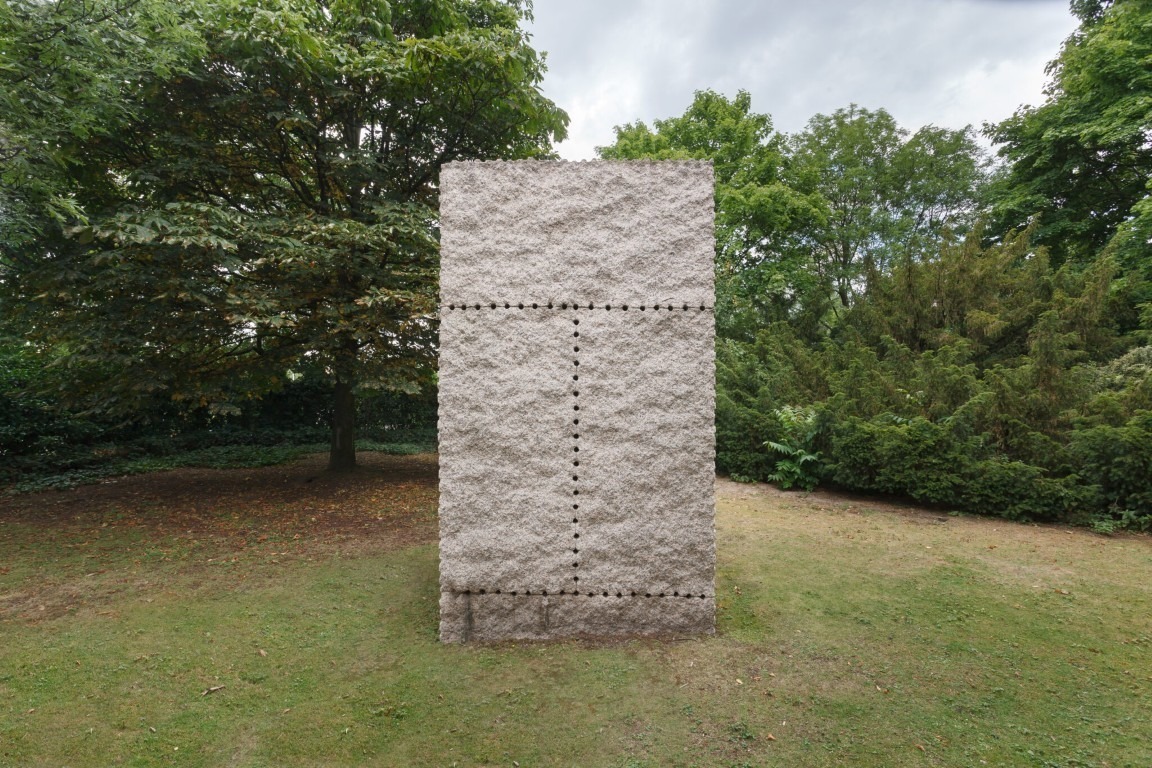
Ulrich Rückriem: Ohne Titel, 2001
Granit (Rosa Porriño)
With 100 solo and numerous important group exhibitions such as documenta, the Venice Biennale or Skulptur Projekte Münster, Ulrich Rückriem counts as one of the most important sculptors in the second half of the 20th century. As far back as the 1960s he was one of the most interesting exponents of Minimalism in Europe. He was a major influence on the development of modern sculpture, in that he turned entirely away from classical subjects and techniques of traditional figurative sculpture to explore the fundamental problems of the genre: size, volume, material and their relationship to the surrounding space.
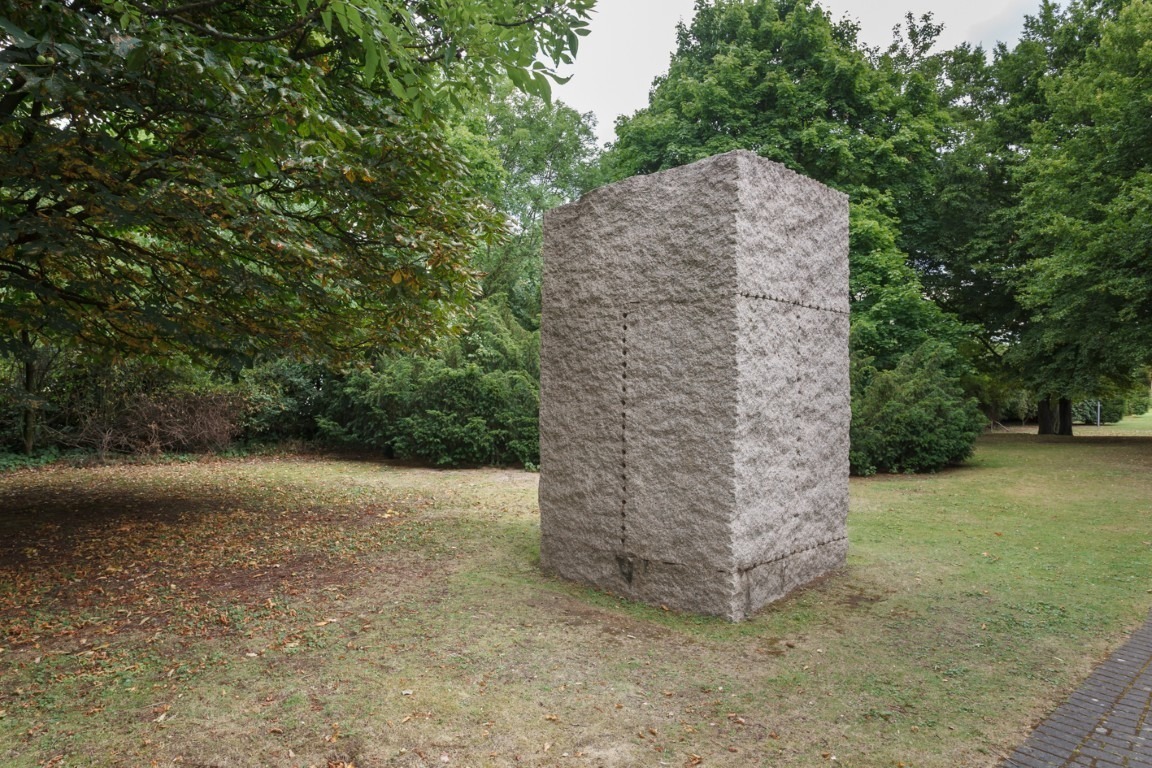
Ulrich Rückriem: Ohne Titel, 2001
Granit (Rosa Porriño)
With 100 solo and numerous important group exhibitions such as documenta, the Venice Biennale or Skulptur Projekte Münster, Ulrich Rückriem counts as one of the most important sculptors in the second half of the 20th century. As far back as the 1960s he was one of the most interesting exponents of Minimalism in Europe. He was a major influence on the development of modern sculpture, in that he turned entirely away from classical subjects and techniques of traditional figurative sculpture to explore the fundamental problems of the genre: size, volume, material and their relationship to the surrounding space.
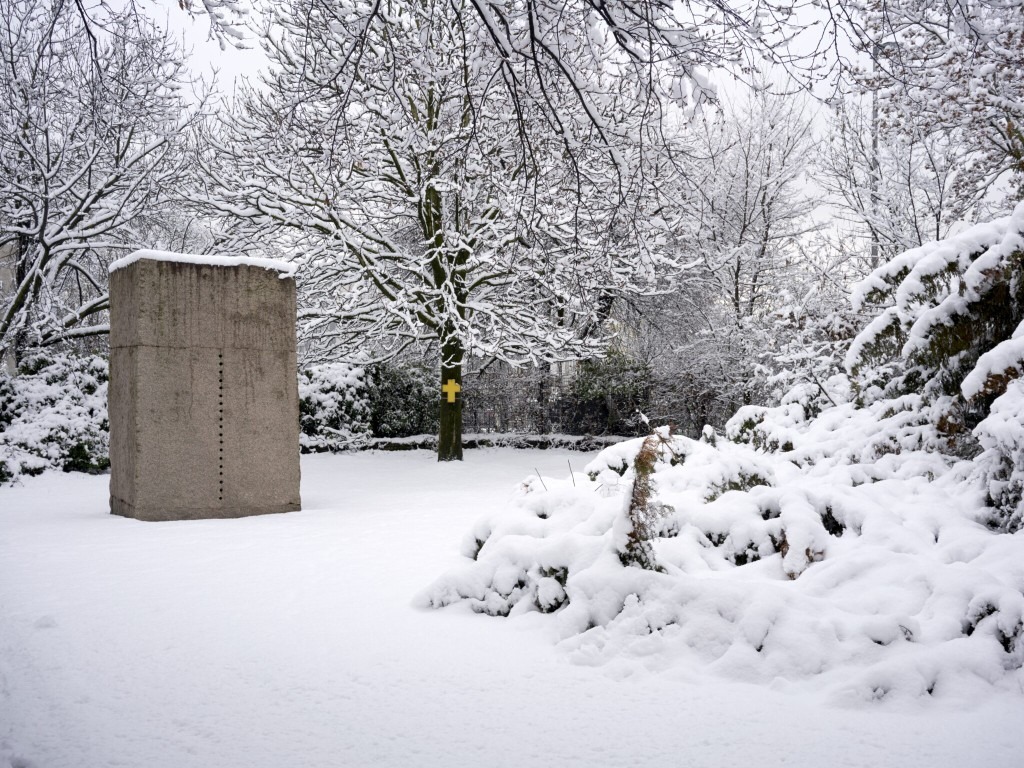
Ulrich Rückriem: Ohne Titel, 2001
Granit (Rosa Porriño)
With 100 solo and numerous important group exhibitions such as documenta, the Venice Biennale or Skulptur Projekte Münster, Ulrich Rückriem counts as one of the most important sculptors in the second half of the 20th century. As far back as the 1960s he was one of the most interesting exponents of Minimalism in Europe. He was a major influence on the development of modern sculpture, in that he turned entirely away from classical subjects and techniques of traditional figurative sculpture to explore the fundamental problems of the genre: size, volume, material and their relationship to the surrounding space.
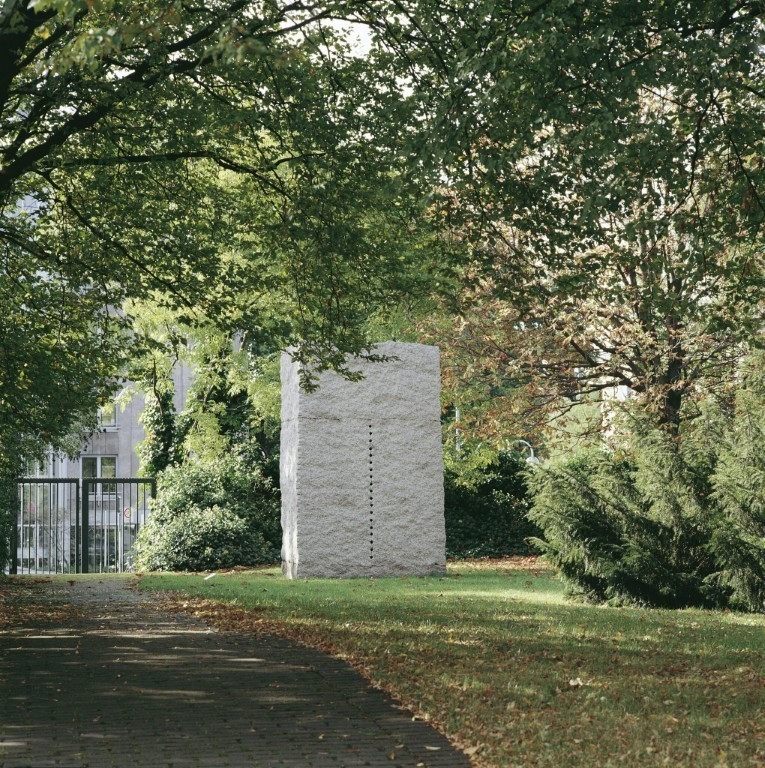
Ulrich Rückriem: Ohne Titel, 2001
Granit (Rosa Porriño)
With 100 solo and numerous important group exhibitions such as documenta, the Venice Biennale or Skulptur Projekte Münster, Ulrich Rückriem counts as one of the most important sculptors in the second half of the 20th century. As far back as the 1960s he was one of the most interesting exponents of Minimalism in Europe. He was a major influence on the development of modern sculpture, in that he turned entirely away from classical subjects and techniques of traditional figurative sculpture to explore the fundamental problems of the genre: size, volume, material and their relationship to the surrounding space.
*January 12, 1979 in Velden/Germany
Participant of KölnSkulptur # 5, 6, 7, 8, 9, 10, 11
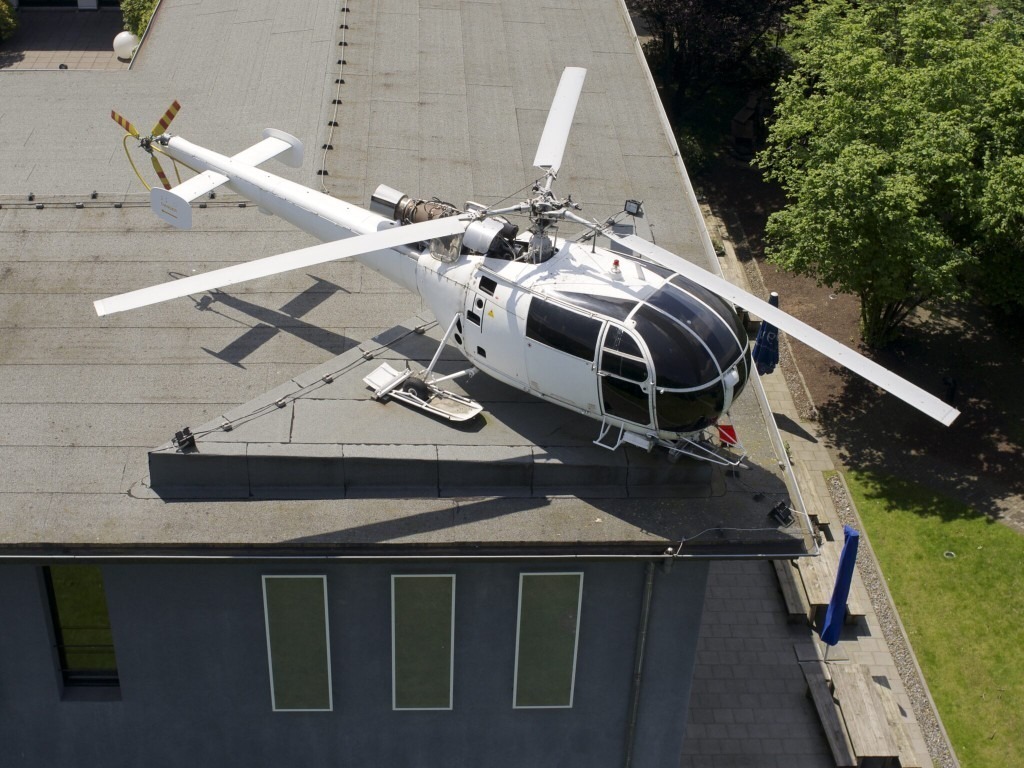
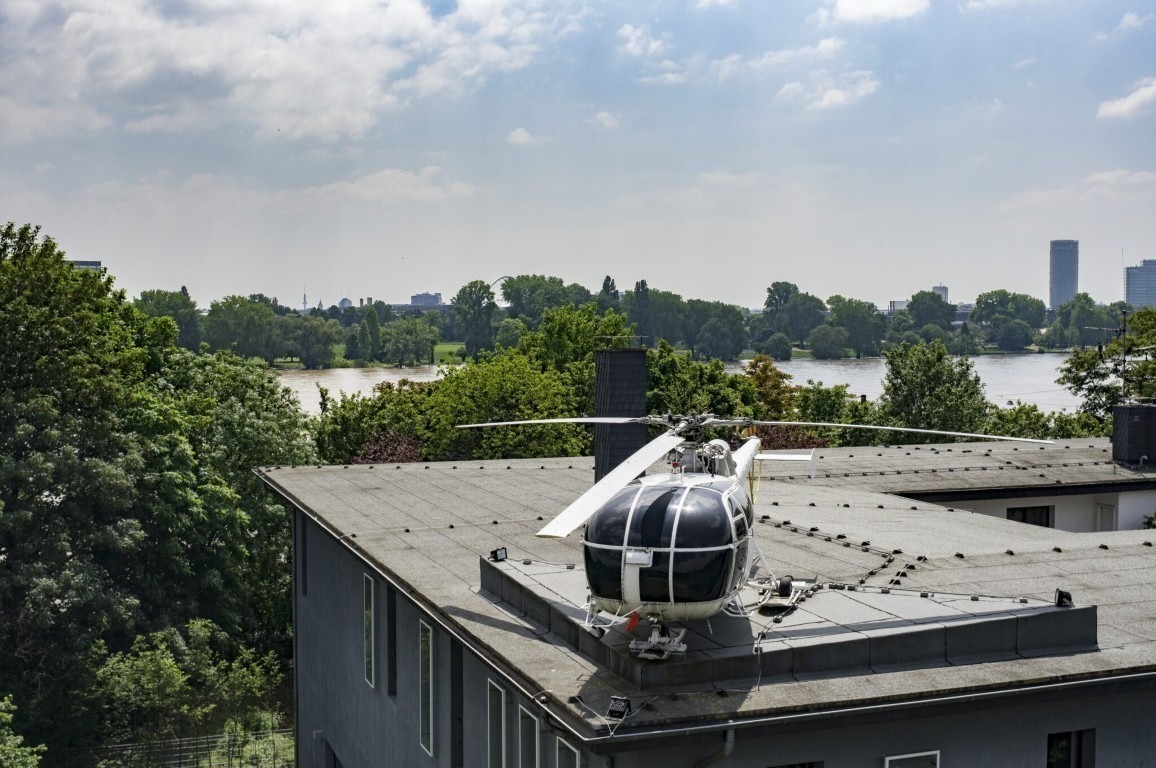
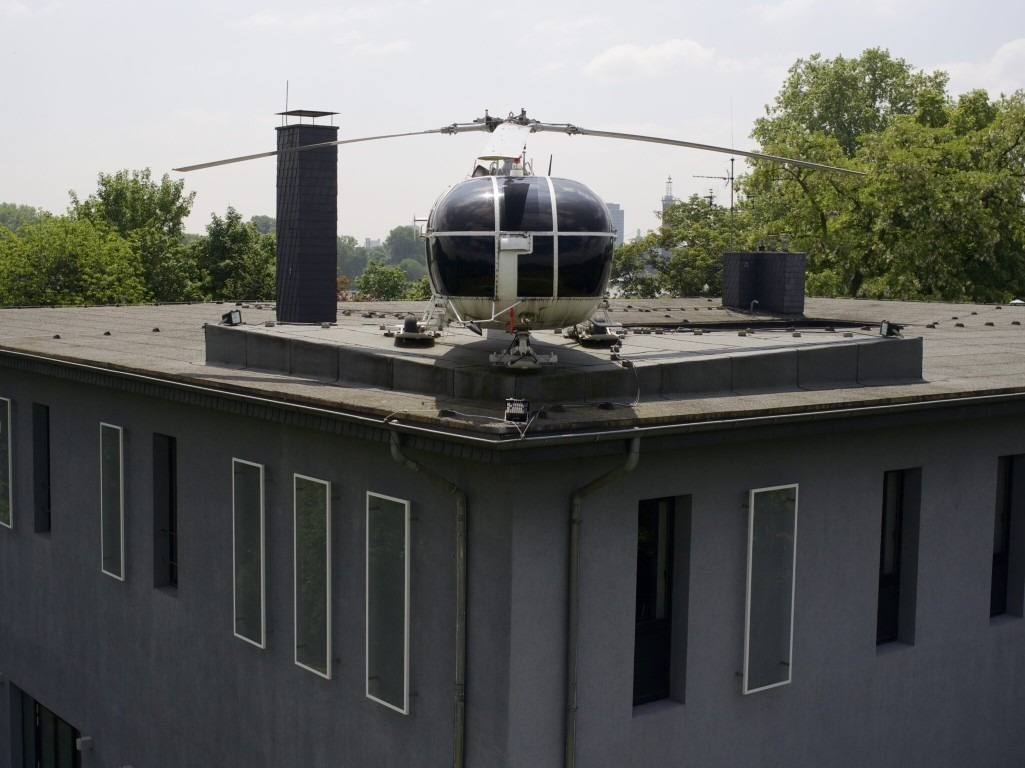
Michael Sailstorfer: Hoher Besuch – Köln, 2009
Helicopter, paint, electric motor
A helicopter has landed on the roof of the main building of the Stiftung Skulpturenpark Köln. Where has the helicopter come from? What is its destination and who is aboard? Hoher Besuch – Köln (High-Ranking Visit – Cologne) is the title of the sculpture by Michael Sailstorfer, a French SE 3160 Alouette 111, with a white outerskin and painted black windows, whose engine has been replaced by a silent electric motor. For special occasions the helicopter’s rotor can be activated and rotates almost noiselessly, as if in a vacuum. The intentional absence of the usual mechanical noises is aimed at forging an atmosphere, which is both filmic and reminiscent of silent flashbacks or dreams. It alienates the observer by evoking an “elsewhere”, which paradoxically is clearly located in present. As with many of the works by Michael Sailstorfer, Hoher Besuch is in a state of indeterminacy. The sculpture exploits the elemental feeling of insecurity underpinning so many of life’s so-called significant events, and directs our focus at the flowing, permanent transition to which all things are irrevocably subject.
*1957 in Bensberg/Germany
Participant of KölnSkulptur # 7, 8, 9, 10, 11
*16 November 1954 in Oldenburg/Germany
Participant of KölnSkulptur # 6, 7, 8, 9, 10, 11
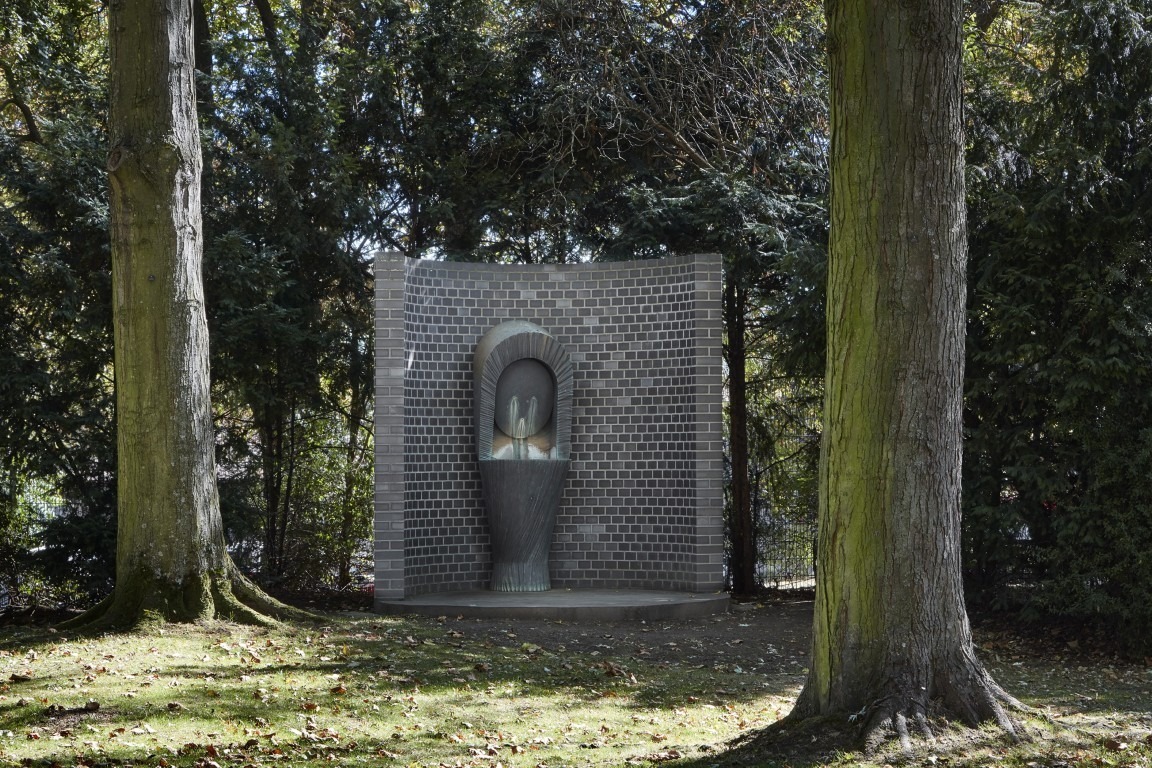
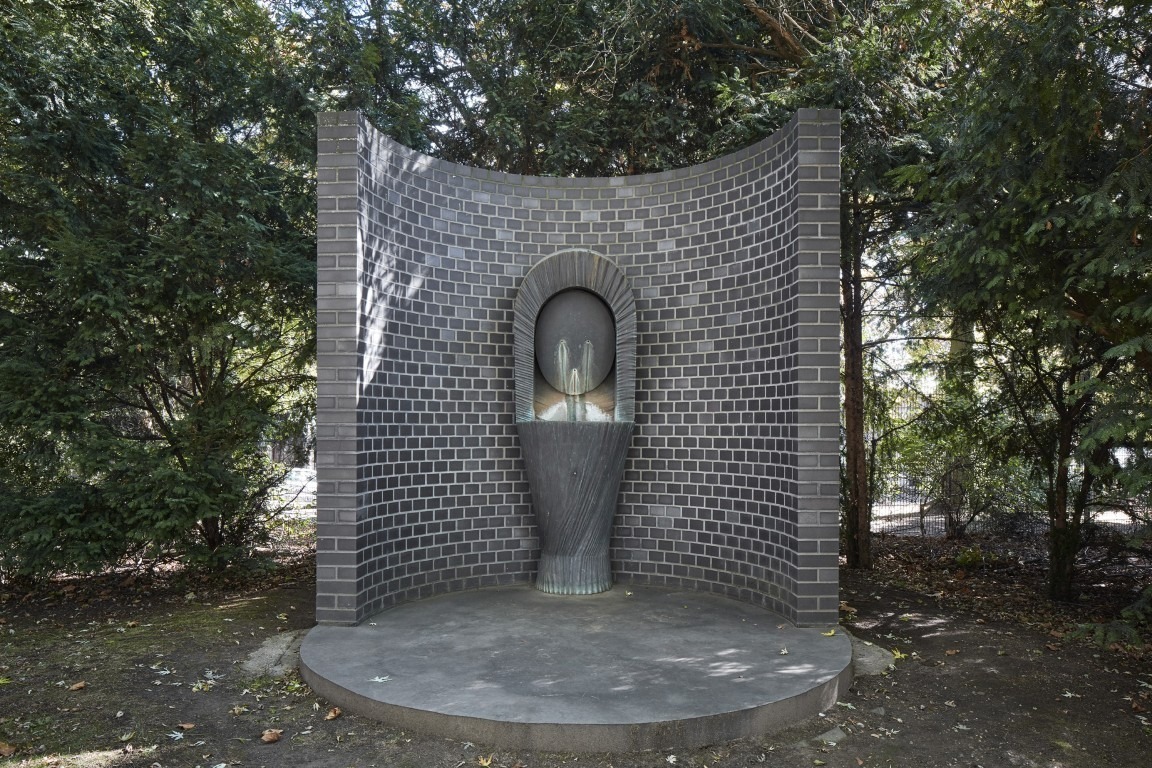
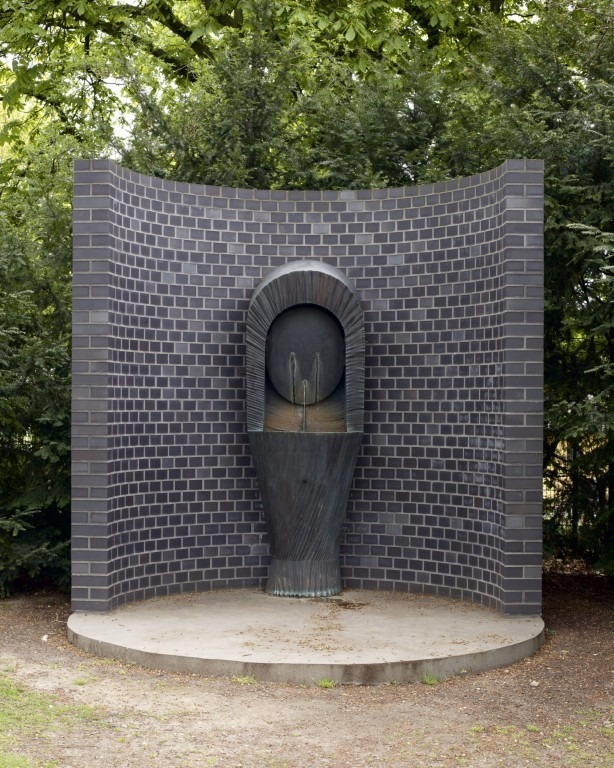
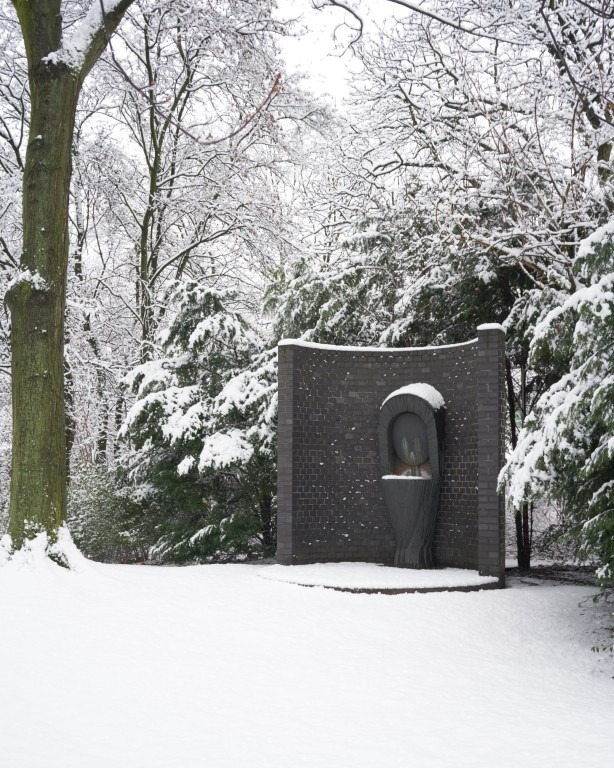
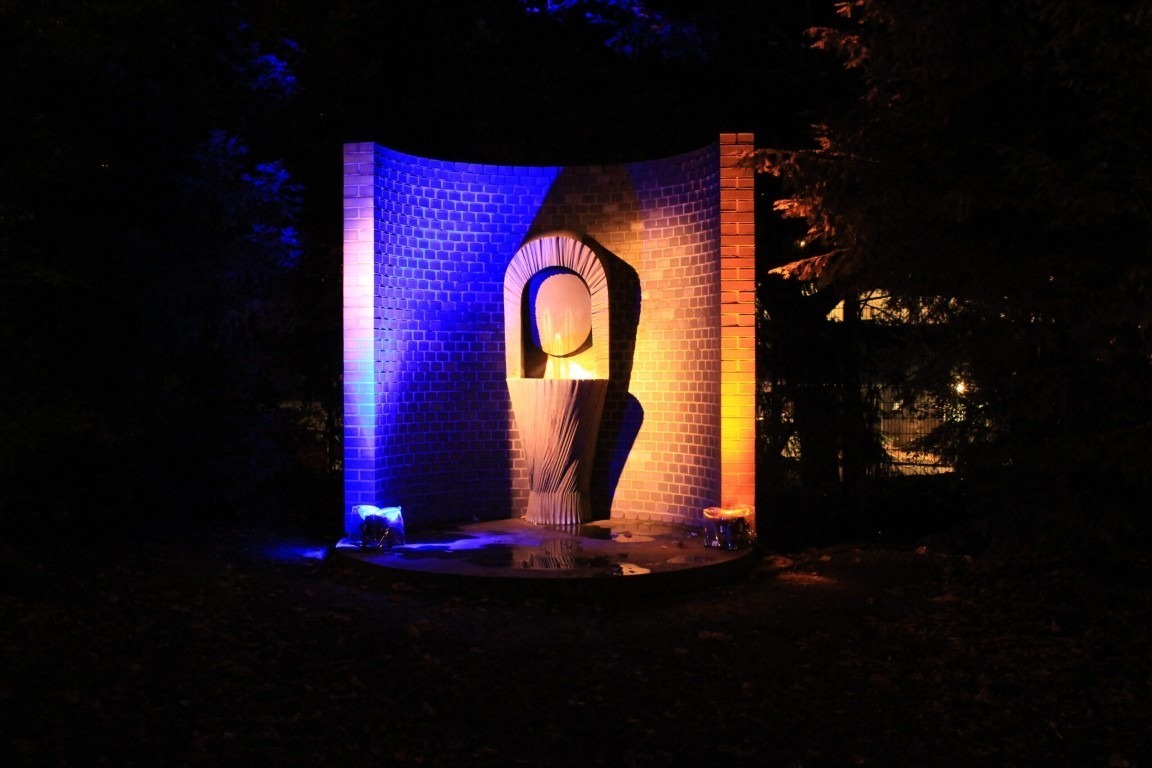
Thomas Schütte: Weinende Frau, 2011
Bronze, aeruginous, bricks
The bronze sculpture Weinende Frau is at the same time a fountain that was created for this site, rather the site with its brickwork was created for this relief. On a small knoll in a sheltered corner of the park, the visitor is confronted with the motif of a very private situation: weeping. We can think of this fountain figure — out of whose mouth water also streams — as a water dispenser and her abstract physiognomy as the theme of the cardinal humour of melancholy that the visitor encounters on his walk through the park.
*1959 in Meppen/Germany
Participant of KölnSkulptur # 4, 5, 6, 7, 8, 9, 10, 11
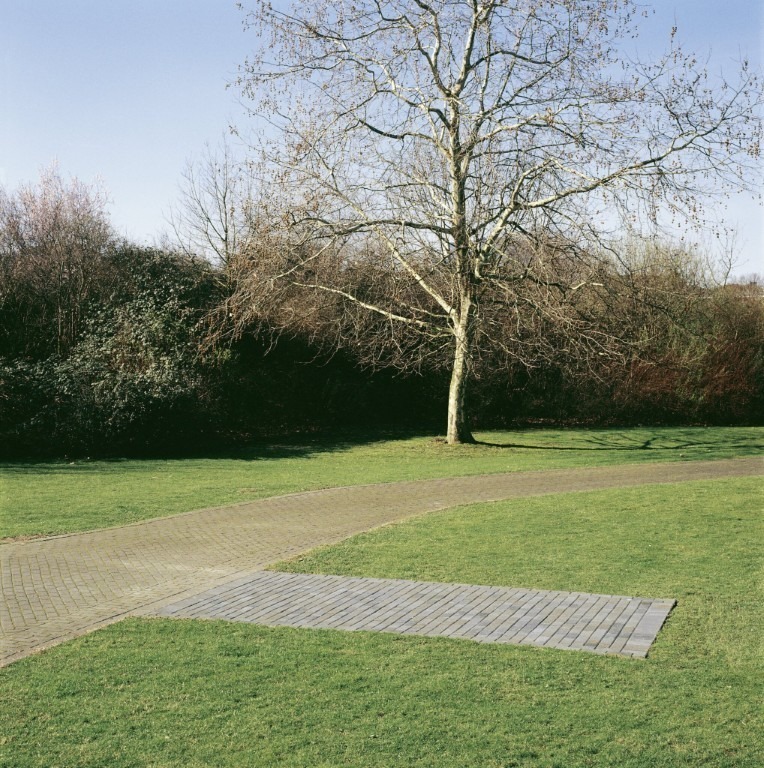
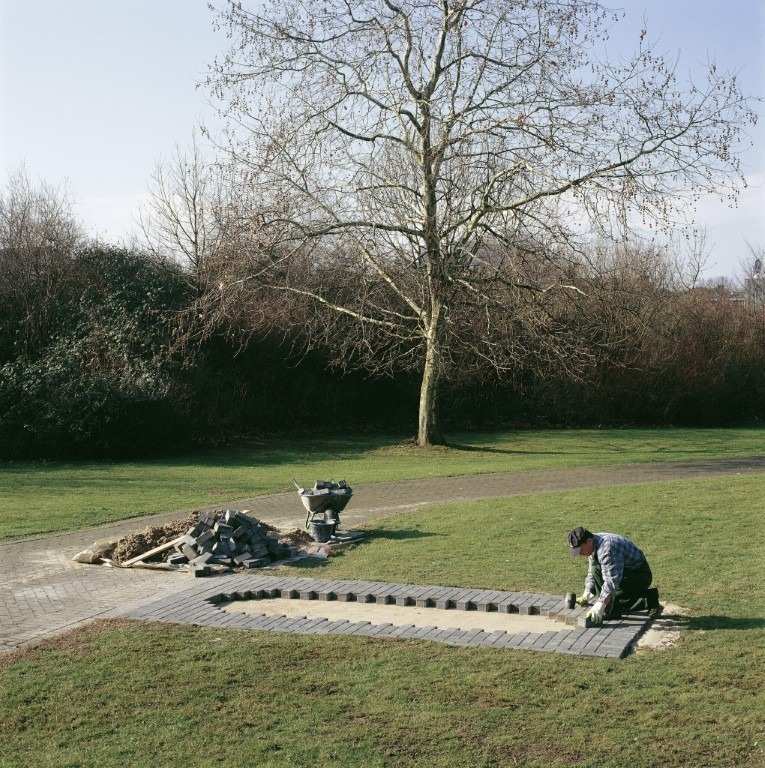
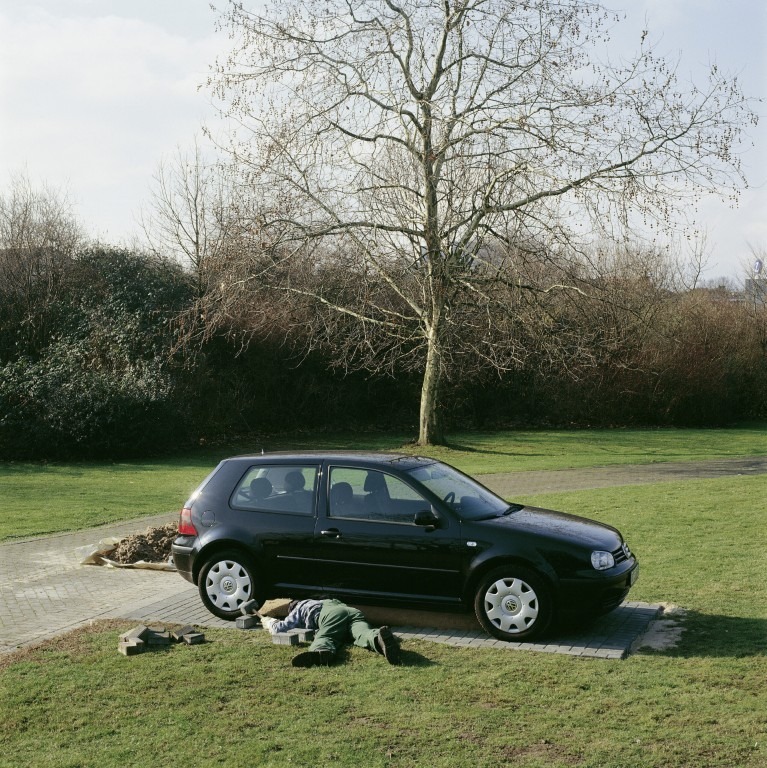
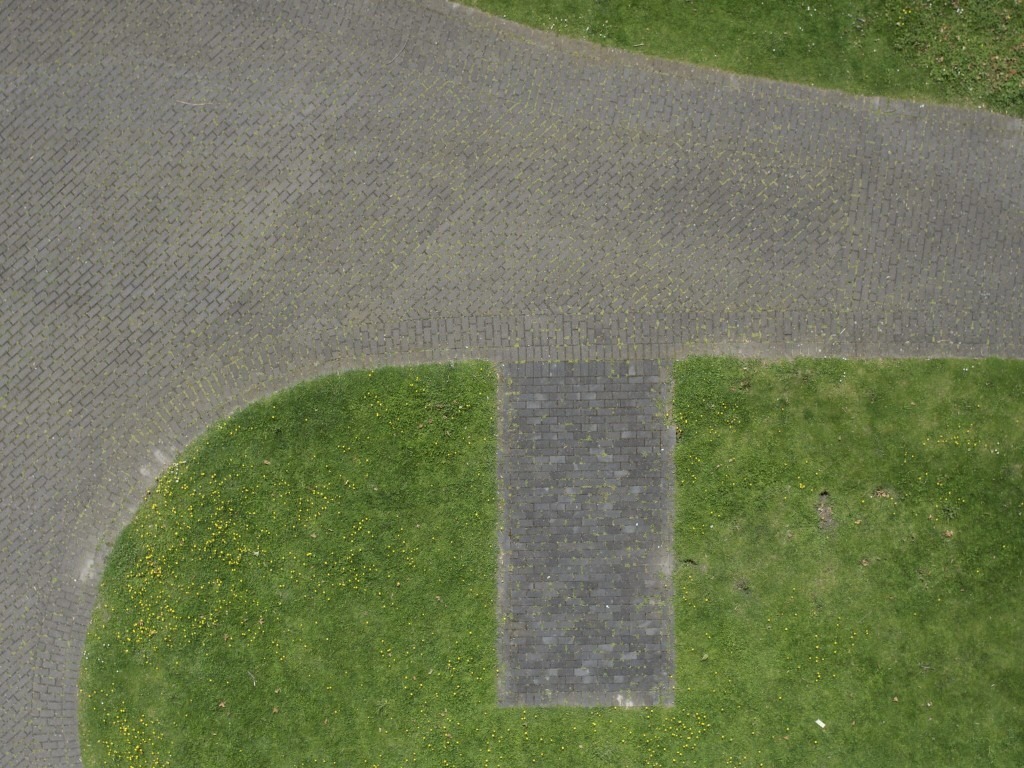
Andreas Slominski: Der Parkplatz, 2007
Cobblestones, sand
Why are things as they are? This question leads us directly to Andreas Slominski’s Der Parkplatz. The economy of means that is evident here was already characteristic of earlier works by the artist, who has twice participated in the Venice Biennale. Now comes this cunningly simple Der Parkplatz, almost crazy, given the elaborate working process it involved. For the paving was first only laid round the edges, and was then completed by a workman lying under the car. But the absurdity of the relationship of his works – such as Tierfallen – to their titles, ultimately leads to the question, “What is art?” The same question as is posed – not without irony – by his installations and performances.
*February 11, 1937 in Volterra/Italy
†January 1, 2018 in Milan/Italy
Participant of KölnSkulptur # 2, 3, 4, 5, 6, 7, 8, 9, 10, 11
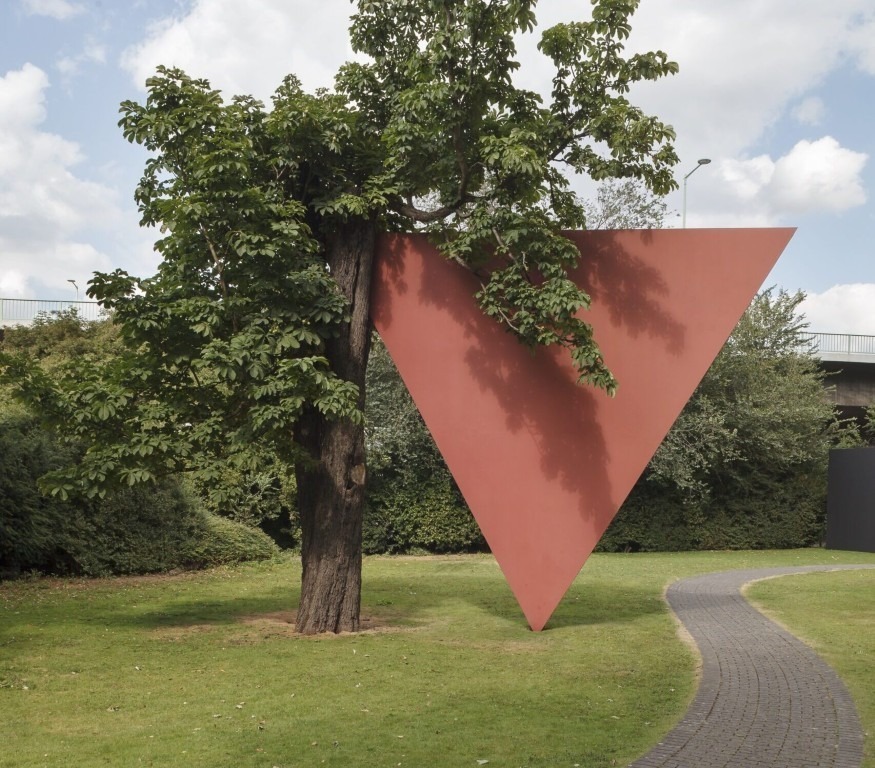
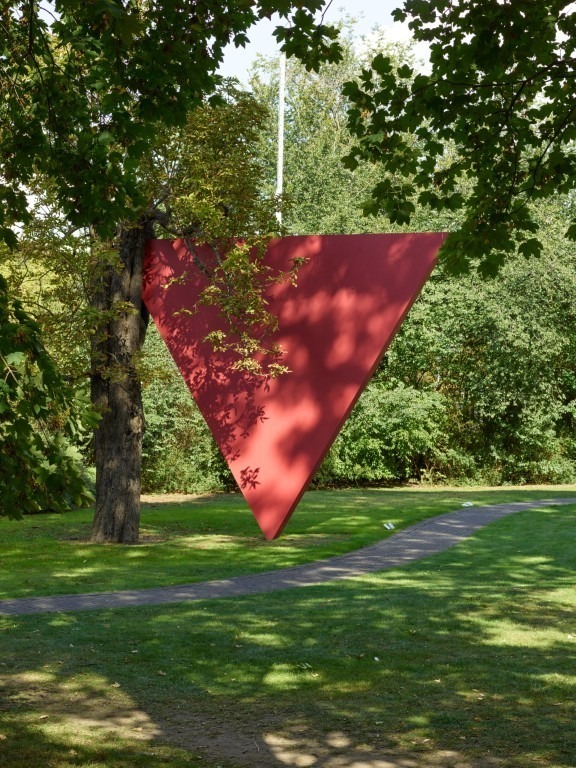
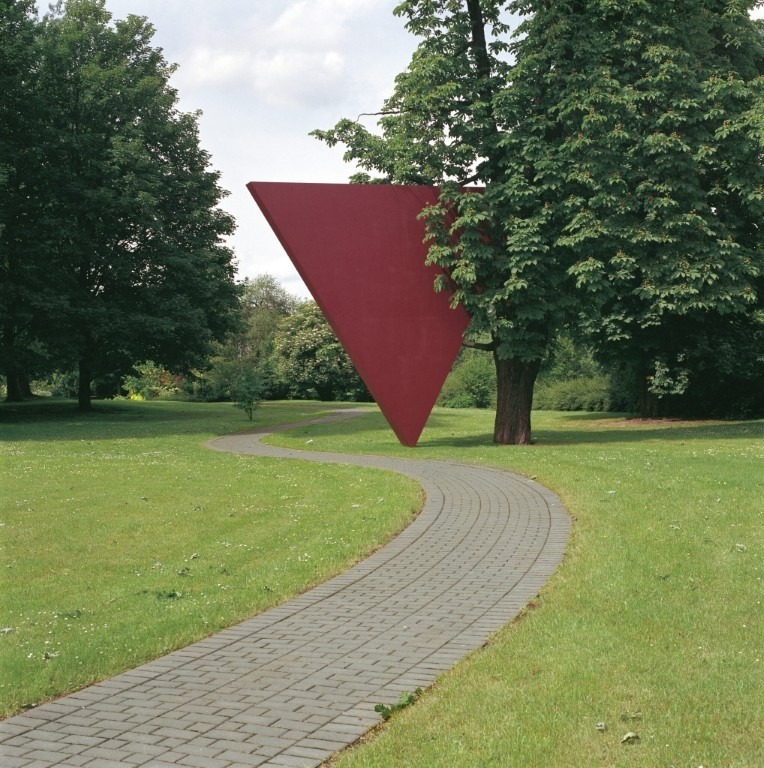
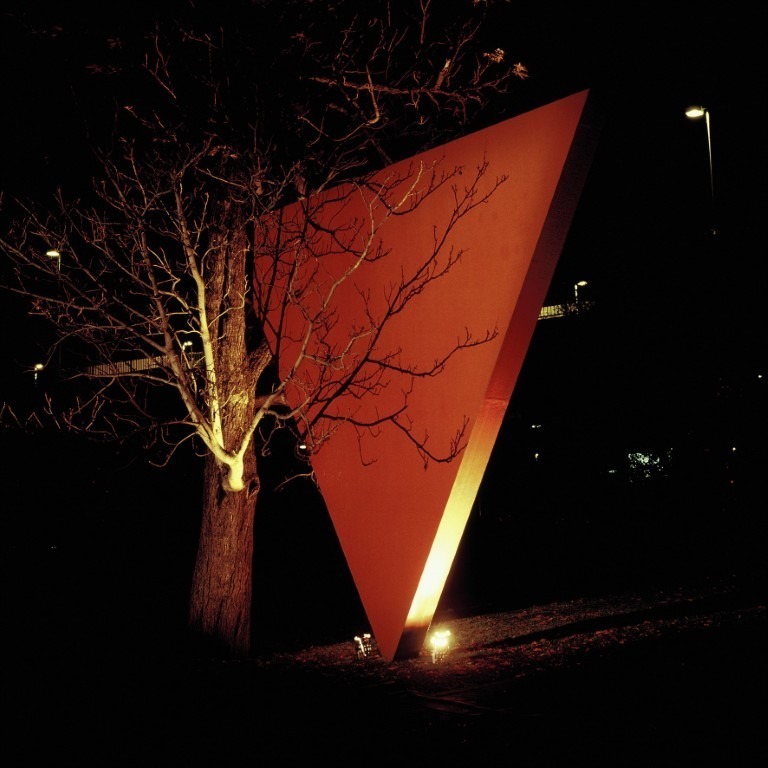
Mauro Staccioli: Untitled, 1999
Steel, painted
Mauro Staccioli has been working as a sculptor since 1968. His formal language can be described as Minimalist, but in contradistinction to Minimalism’s concentration on material and form, Staccioli includes the spatial context of his sculpture in the creative process as an aspect of his work that has equal validity. In consequence he has developed a working method which is mainly dependent on the site. For this reason his works have less of the stringency of Minimal Art’s objective investigation of the material. They incorporate a subjective interpretation of the spatial situation while retaining all Minimalism’s clarity of form.
*18 September 1933 in Shanghai/China
Participant of KölnSkulptur # 2, 3, 4, 5, 6, 7, 8, 9, 10, 11
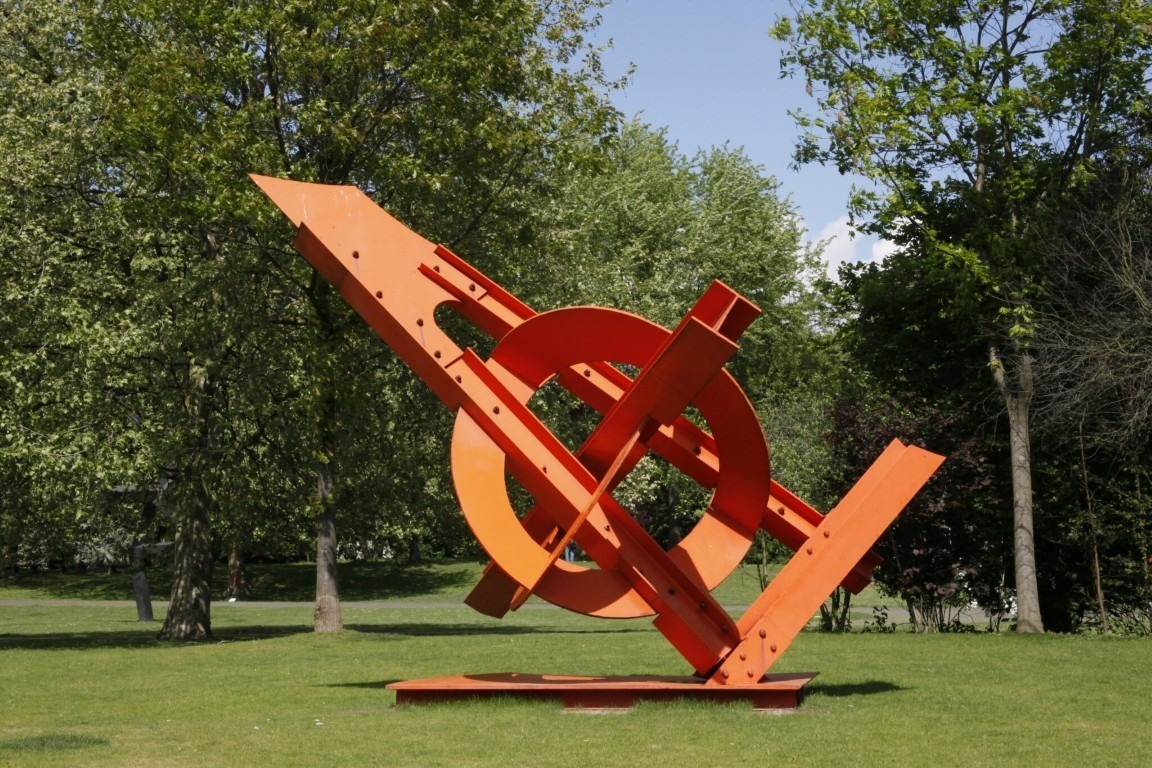
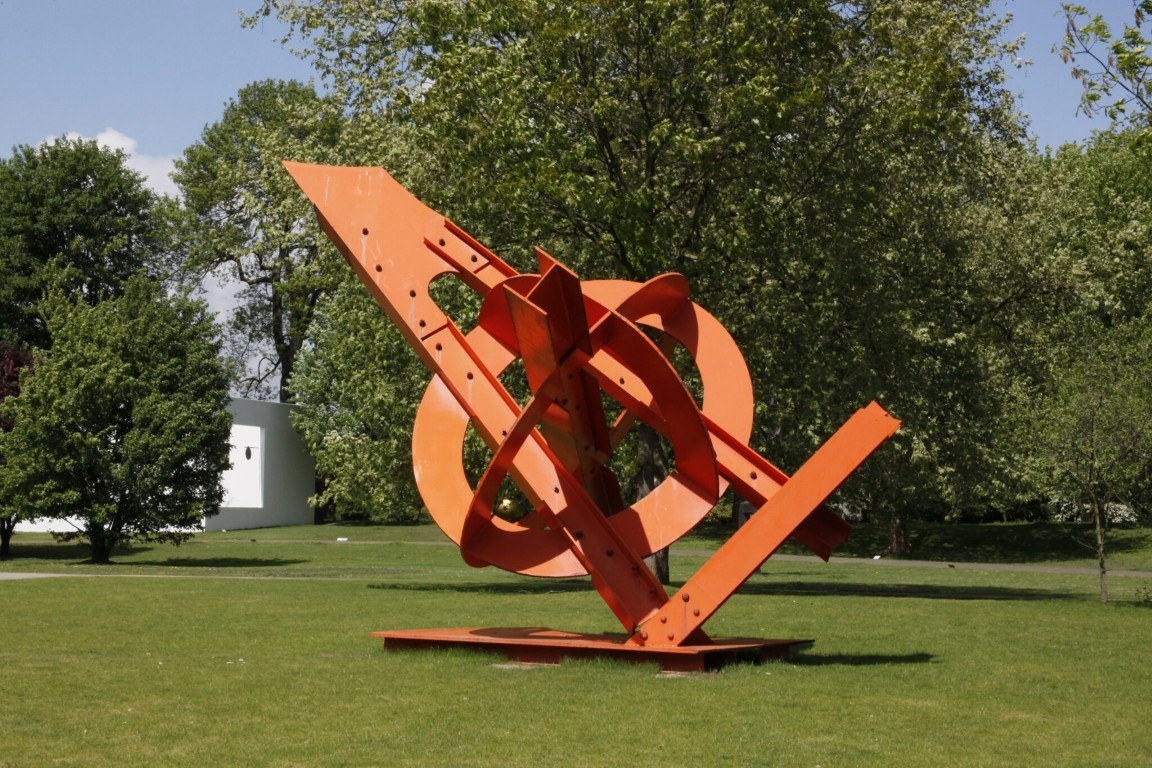
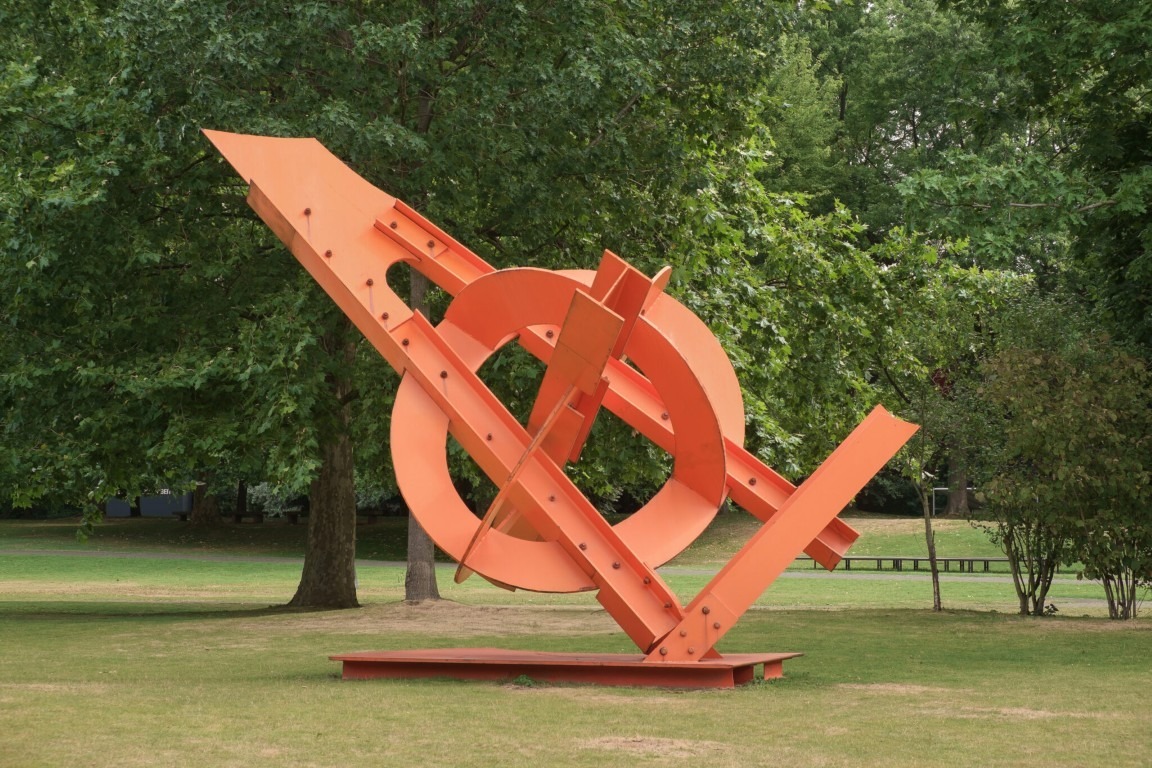
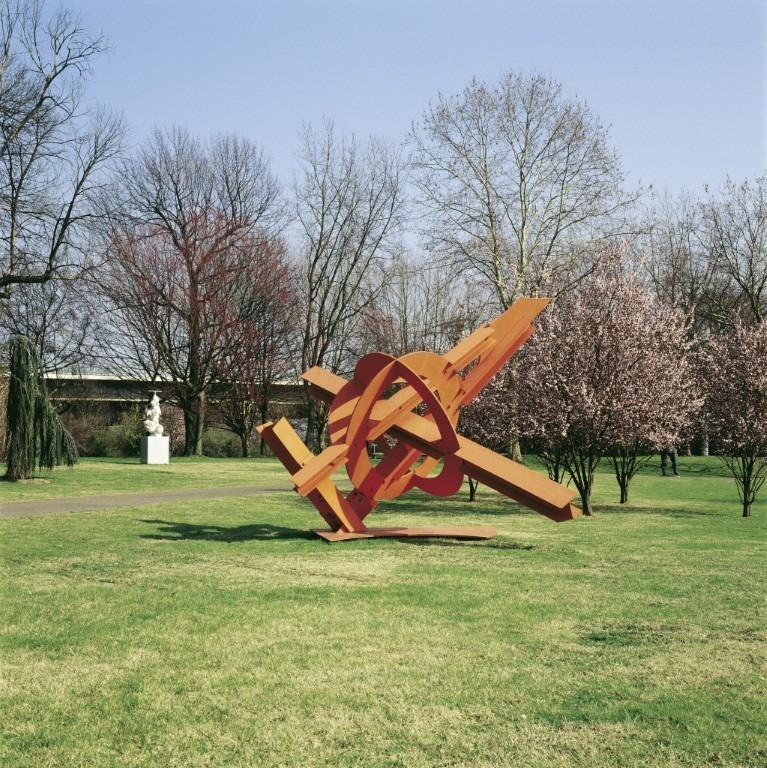
Mark di Suvero: Racine du Naos, 1996
Steel, lacquered
While his wooden sculptures in the late 1950s were still influenced by constructivism, Mark di Suvero began from 1964 to make expressive, space-filling outdoor sculptures from steel joists and other steel components. In spite of the weight of their materiality, his works communicate a spatial dynamism in which Kinetic Art and Abstract Expressionism seem to merge. The works of Mark di Suvero are represented in the collections of the most important international museums, and with more than 100 large-scale sculptures in public spaces all over the world, his work, as no other, represents the face of Abstract Expressionist sculpture.
*13 November 1952 in Schwerte/Germany
Participant of KölnSkulptur # 1, 2, 3, 4, 5, 6, 7, 8, 9, 10, 11
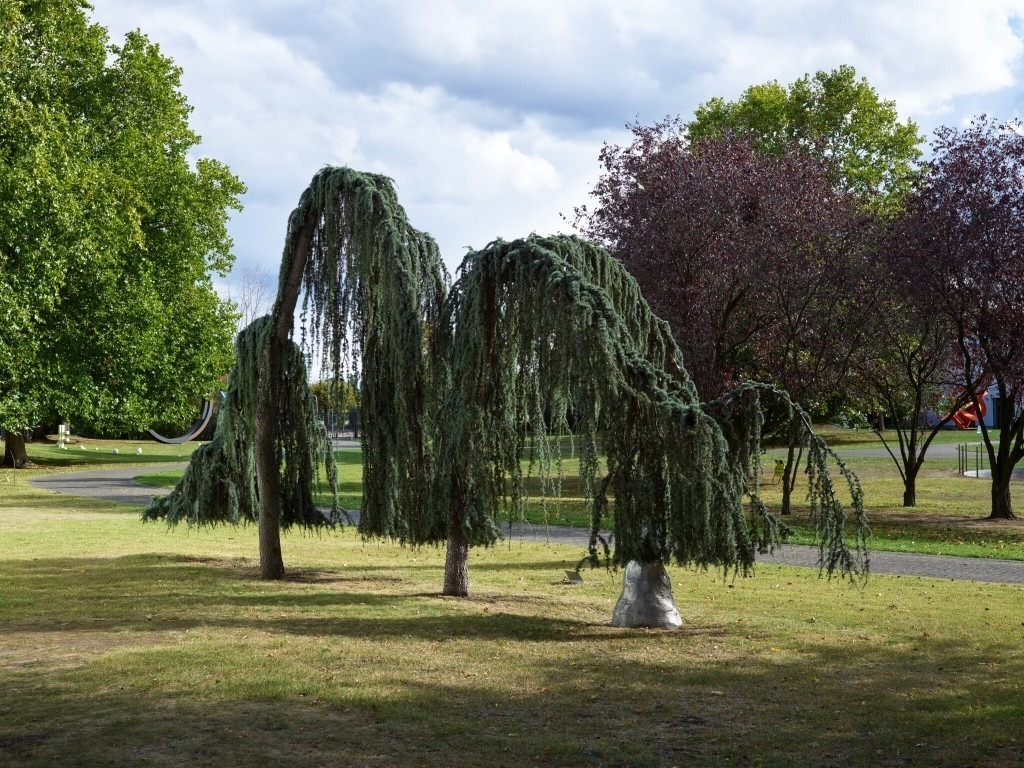
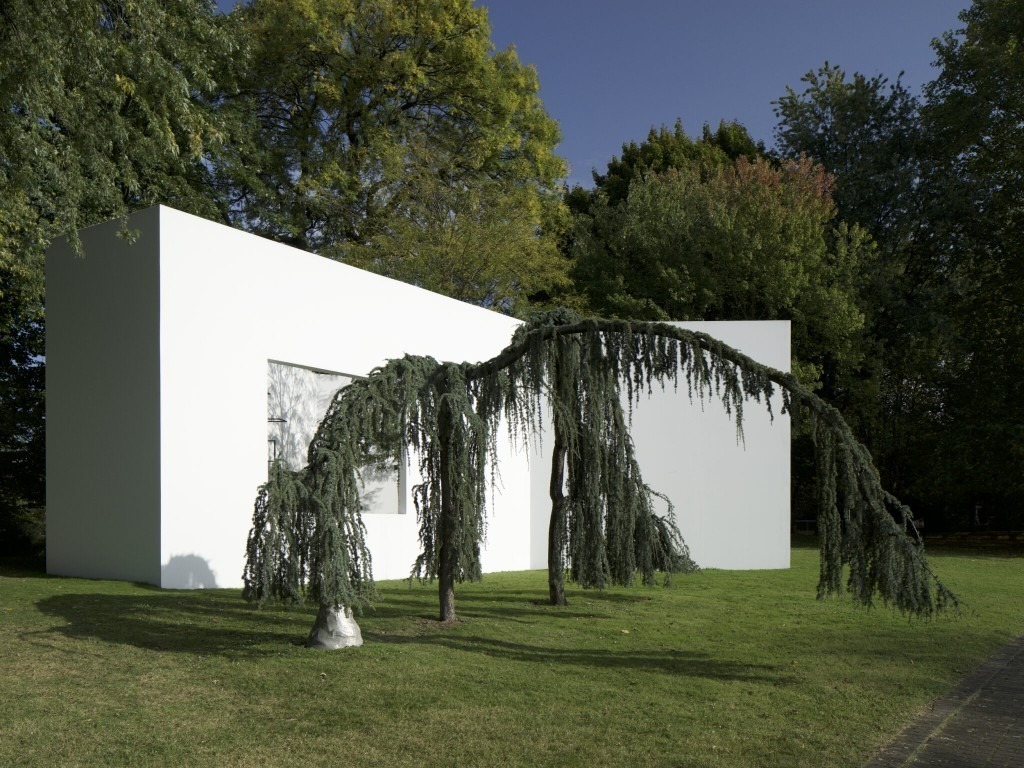
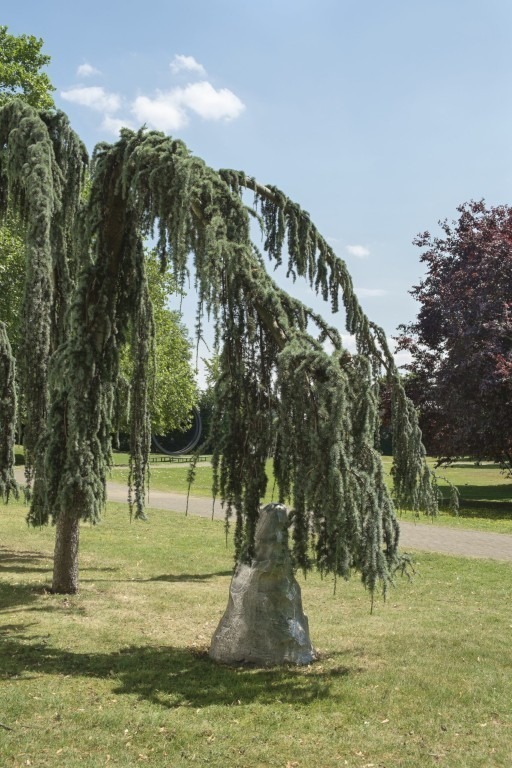
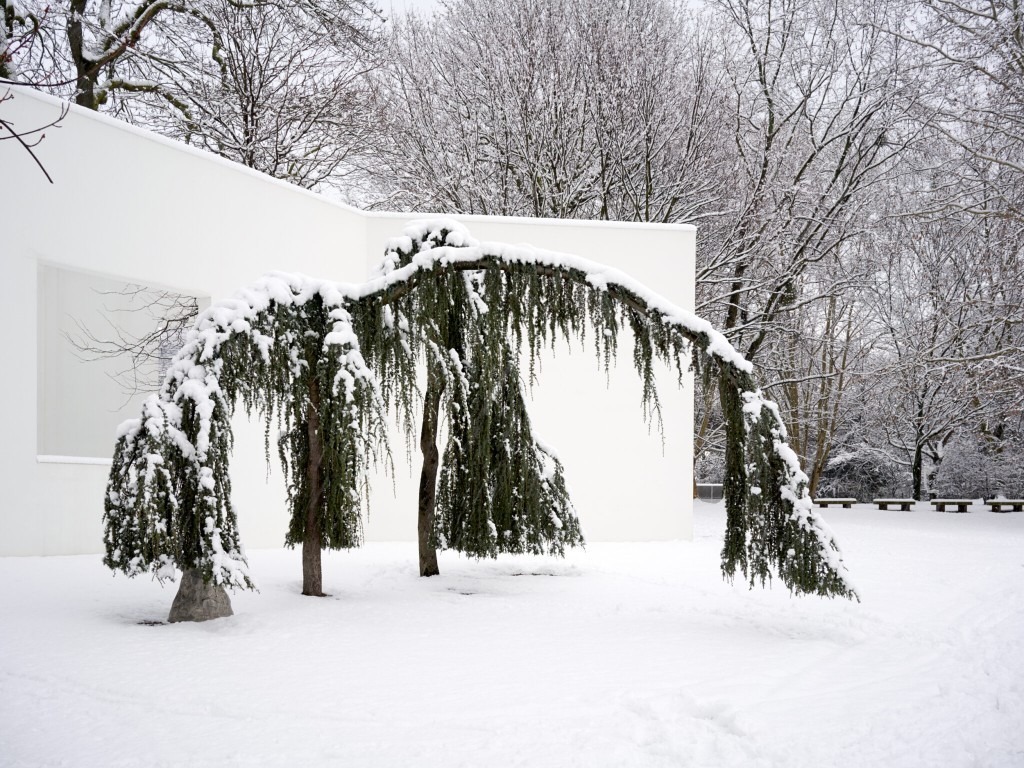
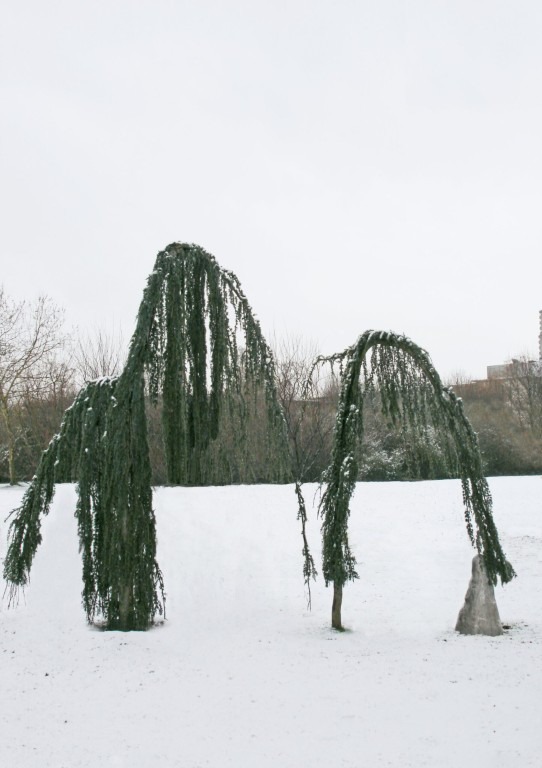
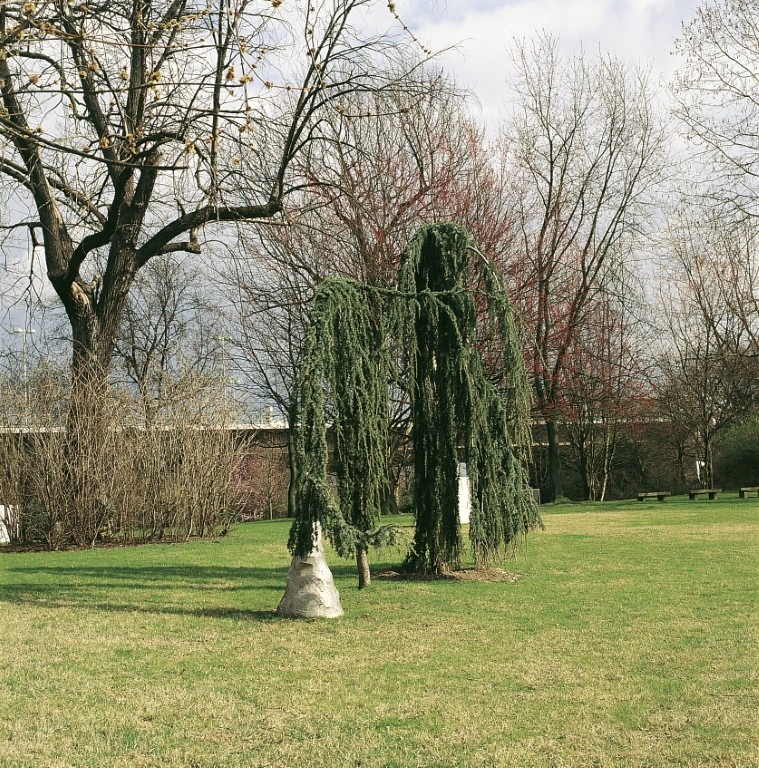
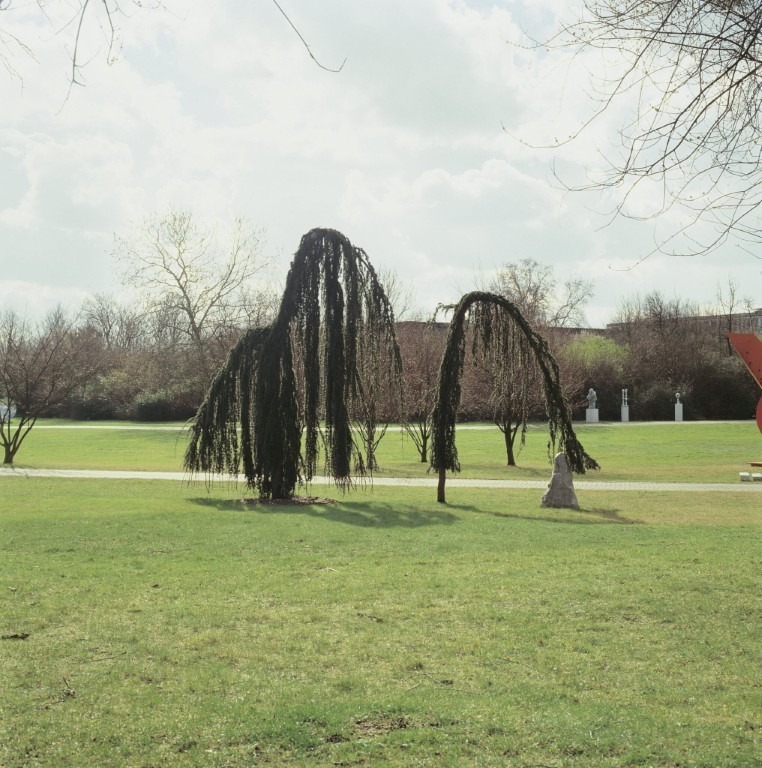
Rosemarie Trockel: L’Arc de Triomphe (Der armselige Baum/Die Zuwenignis), 2006
Two hanging Atlas-cedars (Cedrus atlantica Glauca pendula), aluminum
With her pictures, drawings and small sculptures, as well as with large sculptures and objects, installations and video works, which she puts together in exhibitions to form comprehensive conceptions the artist is pursuing strategies that cross the frontiers between mediums. Conflicting elements, such as (living) trees and a (dead) metal nose, Trockel integrates spatially and as a matter of content into a disturbing ensemble. The erotic connotations, allusions to the plight of the modern artist, the ironic, whimsical combination of sculpture and garden art – L’Arc de Triomphe goes far beyond levelling the threshold between nature and art.
*8 May 1957 in Cologne/Germany
†6 March 2006 in Hürth/Germany
Participant of KölnSkulptur # 2, 3, 4, 5, 6, 7, 8, 9, 10, 11
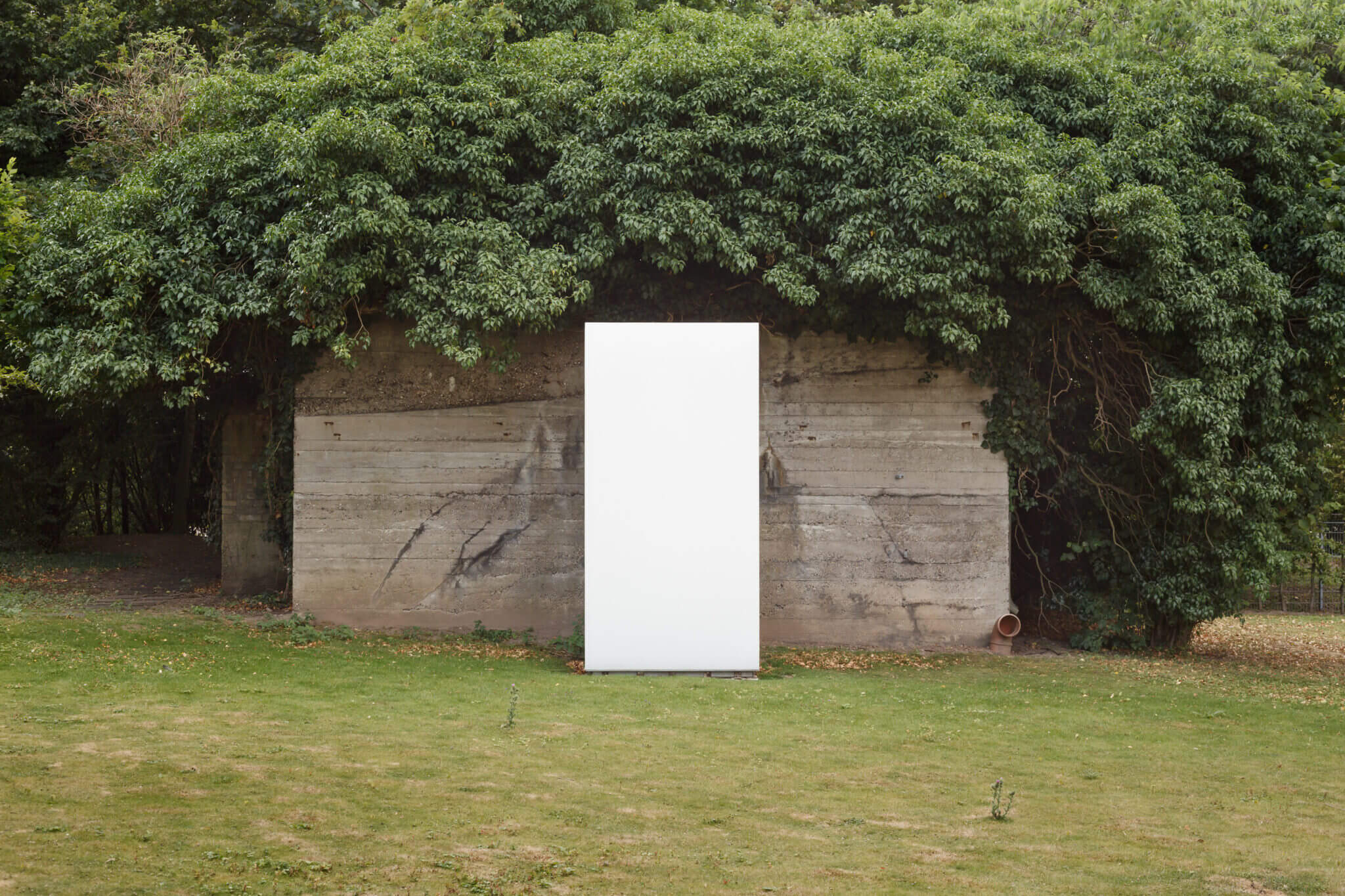
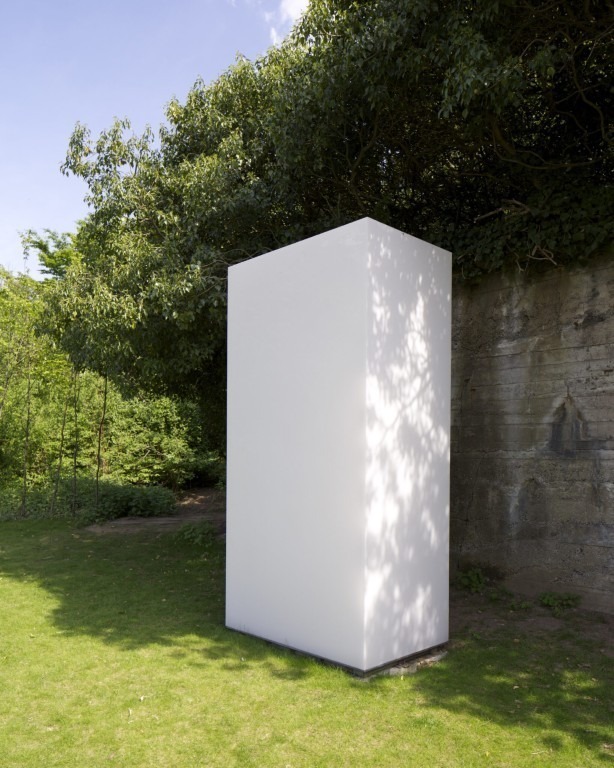
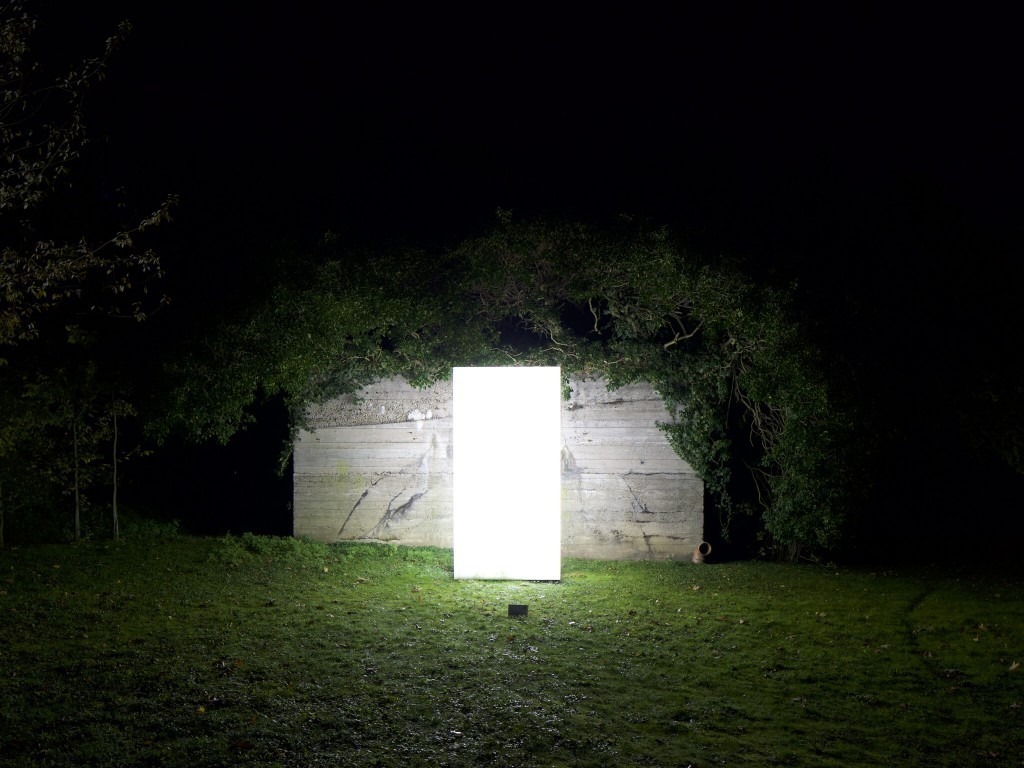
Simon Ungers: Monolith, 1999
Plexiglass, steel, fluorescent tubes
Simon Ungers studied architecture at Cornell University from 1975 to 1980 in Ithaca, New York. He became known internationally as an architect when he built the T-House (in collaboration with Tom Kinslow), a private house with a sculptural feel made of Corten steel, and the Cube-House, made of concrete blocks. As an artist he specialised in Minimalist (light) installations and sculptures, which were built giving due consideration to the site. In 1995 he won the competition for the Holocaust Monument in Berlin (design remains unbuilt). Ungers was on the teaching staff at Harvard University, Cornell University and the University of Maryland. He lived and worked in New York and Cologne.
*20 April 1941 in Château-Arnoux/France
Participant of KölnSkulptur # 1, 3, 4, 5, 6, 7, 8, 9, 10, 11
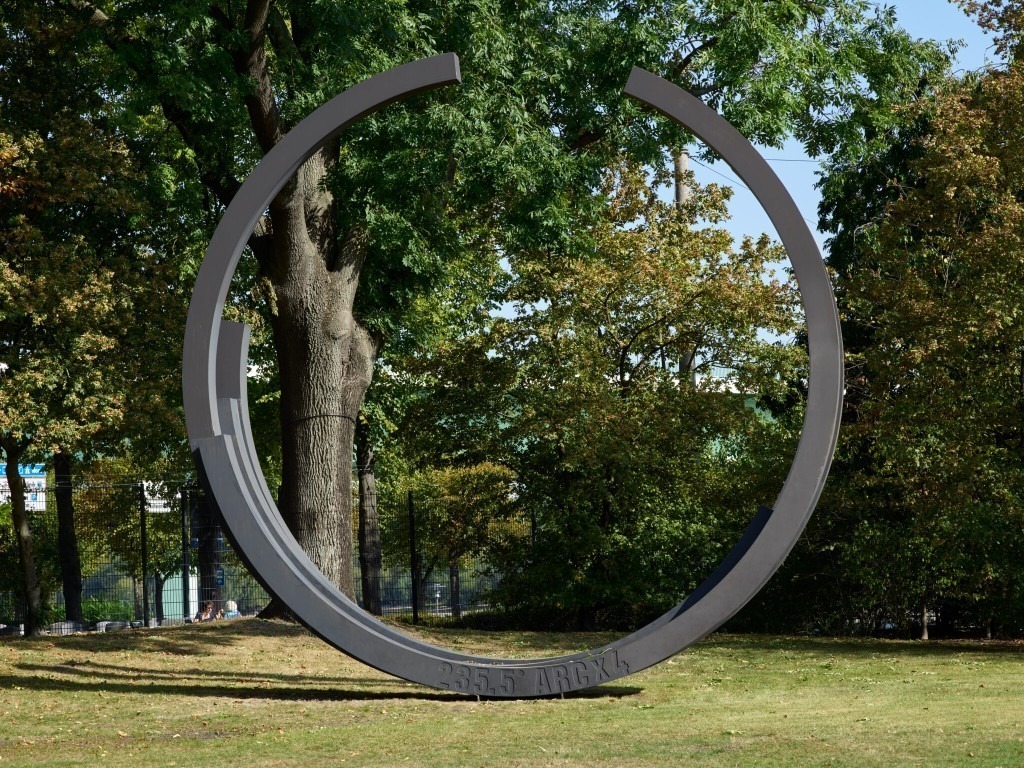
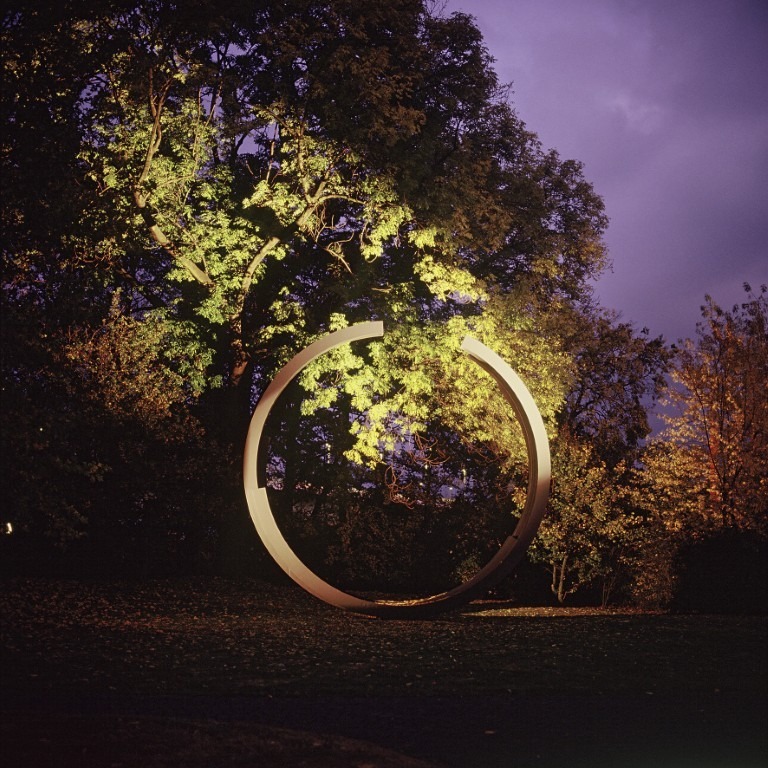
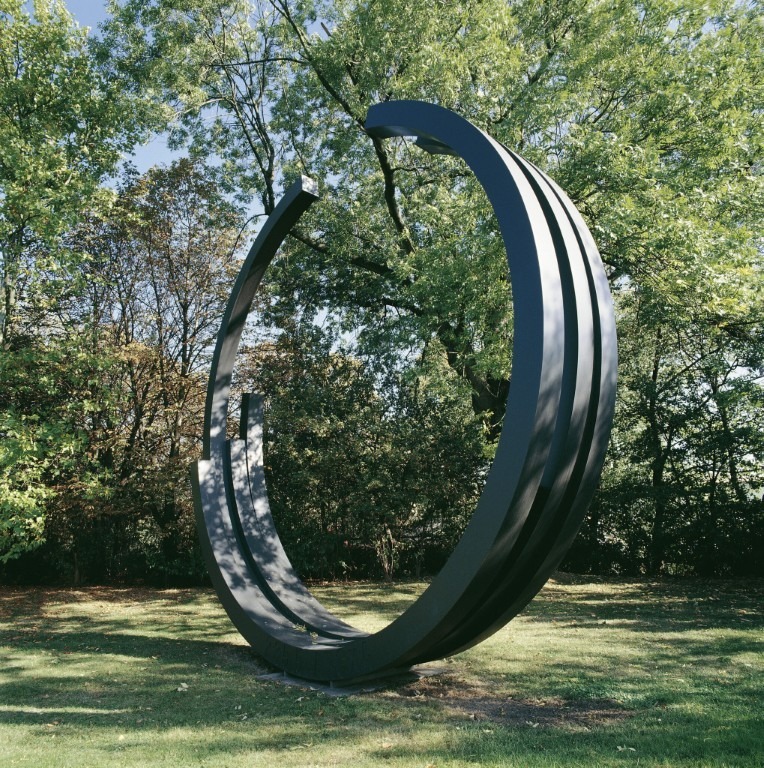
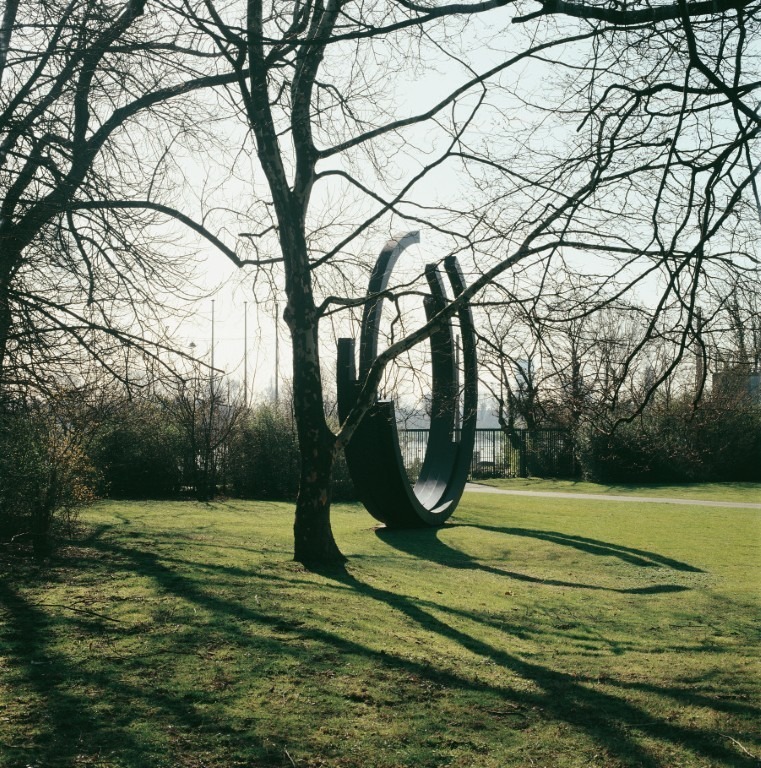
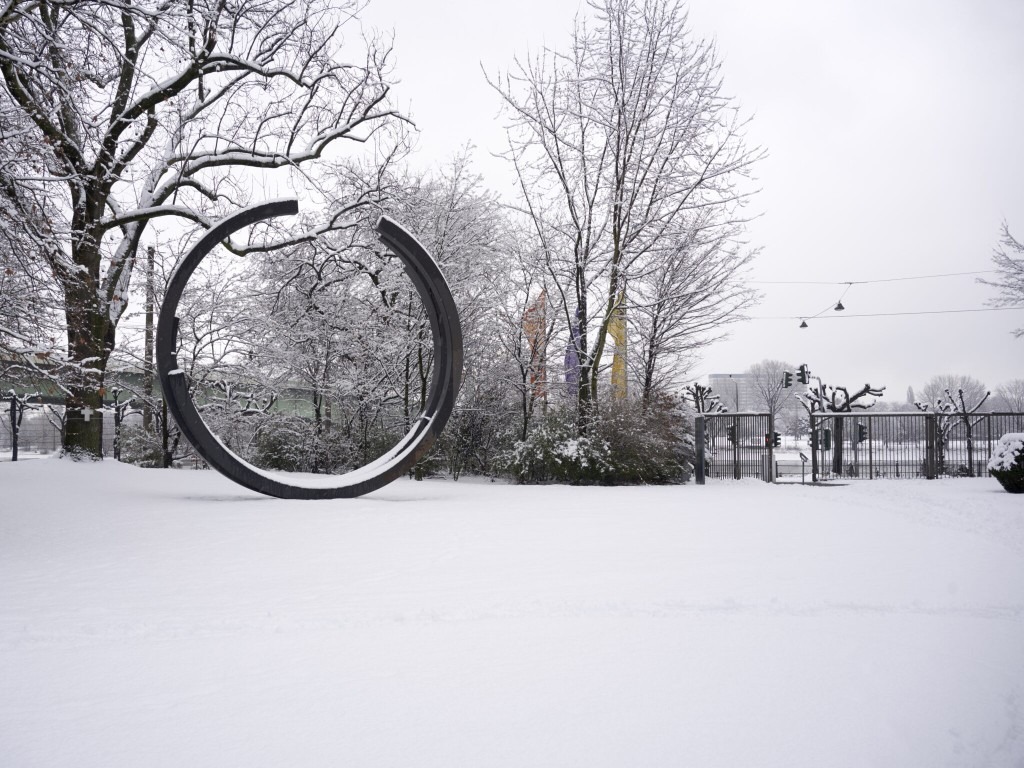
Bernar Venet: Four Arcs of 235,5°, 1999
Steel, painted
The central feature of the work of Bernar Venet, which covers many mediums, is dynamism. It governs his activities in all fields: painting, installation, design, concrete music, as well as theoretical writings, but above all it characterises his large-scale steel sculptures. The different programmatic groups of work shift between two diametrically opposed positions, one systematic, the other random. The element that provides structure is line (ligne terminée or ligne déterminée), which takes the form of a curved or bent band, rod or bar of steel. He took part in documenta in 1977 and in the Venice Biennale in 1978, and he achieved international recognition in the 1990s.
*2 June 1960 in Cully/Switzerland
Participant of KölnSkulptur # 6, 7, 8, 9, 10, 11
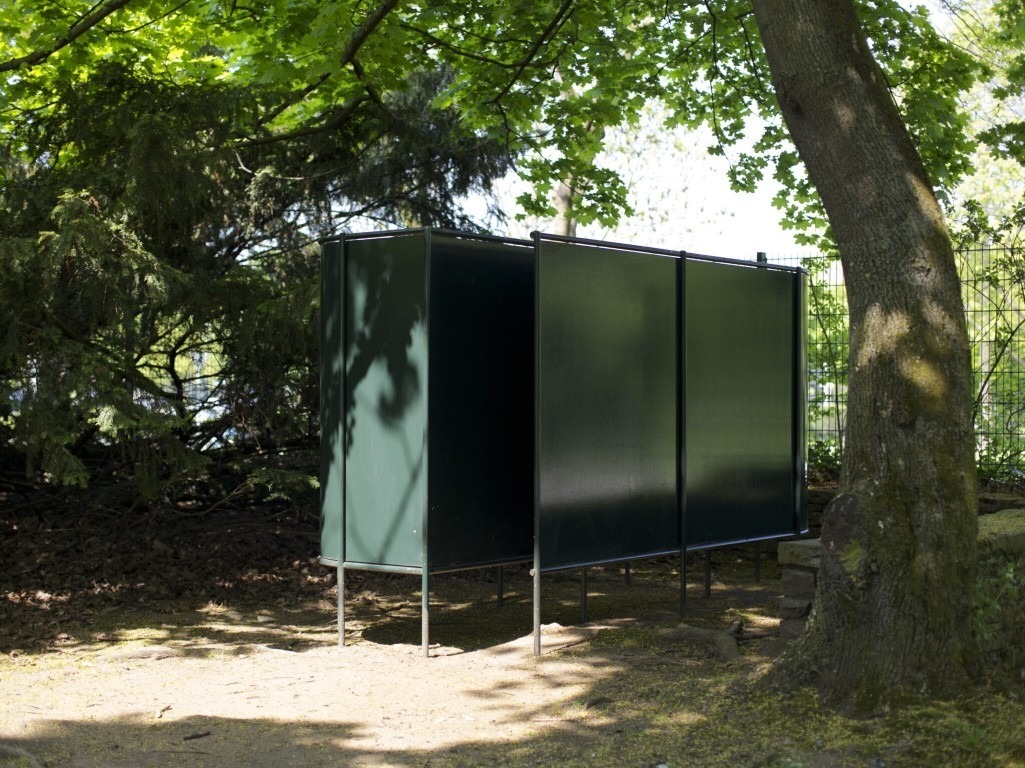
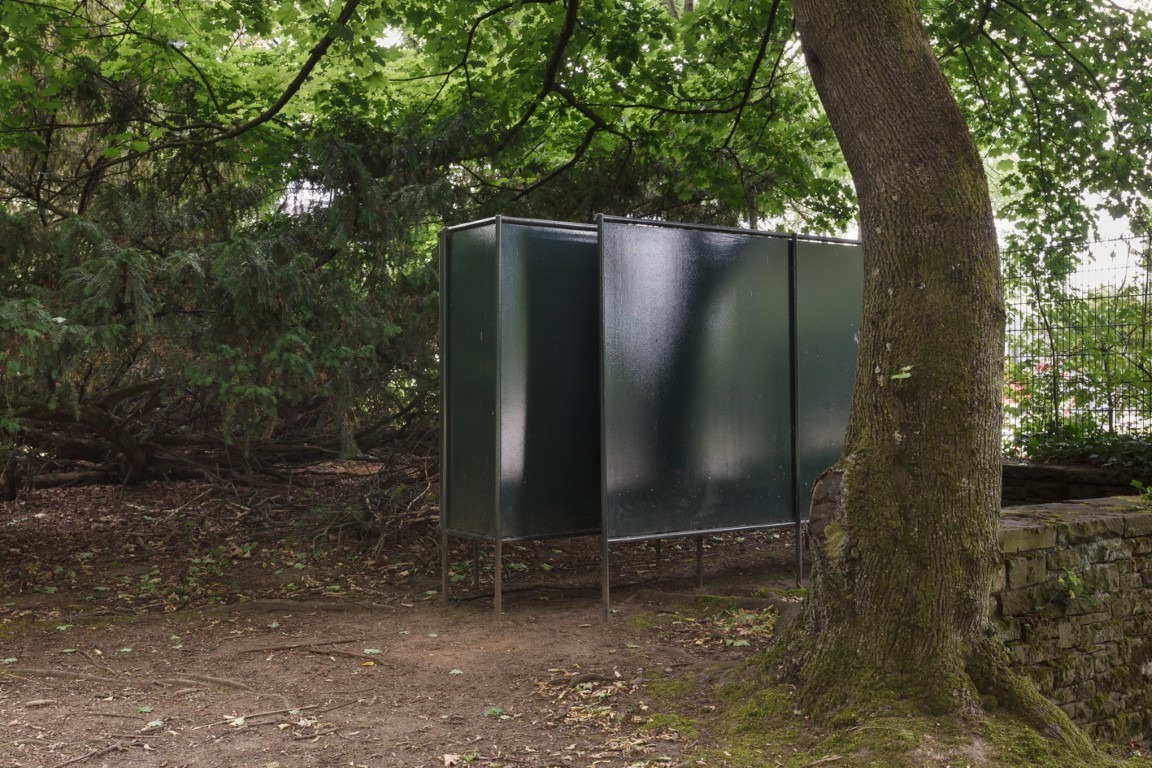
Bernard Voïta: Green Memories, 2011
Steel, varnished
Bernard Voïta has created a secret place in the park, already expressed in the title Green Memories. The sculpture itself does not tell of these memories; it is only highly charged with those from the artist’s mental world. The work is a miniature replica of a public pissoir as it exists in Paris. In its location near the boundary line to the busy traffic of the Riehler Strasse outside of the park, the ambivalence of an intimate place in the context of the romantic park grounds provides a contrast to public city space.
*1960 in New York/USA, lives and works in Paris/France
Participant of KölnSkulptur # 2, 3, 4, 5, 6, 7, 8, 9, 10, 11
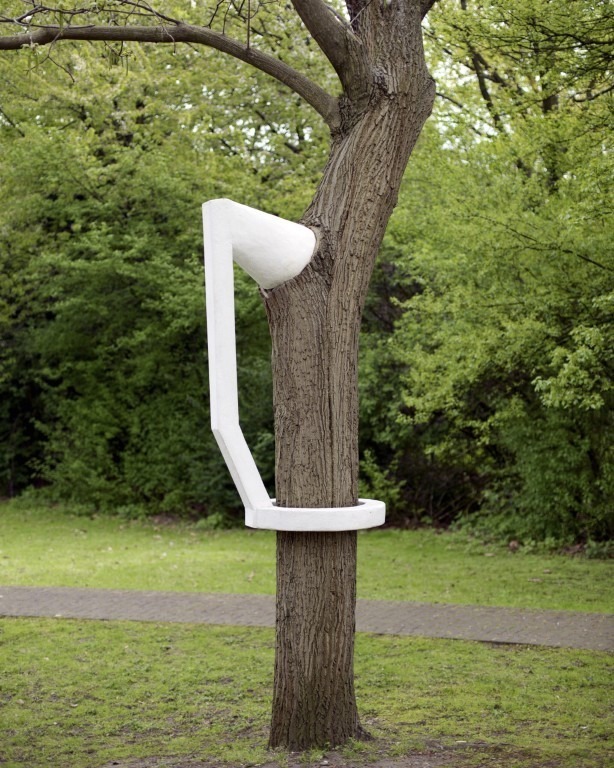
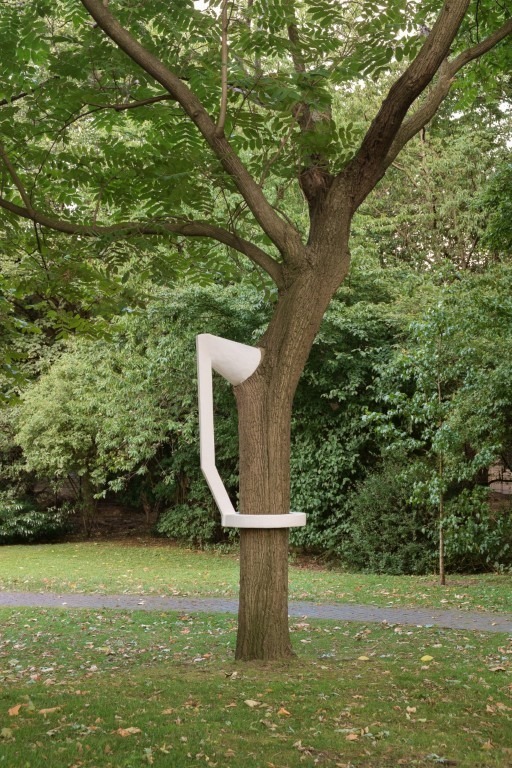
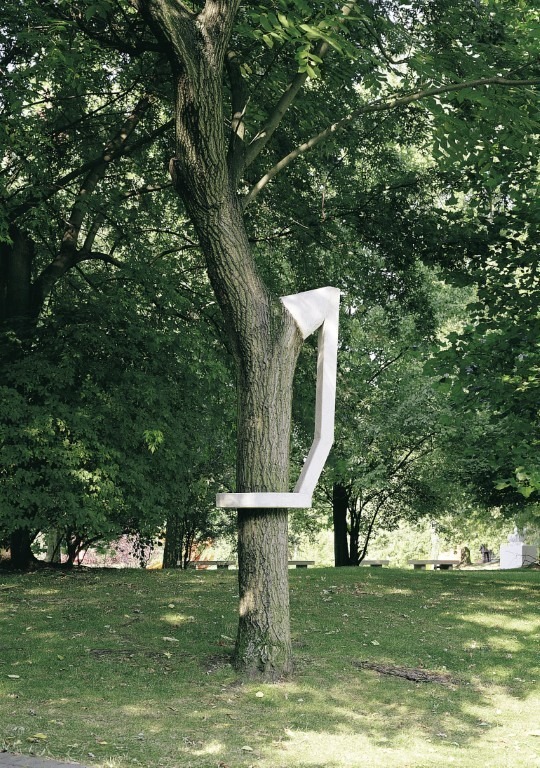
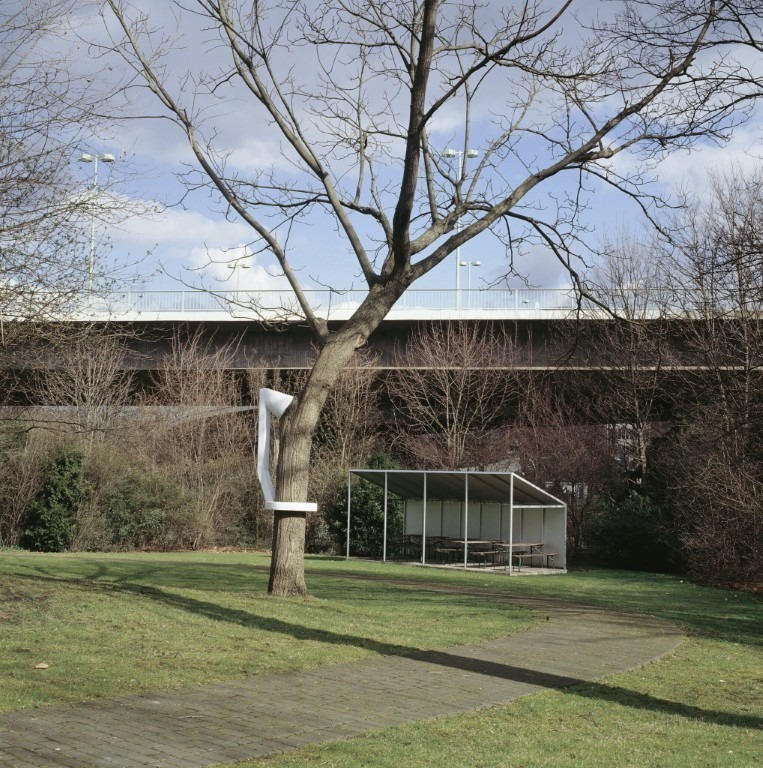
Paul Wallach: Ring-Around, 1999
White cement
Paul Wallach is largely known for small abstract sculptures made from fragile materials such as plaster, rusty metal or driftwood, which are never placed free-standing in open spaces, but against walls or in places rarely used to display works of art, such as the corners of rooms. The sculpture and its location creates an “interspace” – and together they form a coherent entity. This always creates a delicate mutual relationship, which the viewer is drawn into as a partner for further dialogue. In this way the basic Minimalism of the sculptures takes on a human dimension.
*24 September 1947 in Stams/Austria
†21 April 2020 in Vienna/Austria
Participant of KölnSkulptur # 8, 9, 10, 11
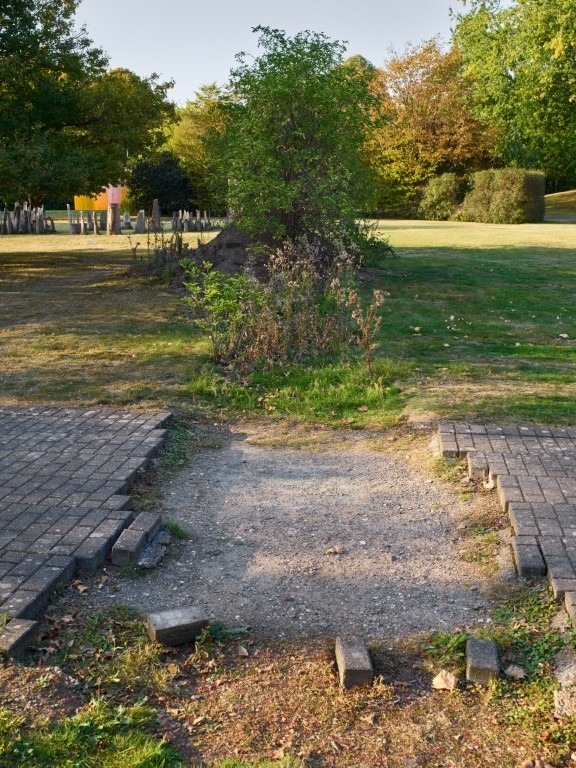
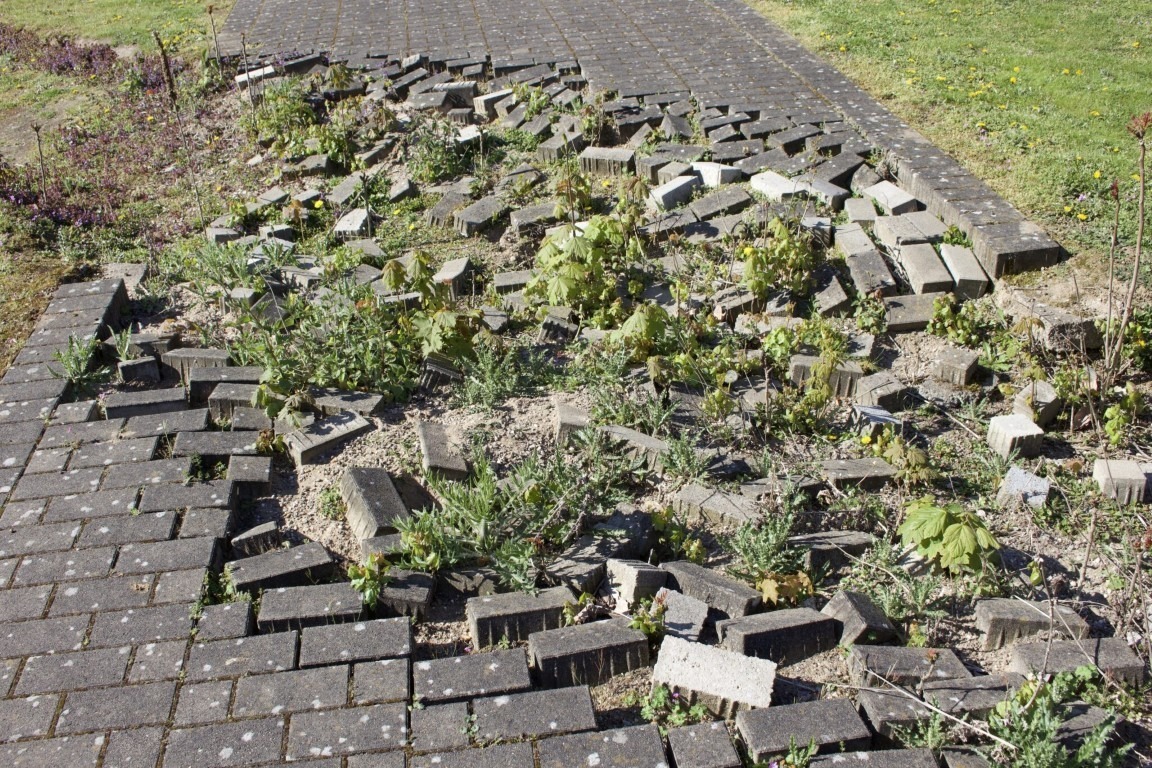
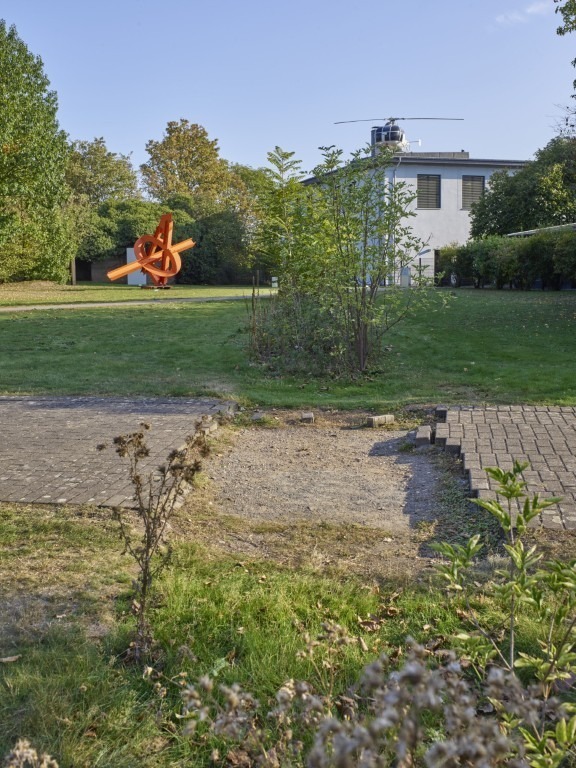
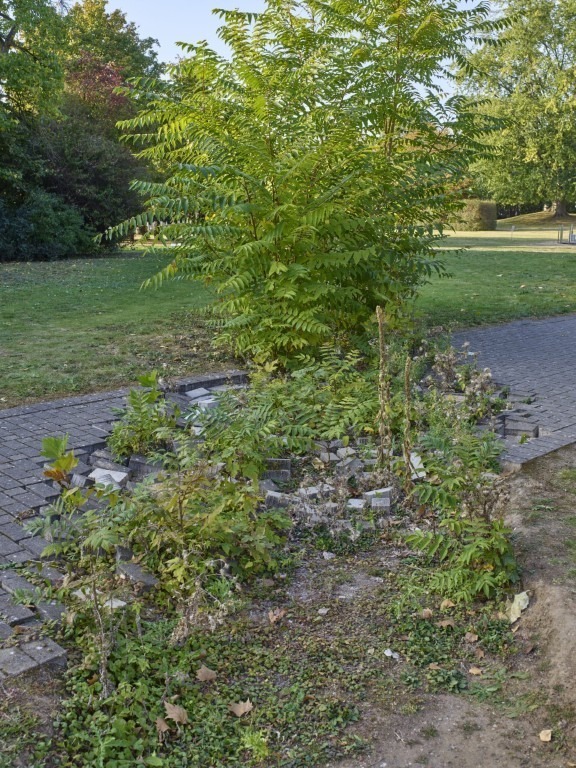
Lois Weinberger: Spur, 2015
Soil, plants
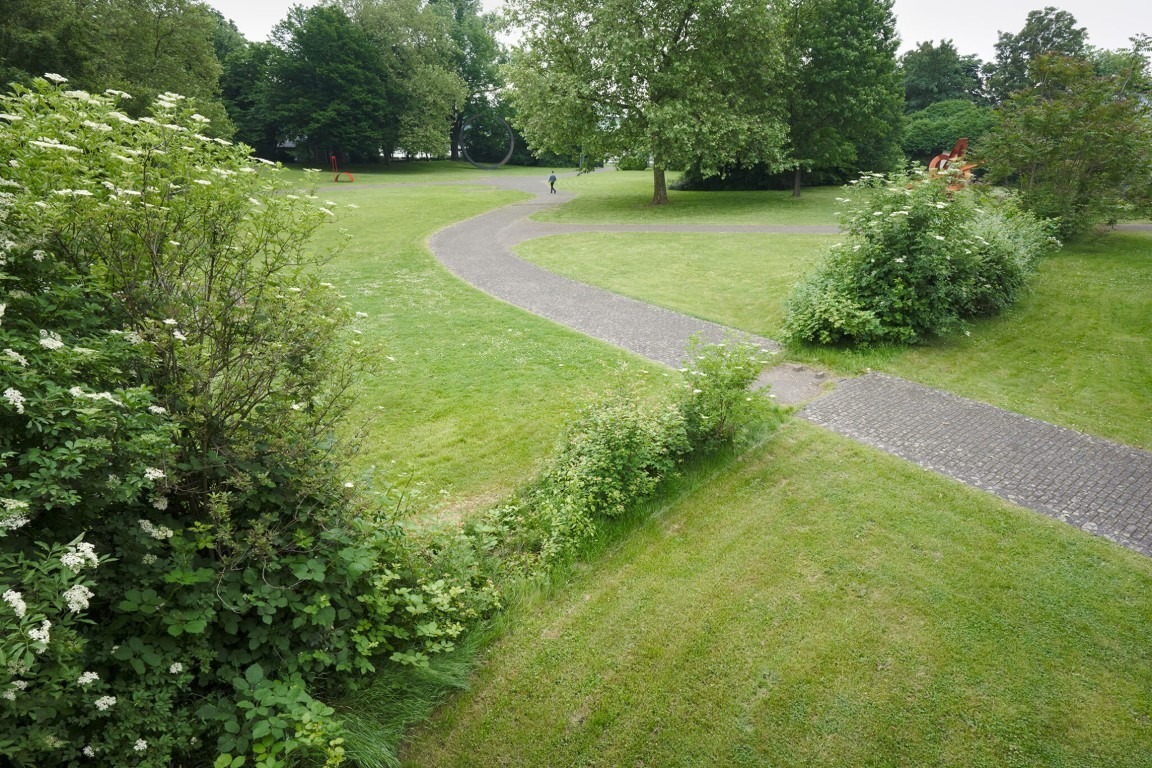
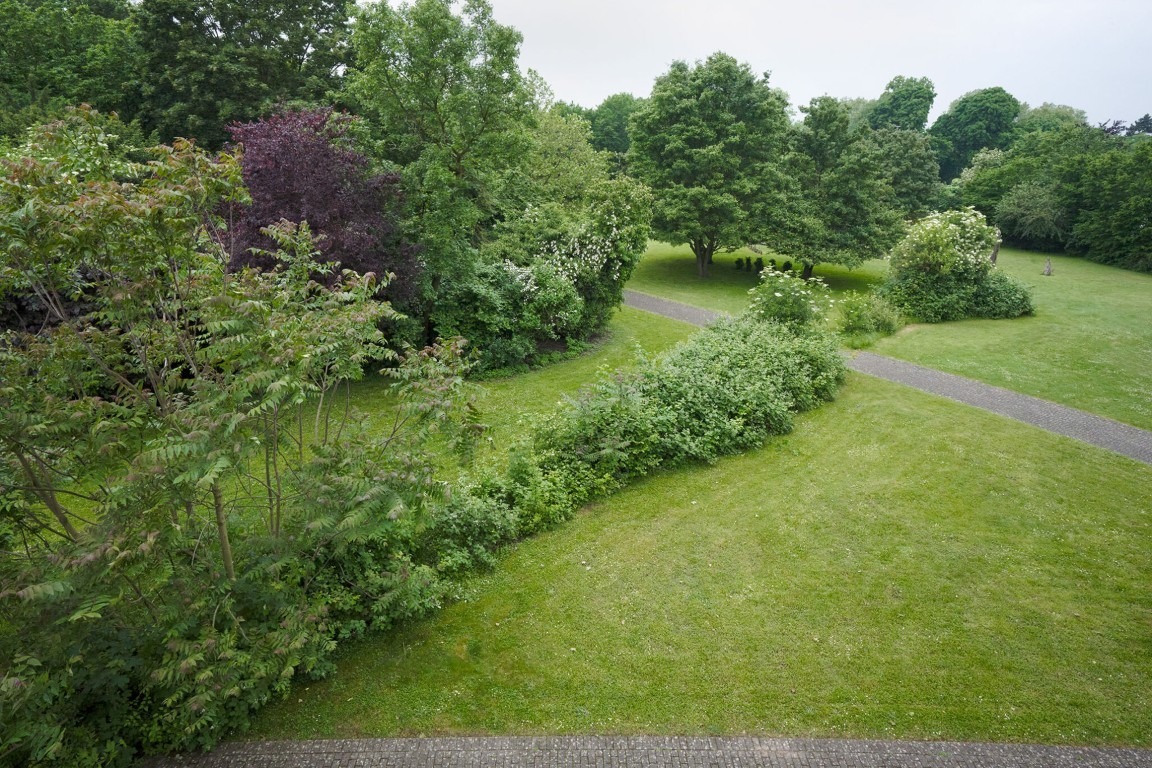
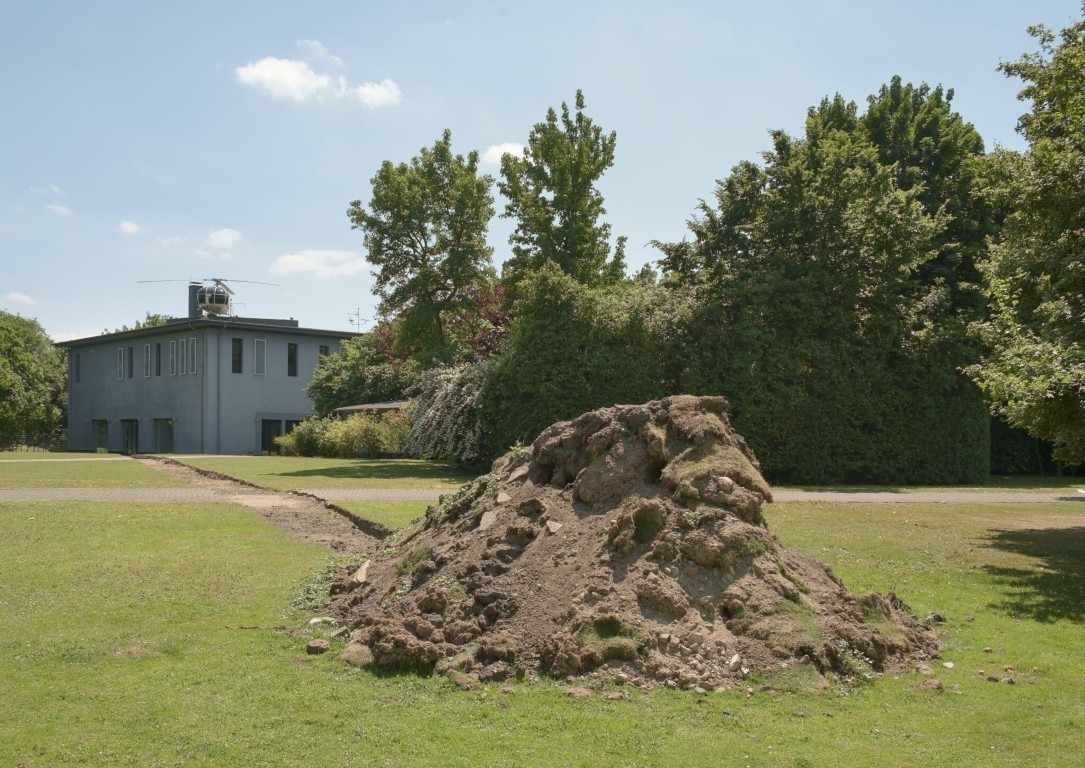
Lois Weinberger has an aisle drawn through the park. It crosses the stone-paved paths twice, cut through the lawn surface by a digger. The aisle ends in a heap of debris, the spoil of lawn, rubble and earth contrasting with the perfection of the park landscape. Weinberger’s aisle is cut and delicate groove, and at the same time a road for invasive plants. In his work, which reached a greater audience through a planting at Kassel main station during documenta 10, Weinberger deals with so-called ruderal species. Mostly referred to as weeds, they colonise fallow ground, cracks in the tarmac, heaps of rubble or undeveloped peripheries. In “well-kept” gardens they are normally weeded out. But Weinberger creates a hierarchical shift with a political purpose. He sees the ruderal plants as migrants, forced to survive under poor conditions. They suffer the same fate as people who lost their homes.
*1958 in Bocholt/Germany
Participant of KölnSkulptur # 2, 3, 4, 5, 6, 7, 8, 9, 10, 11
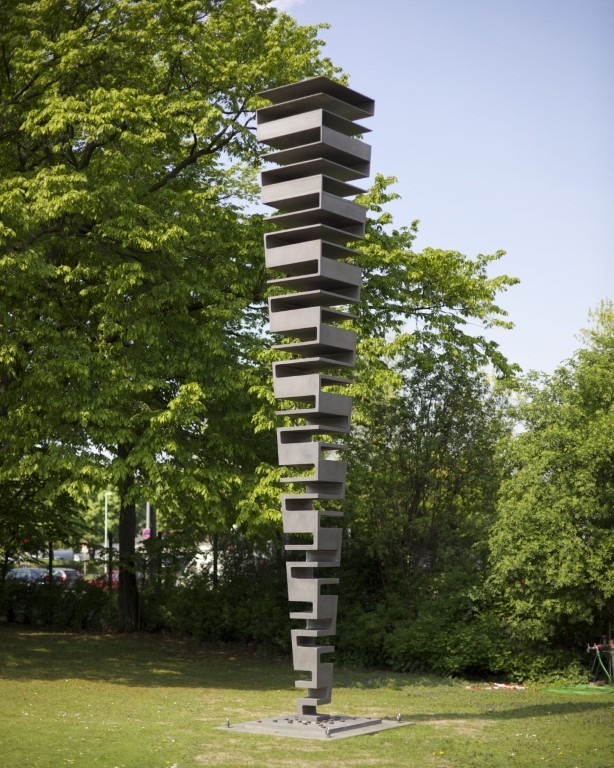
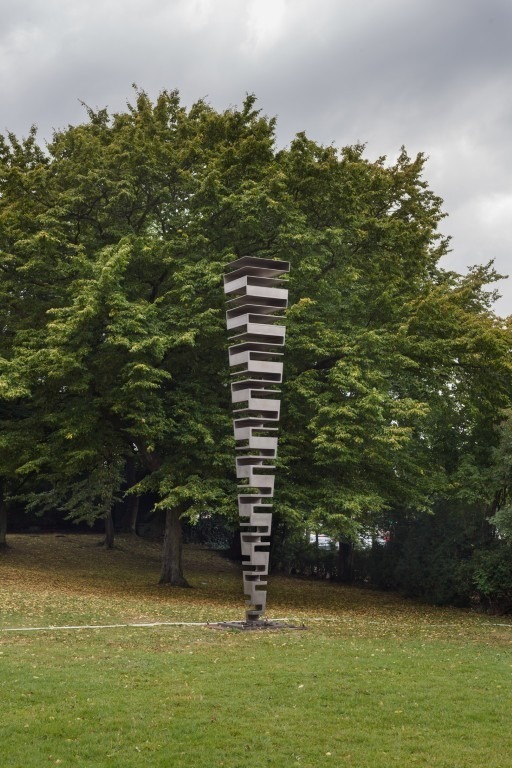
Martin Willing: Quadratschichtung, zweiachsig, wachsend, 1999/2000
titan, cut by water jet, welded, sandblasted
Martin Willing explores kinetic issues and oscillation processes in space with scientific precision ans systematics. In the process he makes sculptures from geometrically exact, shaped metal rods and strips (for preference in titanium, steel and duraluminum), which are pre-stressed against gravity. In this way they develop a special dynamic of the own somewhere between stasis and movement. The trained physicist cuts out of solid metal, and the closed form is in this way opened and made to oscillate. Monumental kinetic freestanding sculptures like Quadratschichtung, because of the complicated calculations and elaborate construction involved, form a limited position in his work.
*1988 in Guangdong/China, lives and works in Hong Kong/China
Participant of KölnSkulptur # 10, 11
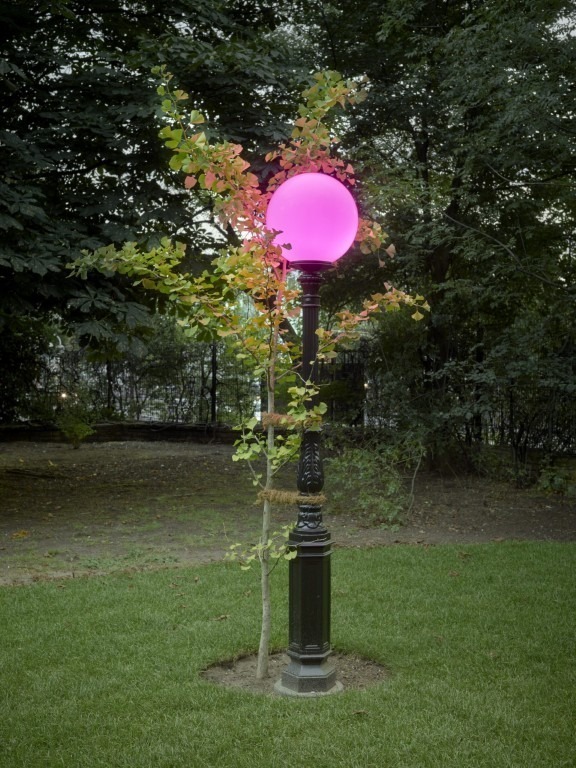
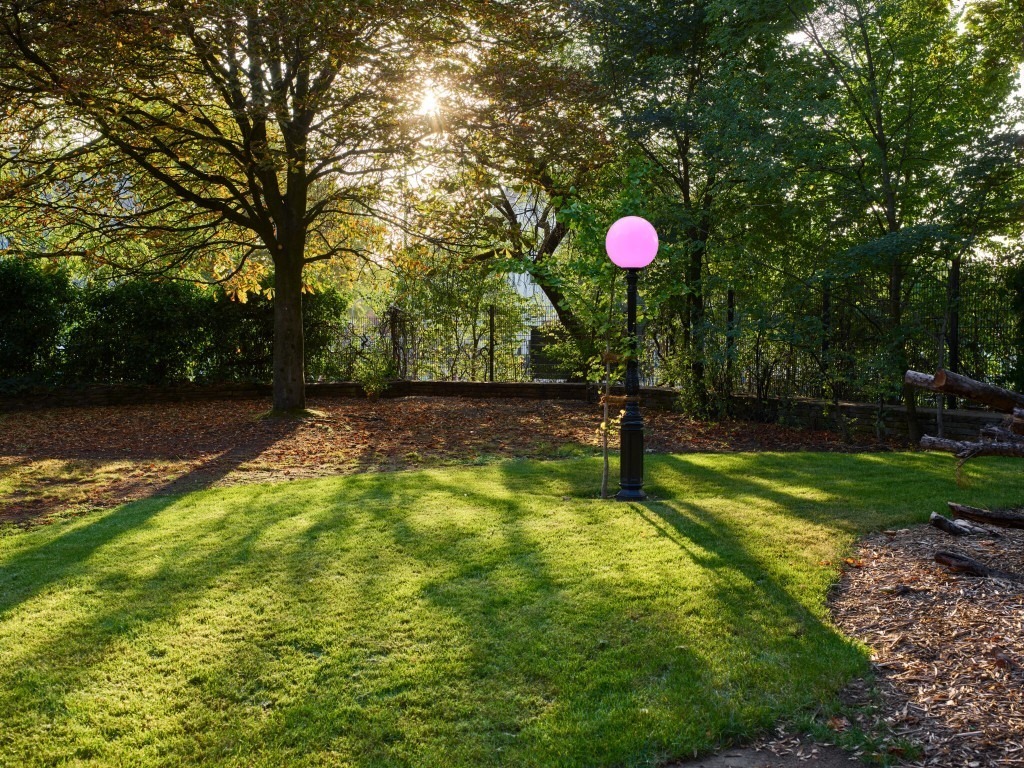
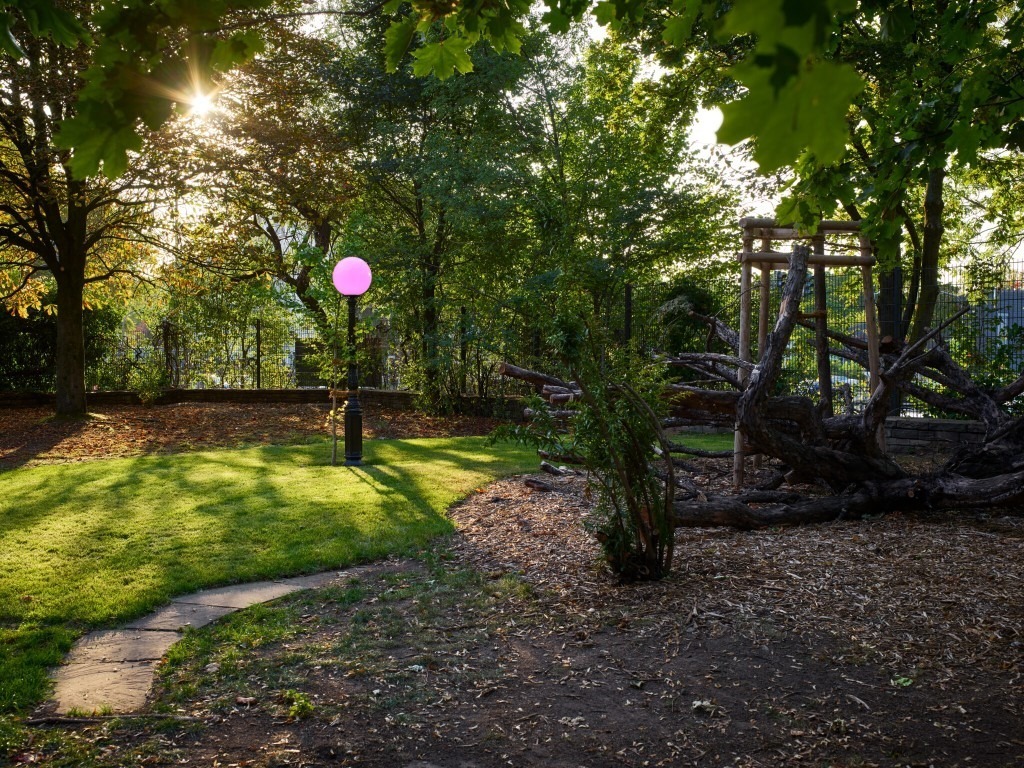
Trevor Yeung: Two Reliers, 2020
Ginkgo biloba, streetlamp, cast iron, glass, LED grow light bulb
In Two Reliers by Trevor Yeung, a young ginkgo tree enters a close relationship with a small streetlamp fitted out with a pink LED light. The lamp serves as physical support for the little tree and also promotes its growth at night. Cultural progress has forced nature into a state of dependency on humankind. Yeung’s work can be read as critical commentary, but also as an intimate gesture of reconciliation between humans and nature.
*30 April 1958 in Mauthen/Austria
Participant of KölnSkulptur # 3, 4, 5, 6, 7, 8, 9, 10, 11
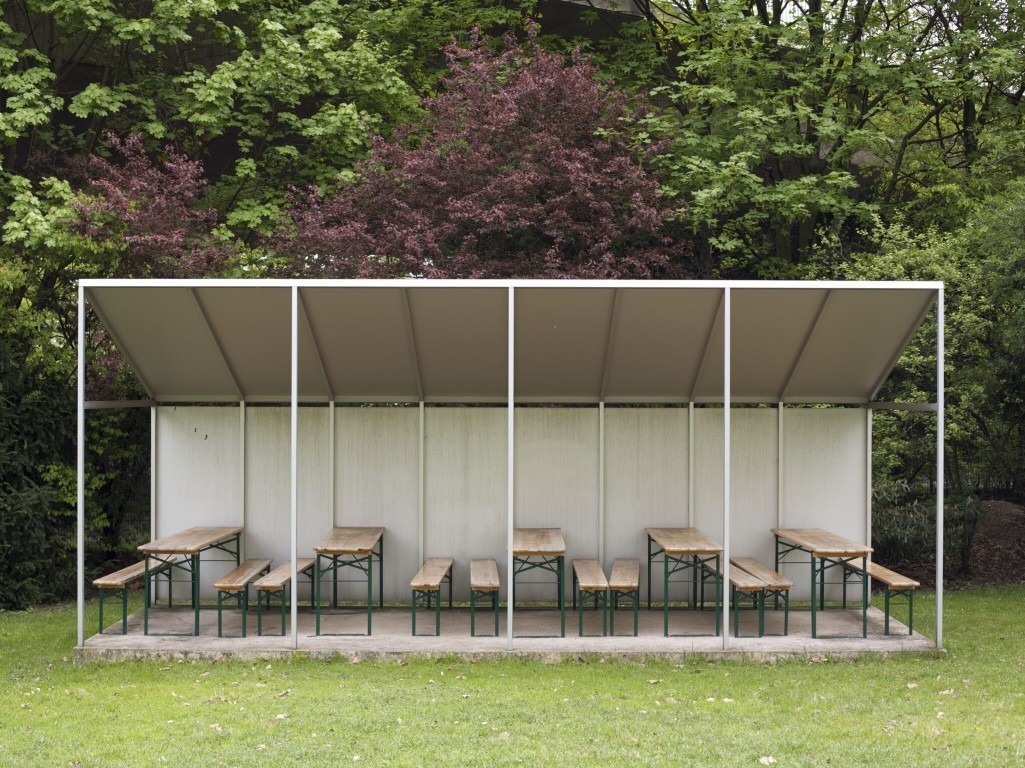
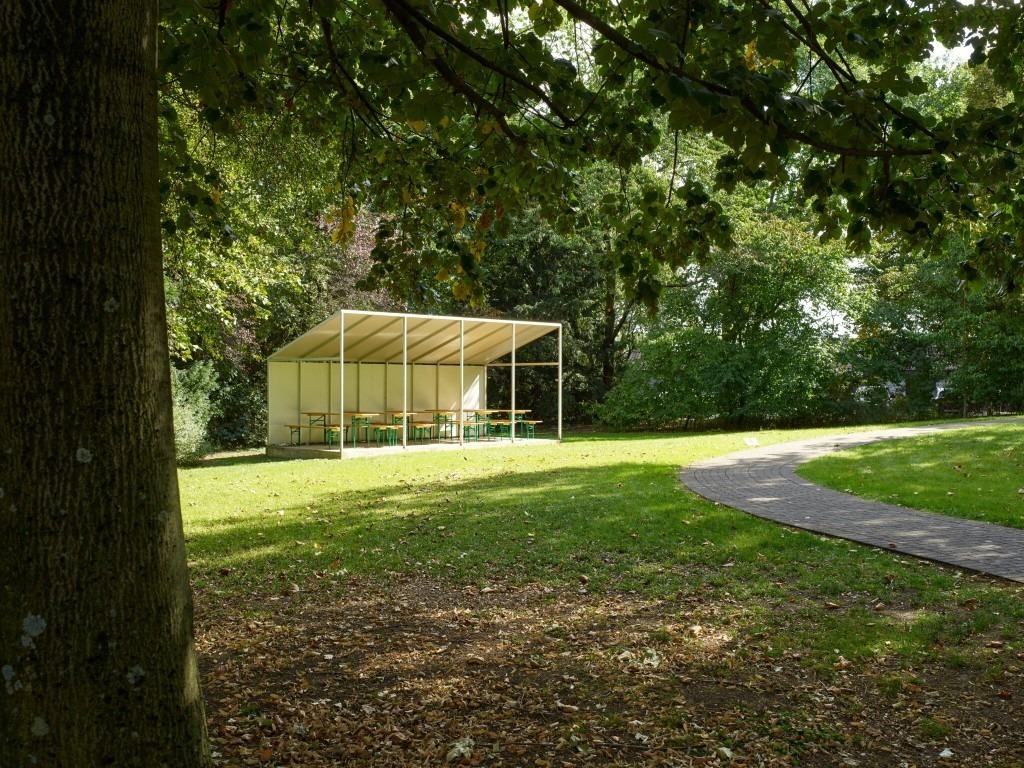
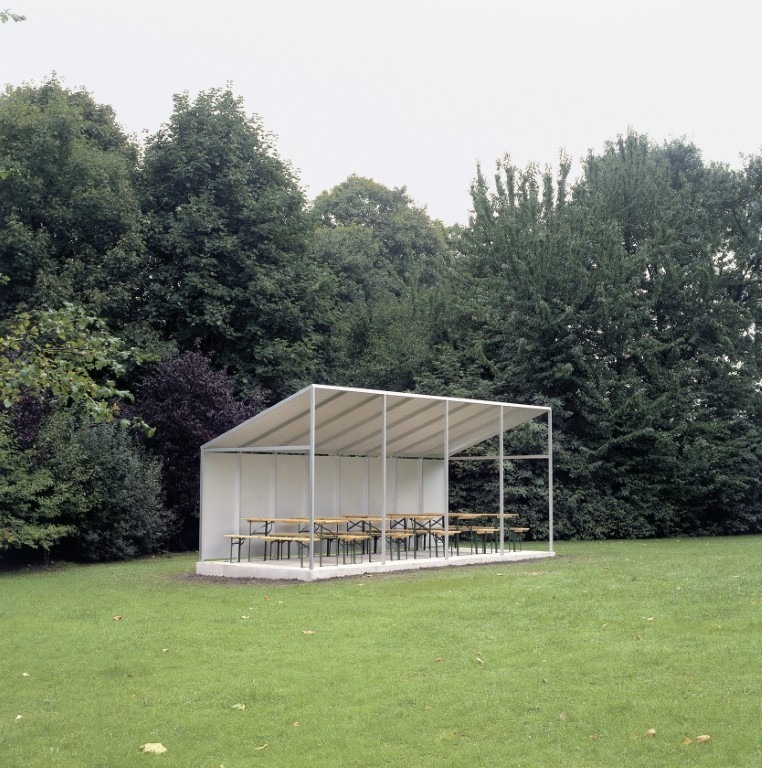
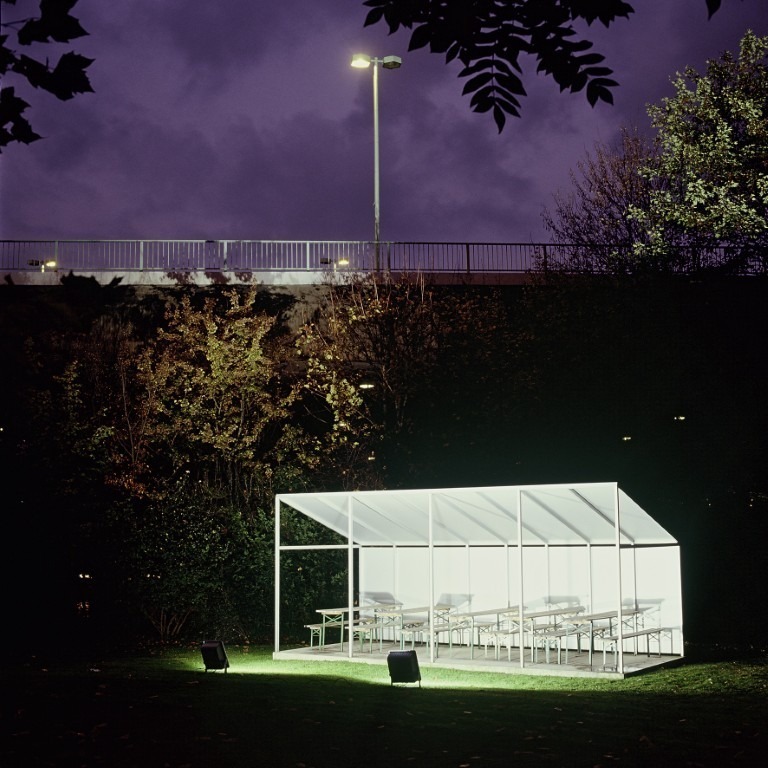
Heimo Zobernig: Spartakus Catering, 1998/2001
Aluminum, concrete, beer tables, and beer benches
Heimo Zobernig belongs to a generation of artists who submit the meaningfulness of System Art to sceptical scrutiny on the formal, narrative and reception levels. His works are created in conjunction with and are dependent from their site. From a dedicated avoidance of content, a web of meaning that is both self-referential and open, with numerous cross-references, arises. The Austrian artist dissects and analyses phenomena with almost scientific precision, and presents their component parts, not without humour, in new constellations, e.g. at documenta 9 and 10 and at the Venice Biennale in 2001.
KölnSkulptur #11 is sponsored by:
