
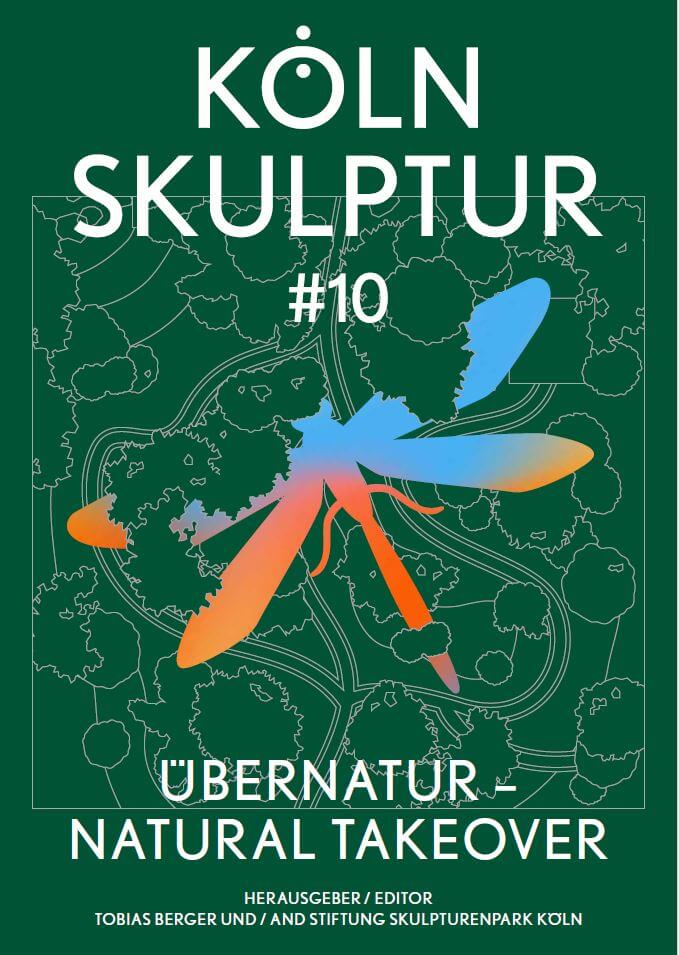
KölnSkulptur #10 · 2020–2023
ÜberNatur – Natural Takeover
Curator: Tobias Berger
The Skulpturenpark Köln is a unique exhibition venue featuring loaned works from past KölnSkulptur exhibitions, interspersed with the permanent collection amassed by Dr Michael and Dr Eleonore Stoffel. Every two years, a curator is invited to add new artworks to this constellation of outdoor sculpture. Most of the works shown at KölnSkulptur have been commissioned especially for the exhibition. The Skulpturenpark Köln is thus a unique hybrid of permanent display and temporary group exhibition.
ÜberNatur – Natural Takeover marks the 10th iteration of the biannual KölnSkulptur exhibition of contemporary outdoor sculpture. Eight new works have been added to the Skulpturenpark Köln this year. Inspired by the location of the public park – wedged between the Rhine, the Cologne Zoo, the Flora and the adjacent Botanical Garden artworks have been commissioned or selected that engage with notions of nature and initiate dialogue with the natural environment.
Spur (2015) by Lois Weinberger can be read as the lodestar around which this year’s exhibition revolves. Commissioned for KölnSkulptur #8, it is a sixty-metre-long shallow trench cut into the ground. It has slowly developed to become a ‘ruderal community’, a living constellation of invasive weeds and a few furtive animals, which have made their home on the rough terrain. This ‘wilderness’ of weeds, a disruptive intervention in the public park, interrogates the connections between planning and planting and between idea(l)s of ‘nature’ and nature itself. This oscillation between the ‘natural’ and the ‘artificial’ – in effect a destabilisation of the two contrasting terms, which are already blurry and shifting – was a determining feature in the choice of which artworks to commission for KölnSkulptur #10. This year’s exhibition accentuates the ‘park’ in Skulpturenpark, emphasising not only its physical location, but also wider growing concerns about humanity’s place within a larger ecology – a communal ecology, in which humans, animals and plants co-exist in various constellations, all faced with the threat of climate change and ecological crisis.
KölnSkulptur #10 opens amid a devastating global pandemic, triggered by a rare spillover of a virus from wild animals to humans. Facilitated by ever-closer connections between disparate parts of the world as a result of globalisation, the virus has rampaged like wildfire across the planet, infecting millions of people.
The ‘new normal’ created by this global pandemic is causing us to view the world from novel perspectives; art and exhibitions of art are not exempt from such new interrogations. It is now of the utmost urgency that we raise awareness of the network of interconnections between striving for economic growth and globalisation and the devastating impact these can have on our natural environment. At the same time, we must not forget the visionary power of art and its ability to forge new ideas and sense-forms – not to mention its ability to refer to the ineffable beyond the relentless logic of utility and human efficiency.
Size does not define the significance of sculptural work. Sometimes small gestures can have a large impact, as can be seen in the current pandemic. Some of the works shown at KölnSkulptur #10 diverge from the expected scale of outdoor sculpture. Smaller and often barely perceptible pieces allow visitors to engage with the world at a microcosmic level, but also to widen their focus out to the larger, more unpredictable, macrocosm, in which we live.
ÜberNatur – Natural Takeover questions the monumentality of outdoor sculptures. The exhibition thus oscillates between the smallest work by Ayşe Erkmen and the largest by Dane Mitchell. Erkmen’s contribution consists of a replica of Lonely George, a Hawaiian tree snail, the last of its species, which died in 2019 after scientists spent fourteen years unsuccessfully trying to find it a mate. Mitchell’s work features two artificial trees designed to camouflage mobile data antennae and surveillance equipment, originally mass-produced in China. This piece has been imported for KölnSkulptur #10 from last year’s Venice Biennale, where it was exhibited in the context of New Zealand’s national pavilion.
At KölnSkulptur #10, visitors will encounter works that touch upon fundamental issues of birth, emergence, growth and decay, works that address both the microcosmic and macrocosmic levels of existence and that weave together diverse viewpoints to create complex connections – allowing us to sense and think with, and beyond, nature.
The crux of today’s ‘new normal’ is the need for communication, understanding and negotiation. Mary Bauermeister’s sculpture, Rübezahl, should, therefore, be read as the nucleus of KölnSkulptur #10. It offers visitors a place to sit and somewhere to reflect and contemplate. It opens up a space where taking one’s time and care and attentiveness have value, a space where nature can take hold.
Tobias Berger
Curator of the exhibition KölnSkulptur #10
New positions within this exhibition:
| Mary Bauermeister | Rübezahl, 2020 |
| John Bock | Schlupf, 2020 |
| Leelee Chan | Blindfold Receptor (Gulf Frit. Orange), 2020 |
| Ayşe Erkmen | Lonesome George, 2020 |
| Dane Mitchell | Post hoc, 2019/2020 |
| Katja Novitskova | Approximation (corn snakes hatching), 2017 |
| Guan Xiao | Old Eggs and the Catcher, 2020 |
| Trevor Yeung | Two Reliers, 2020 |
Positions in the exhibition:
| Tom Burr | No Access: cluster one (B, D, E, I, M), 2015/2017 |
| James Lee Byars | Untitled (Sigmund Freud), 1989 |
| Nina Canell | Power (Powerless), 2013 |
| Edith Dekyndt | The Fences, 2015 |
| Bogomir Ecker | Ohr, 1986 |
| Fischli/Weiss | Garten, 1997/1999 |
| Sou Fujimoto | Garden Gallery, 2011 |
| Dan Graham | Greek Cross Labyrinth, 2001 |
| Lena Henke | The Doors, 2013 |
| Jenny Holzer | Ambition is just …, 1997 |
| Leiko Ikemura | Katzenmädchen mit rhein-Blick, 1999 |
| Anish Kapoor | Untitled, 1997 |
| Stefan Kern | Ohne Titel (Tribüne), 1996 |
| Hubert Kiecol | Rheinwein, 2011 |
| Per Kirkeby | Læsø-Kopf II, 1983 |
| Klara Lidén | Harvest Moon, 2013 |
| Jorge Pardo | Tomatensuppe, 1997 |
| Mandla Reuter | Der Park, 2011 |
| Ulrich Rückriem | Ohne Titel, 2001 Granit, schwarz, Schweden, gespalten, geschnitten, geschliffen, 1986 |
| Michael Sailstorfer | Hoher Besuch – Köln, 2009 |
| Karin Sander | Paradise 231, 2013/2015 |
| Thomas Schütte | Weinende Frau, 2011 |
| Joel Shapiro | Untitled, 1996/1999 |
| Andreas Slominski | Der Parkplatz, 2007 |
| Mauro Staccioli | Untitled, 1999 |
| Mark di Suvero | Racine du Naos, 1996 |
| Rosemarie Trockel | L’Arc de Triomphe (Der armselige Baum/Die Zuwenignis), 2006 |
| Simon Ungers | Monolith, 1999 |
| Bernar Venet | Four Arcs of 235,5°, 1999 |
| Bernard Voïta | Green Memories, 2011 |
| Paul Wallach | Ring-Around, 1999 |
| Lois Weinberger | Spur, 2015 |
| Martin Willing | Quadratschichtung, zweiachsig, wachsend, 1999/2000 |
| Heimo Zobernig | Spartakus Catering, 1998/2001 |